

The MMX Mars moons mission 2026, led by Japan’s space agency JAXA, is scheduled to launch on October 20, 2026, beginning an ambitious journey to study Mars’ two moons and bring material from Phobos back to Earth. NASA confirmed the planned launch date in an October 8 media advisory and announced a U.S. science briefing for October 15.
If the mission succeeds, scientists will be able to analyze samples from the Mars region in laboratories on Earth. That could help resolve a long-standing question: Did Phobos and Deimos form from debris after a giant impact on Mars, or are they captured objects from elsewhere in the solar system?
As of October 10, the MMX Mars moons mission 2026 has not launched yet. Its milestones and dates are mission plans, not completed achievements, and launch schedules can change for technical or weather reasons.
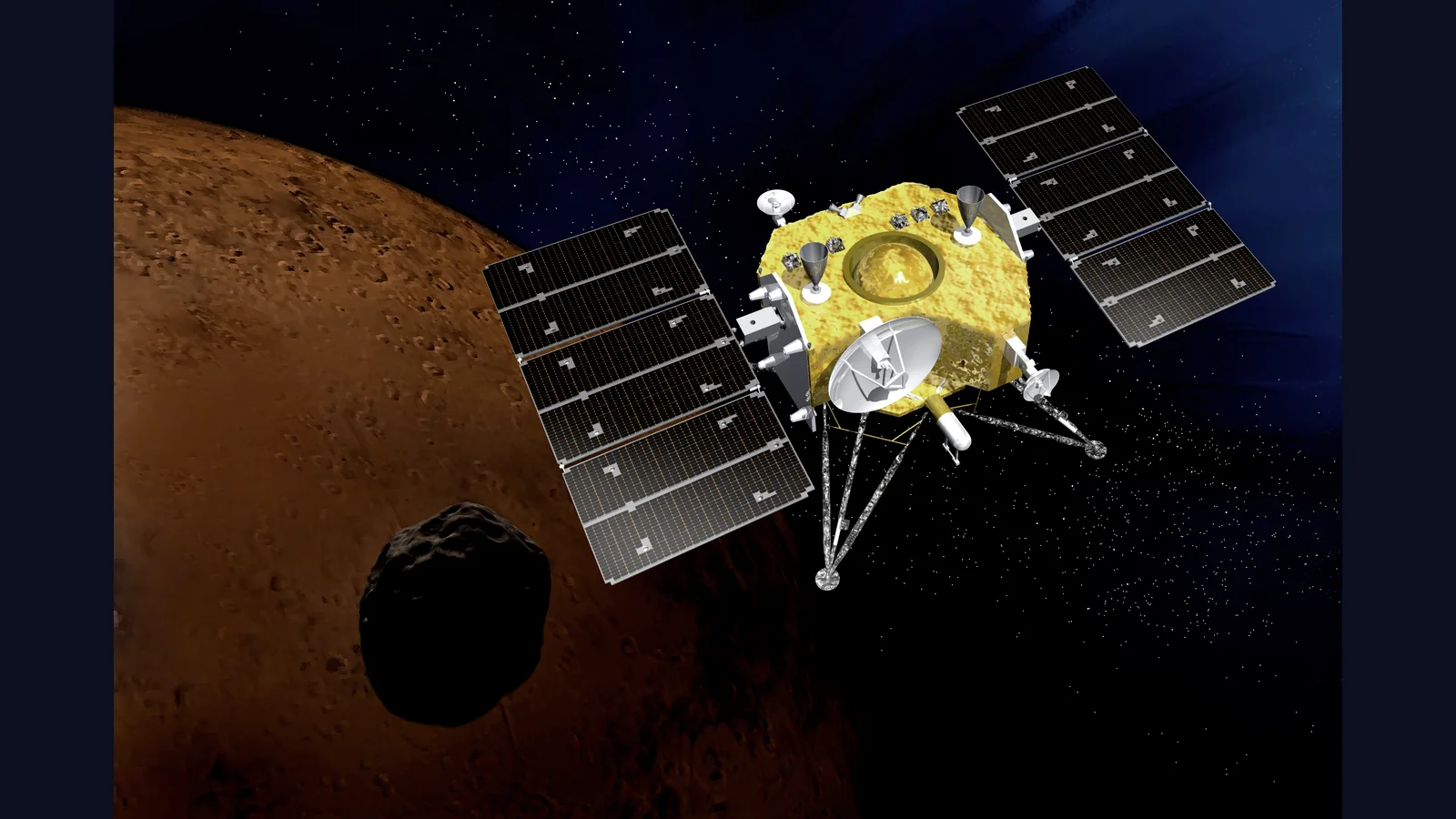
What is the MMX Mars moons mission 2026?
MMX stands for Martian Moons eXploration. It is a Japan Aerospace Exploration Agency, or JAXA, mission designed to investigate Phobos and Deimos, the two small moons that orbit Mars. Its central objective is to return a sample from the surface of Phobos to Earth.
JAXA says the spacecraft will study the moons’ topography, composition, internal structure and gravity. It will also make observations that help scientists understand the broader Mars system. The mission brings together teams and instruments from Japan, the United States and Europe.
Unlike a mission that lands on Mars itself, the MMX Mars moons mission 2026 will focus primarily on a moon. That distinction matters because the moons have different gravitational environments, surfaces and scientific histories from the planet below.
When will the MMX Mars moons mission 2026 launch?
JAXA has announced a target launch time of 4:41:03 a.m. Japan Standard Time on Tuesday, October 20, 2026, from the Tanegashima Space Center in Japan. In the United States, that corresponds to the afternoon of Monday, October 19, Eastern Daylight Time.
The launch vehicle is Japan’s H3 rocket. JAXA has listed a backup launch period extending from October 21 through November 7, 2026. The existence of a backup window is normal for complex space missions; it does not indicate that a delay has already happened.
NASA has scheduled a media teleconference for 4 p.m. EDT on October 15 to discuss its contributions. That briefing is a preview, not the launch itself. Viewers should confirm the final countdown and launch stream through official JAXA and NASA channels closer to liftoff.
Why do scientists want to study Phobos and Deimos?
Phobos and Deimos are small, irregularly shaped moons of Mars. Their origins remain debated. One hypothesis suggests they are asteroids captured by Mars’ gravity. Another proposes that a major collision involving Mars created debris that later formed the moons.
Both explanations have important implications for how the early solar system evolved. If the moons were captured objects, their material may preserve information about conditions in another part of the solar system. If they formed after an impact, their composition may record a violent chapter of Mars’ own history.
Remote observations have provided valuable clues, but images and spectra alone cannot always identify the exact minerals or isotopic ratios needed to discriminate between formation scenarios. A returned sample can be examined with instruments far more varied and sensitive than those that can fit on a spacecraft.
Why focus on Phobos?
Phobos is the larger and closer of Mars’ two moons. MMX is designed to approach it, map it in detail and select a safe location to collect surface material. The mission also plans observations of Deimos, providing comparative data about the two bodies.
The goal is not to prove a favored hypothesis in advance. Scientists will compare what the mission actually measures against predictions from competing models. The outcome could support one theory, reveal a more complex history or leave some questions unresolved.
How will the MMX Mars moons mission 2026 collect samples?
JAXA’s plan calls for detailed remote observations before a sampling attempt. The spacecraft must understand the terrain, surface conditions and local gravity well enough to approach a small moon safely.
Phobos’ gravity is extremely weak compared with Earth’s. That makes operations different from landing on a large planet: even small movements and forces can affect how a spacecraft interacts with the surface. Mission planners must control the approach, contact and departure with precision.
MMX carries a sampling system designed to collect surface material. NASA says a pneumatic sampler mechanism developed by Honeybee Robotics, a Blue Origin company, is among the U.S. contributions. The spacecraft will carry collected material in a return system intended to survive the journey back to Earth.
JAXA’s mission goal is to return more than 10 grams of material from Phobos. That may sound small, but a carefully preserved sample can support many laboratory analyses, especially when researchers know the geological context of the collection site.
Why is the sample’s context important?
A laboratory can reveal chemistry and mineralogy, but the meaning of those measurements depends partly on where the material came from. Surface mapping, nearby geological features and observations of the sampling site help researchers connect individual grains to the moon’s broader history.
That is why MMX is not just a scoop-and-return mission. Orbital surveys and surface observations are integral to interpreting the eventual sample.
What is NASA contributing to MMX?
NASA is a major international partner, even though JAXA leads the mission. The agency’s October 8 advisory identifies several U.S. contributions:
- MEGANE: A gamma-ray and neutron spectrometer developed by Johns Hopkins Applied Physics Laboratory to study the elemental composition of the Martian moons.
- Sampling hardware: A pneumatic surface sampler mechanism developed by Honeybee Robotics.
- Communications and navigation: Support from NASA’s Deep Space Network.
- Scientific participation: Funding for U.S. researchers working on the mission science team.
MEGANE is designed to measure signals associated with elements in surface materials. That information can complement the returned sample and help compare different parts of the moon.
For the MMX Mars moons mission 2026, the Deep Space Network is essential because communicating with a spacecraft near Mars is not like connecting to a satellite close to Earth. Signals must cross enormous distances, and communication delays make real-time joystick-style control impractical.
Other international partners include French and German space agencies, which are involved in the mission’s small rover and science work. The mission illustrates how planetary exploration increasingly combines specialized expertise from several countries.
MMX Mars moons mission 2026: timeline through 2031
| Period | Planned milestone |
|---|---|
| October 2026 | Launch from Tanegashima on H3 |
| August 2027 | Arrival in the Mars region and survey work begins |
| 2027–2030 | Detailed Phobos study, rover operations, sampling and Deimos observations |
| No earlier than December 2028 | Phobos surface sample collection, according to NASA’s current advisory |
| 2030 | Departure from the Mars region |
| 2031 | Planned sample capsule return to Earth |
These are planning milestones. Spacecraft trajectories, operations and landing windows can change as engineers evaluate actual conditions. NASA’s current schedule places arrival at Mars in August 2027 and sample collection no earlier than December 2028.
What could MMX teach us about the future of Mars exploration?
First, the mission may help resolve the origin of the Martian moons. Different formation pathways imply different histories of collisions, material transport and planetary evolution.
Second, MMX will test technologies needed for precision operations around small bodies, including navigation, surface contact, sample handling and return flight. These are useful capabilities for future robotic exploration beyond Mars as well.
Third, researchers can study whether Phobos contains material related to Mars or material delivered from elsewhere in the solar system. That may offer clues about how water-bearing and organic-rich materials moved among young planets and smaller bodies. Finding organic compounds would not, by itself, prove that life existed.
Fourth, the mission will demonstrate how sample return changes the pace of science. Once material reaches Earth, researchers can study it with instruments that improve over time. Properly curated samples can remain scientifically valuable for decades.
Could the mission help future human exploration?
MMX is not a crewed mission and does not announce a human landing on Phobos. Still, better maps, composition data and experience operating in the Mars system can inform future exploration planning.
Some long-term concepts consider the Martian moons as potential places to operate instruments or support exploration. For a related future space mission, see our NASA PRIMA telescope overview; PRIMA is an astronomy observatory rather than a Mars sample-return mission. Those are future possibilities, not MMX commitments. The near-term mission remains scientific and robotic.
What are the biggest technical challenges?
The spacecraft must survive launch, travel to Mars, navigate near a small irregular moon, characterize the surface, collect a useful sample and send a capsule safely back to Earth. Every stage has independent risks.
Small-body navigation is particularly demanding because gravity is weak and the object’s shape can complicate orbital dynamics. Engineers must also account for uncertain surface properties and the possibility that loose material behaves differently from expectations.
Communication delays mean the spacecraft needs reliable onboard autonomy and carefully tested procedures. The sample-return stage adds the challenge of preserving material integrity and guiding a capsule through Earth’s atmosphere.
Success would therefore demonstrate not just a scientific discovery but a chain of engineering capabilities needed for more ambitious missions.
Frequently asked questions
Is MMX launching on October 19 or October 20?
Both dates can appear depending on the time zone. The target is October 20 at 4:41:03 a.m. in Japan, which is October 19 in the U.S. Eastern time zone.
Is NASA running the MMX mission?
No. JAXA leads the mission, while NASA and European partners contribute instruments, technology and scientific support.
Will MMX land on Mars?
No. The primary sample-return target is Phobos, a moon of Mars, not the Martian surface.
How much material will return?
JAXA’s stated goal is more than 10 grams of Phobos surface material.
When could the samples arrive on Earth?
The current mission plan targets a return in 2031, subject to mission progress and operational conditions.
Does this mission search directly for living organisms?
Its central goals concern the origin and evolution of the Martian moons and the broader Mars system. Material studies may inform questions about water and organics, but a discovery of life is not a promised outcome.
Bottom line
MMX is one of the most ambitious near-term sample-return missions beyond the Earth-Moon system. With an October 20, 2026 launch target, it aims to investigate Phobos and Deimos and return more than 10 grams of material from Phobos in 2031. The biggest scientific payoff could be a clearer understanding of how Mars’ moons formed and what their history reveals about the early solar system.
Primary sources: NASA’s October 8 MMX media advisory, JAXA’s MMX mission site and JAXA’s mission overview.