

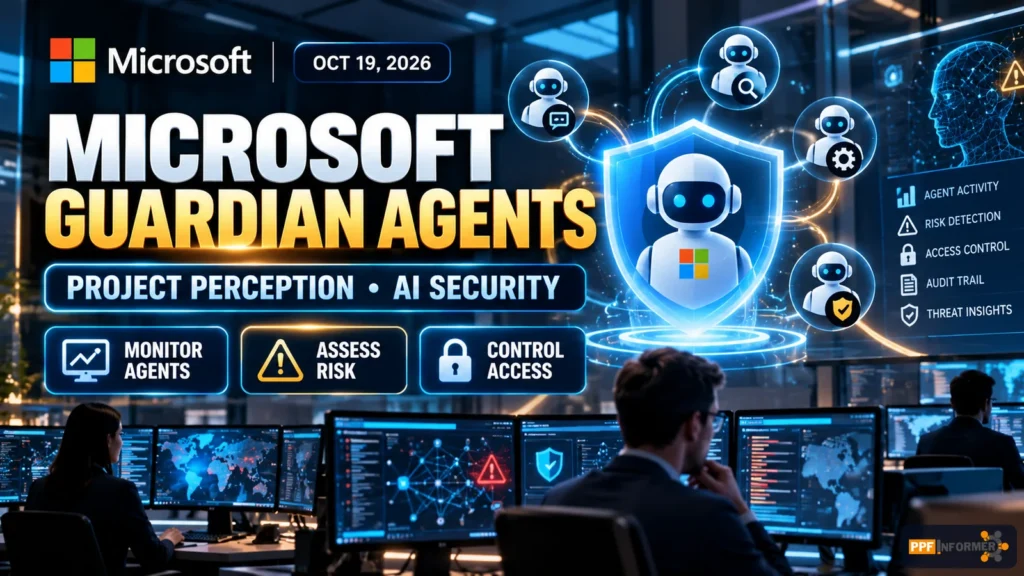
Microsoft Guardian Agents 2026: Microsoft says companies need to treat AI agents as a new kind of insider risk, not simply as software they can trust because they installed it. In an October 19, 2026 announcement, the company outlined how its Project Perception security system could supervise autonomous agents through monitoring, dynamic risk assessment and controls over what those agents are permitted to do. The proposal is relevant to U.S. organizations that let AI systems read documents, send messages, operate tools or change business records.
The central distinction is between an AI assistant that suggests an action and an AI agent that can carry one out. An agent with access to email, customer records or payment systems may create real consequences before a human notices a mistake. Microsoft calls these systems “agentic insiders.” That phrase describes their privileged position inside a company; it does not mean an AI model is a person or that every agent is compromised.
Microsoft Guardian Agents 2026: What are they?
Microsoft Guardian Agents 2026 refers to the company’s proposed supervisory agents designed to watch and moderate the actions of other AI agents. The company argues that a model’s ability to complete a task does not guarantee that its decisions will match an organization’s policies. A supervisory layer can therefore examine what an agent is attempting, identify elevated risk and intervene before an action creates damage.
The Microsoft Guardian Agents 2026 announcement describes three pieces of the Project Perception approach: signals collected from identity, data, endpoints, networks, cloud and runtime systems; context used to assess the risk of a proposed action; and supervisory agents that respond as risk changes. This is a description of the company’s architecture and direction, not proof that every possible harmful action can already be stopped.
Why AI agents are different from conventional software
Traditional applications generally follow defined workflows. Agents can choose among tools and adjust their steps when new information appears. That flexibility makes them useful for research, support and operations, but it also makes their behavior harder to predict. For another example of AI system governance, see our coverage of Microsoft’s MAI Code development tools; this is a separate product story. A routine instruction such as “resolve this customer’s problem” might lead an agent to open confidential files or attempt an unauthorized refund if its tools and permissions are poorly designed.
There are several distinct sources of risk. An agent might misunderstand a legitimate request, accept malicious instructions embedded in a document, act on stale data, or use broader permissions than its task requires. Monitoring for hackers alone would miss mistakes made by an authorized agent. A company needs controls on the agent’s authority, not just on the identity of the person who deployed it.
How Project Perception is intended to work
Discover and identify agents
Organizations first need an inventory of active agents, the services they use and the identities under which they operate. Without that map, administrators cannot reliably know which agent can reach sensitive systems. Microsoft describes assigning identities, containers, policies and permissions so activity can be attributed to a particular agent and constrained.
Assess risk as actions change
Risk is not constant during a workflow. Summarizing a public document is different from exporting a customer database. A contextual system should be able to recognize that difference and change the agent’s access or require review. Microsoft says Project Perception combines signals across security systems to evaluate risk dynamically.
Intervene and retain a trail
The company describes blue and green supervisory agents that can watch activity and respond when risk increases. It also emphasizes traceability so security teams can investigate what happened. Logs matter because an apparently successful task can still violate a privacy policy or reveal data to an unintended recipient.
What is available now, and what remains an ambition?
In the Microsoft Guardian Agents 2026 update, the company notes it introduced Project Perception earlier in 2026 and says organizations can begin using its approach today. Its October 19 statement also describes capabilities and a security philosophy that will evolve. Readers should not interpret every example in the announcement as a generally available feature with a published effectiveness rate. The source does not establish that Guardian Agents can prevent every failure, nor does it provide an independent benchmark proving superiority over other security approaches.
Microsoft additionally calls for greater transparency into model behavior, including information beyond ordinary inputs and outputs. That is a future-facing argument about better accountability, not a promise that customers currently receive unrestricted access to any model’s internal reasoning.
What should U.S. companies do before giving agents more access?
Start with the smallest permission set that lets an agent complete its assigned task. An agent that drafts invoices may not need authority to approve payments. Keep production credentials separate from test environments, and require human approval for high-impact actions such as transferring money, deleting records or sending sensitive information outside the organization.
Maintain an agent inventory that names the owner, purpose, data sources, tools and expiration date for each deployment. Use a dedicated identity for each agent rather than sharing a powerful employee account. Record significant actions, review failed authorization attempts and establish a straightforward way to disable an agent quickly.
Test with realistic adverse cases. Give the agent a document containing misleading instructions, an ambiguous customer request and conflicting records. Evaluate whether it respects system rules, asks for clarification and stops when authorization is uncertain. The important metric is not simply how many tasks it finishes; it is how safely it handles exceptions.
Does this mean businesses should stop using AI agents?
No. The Microsoft Guardian Agents 2026 announcement argues for governance rather than a blanket ban. A low-risk agent that summarizes public research is different from one that can modify payroll. The appropriate control depends on the action, the data involved and the cost of a mistake. A company can gain productivity while withholding irreversible authority until safeguards are tested.
What the announcement does not prove
It does not establish an industry-wide rate of AI-agent incidents, prove that Microsoft’s proposed supervision eliminates prompt injection, or show how much an individual business will save. Those questions require independent testing and deployment-specific evidence. A vendor’s architectural description is a useful starting point, not a substitute for an internal security assessment.
Frequently asked questions
What is an agentic insider?
It is an AI agent operating inside an organization’s systems with access to data or tools. The term emphasizes the security consequences of internal permissions, whether or not the agent is acting maliciously.
Can Guardian Agents replace human security teams?
No such outcome has been demonstrated. Microsoft’s own explanation assigns security professionals responsibility for judgment, investigation and policy decisions while automation helps them respond more quickly.
What is the first control a small business should add?
Separate the agent’s account and restrict it to the specific resources it needs. Add human approval before it sends sensitive data or makes irreversible changes.
Sources and verification
Primary source: Microsoft’s October 19, 2026 Project Perception and Guardian Agents announcement. This article distinguishes Microsoft’s stated design from independent proof of real-world effectiveness.


Leave a Reply