

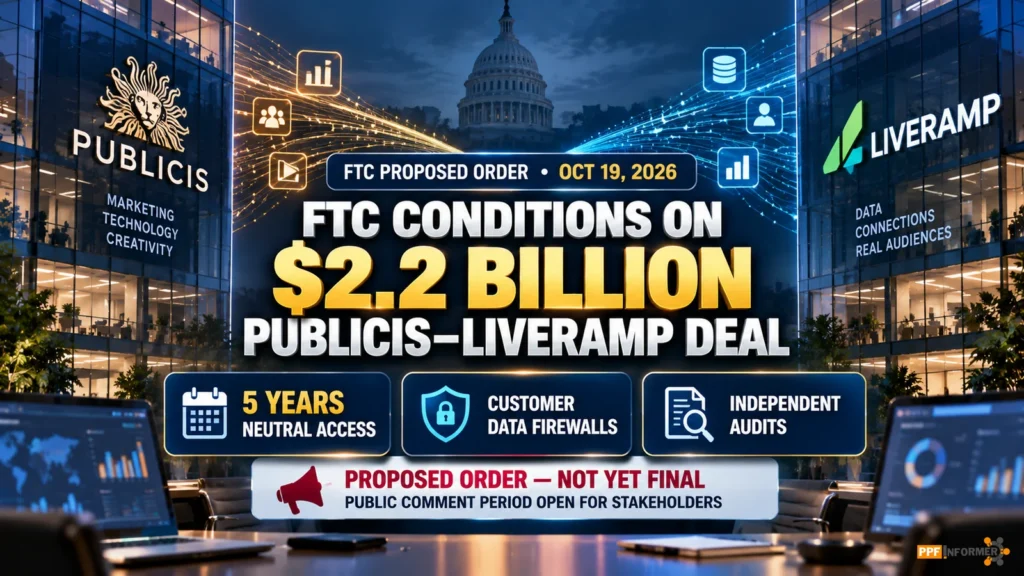
FTC Publicis LiveRamp deal 2026: The Federal Trade Commission announced proposed conditions on October 19, 2026, for Publicis Groupe’s $2.2 billion acquisition of LiveRamp, seeking to protect competition and sensitive customer data in digital advertising. The proposed order would require continued nondiscriminatory access to LiveRamp’s services and restrictions on how the combined business can use information belonging to rival agencies and their clients.
The action matters beyond the two companies. Advertisers depend on a network of agencies, technology vendors and data services to plan campaigns, match audiences and measure results. When one large agency group owns a widely used data platform, competitors may worry about access, pricing and the confidentiality of business information.
FTC Publicis LiveRamp deal 2026: What was proposed?
For the FTC Publicis LiveRamp deal 2026, the agency accepted a proposed consent agreement for public comment and issued an administrative complaint outlining its competition concerns. Publicis plans to acquire all of LiveRamp under a transaction valued at $2.2 billion. The agency’s concern is that ownership could allow Publicis to favor its own agency operations or obtain commercially sensitive information from clients of competing agencies.
This is a proposed settlement framework, not a judicial finding that the companies committed wrongdoing. The FTC’s administrative complaint sets out allegations and a reason to believe competition could be harmed. The public-comment process and final order status should be checked before publication of any later update.
Why is LiveRamp important to digital advertising?
LiveRamp provides data connectivity services that help advertisers and their partners work with audience information across different systems. Such infrastructure can support campaign planning, measurement and data collaboration. The FTC describes LiveRamp as a leading U.S. provider with a broad range of connectivity services.
An agency that uses a platform needs confidence that its workflows will continue working and that its client information will not be exposed to a competitor. For an independent agency, the risk is not only a sudden price increase. Even the possibility of losing neutral access or having confidential strategy data shared can influence vendor choices.
What competition problems does the FTC allege?
The FTC alleges that a combined Publicis and LiveRamp could have the incentive and ability to steer customers toward Publicis agency services. It says rivals could face degraded or delayed access to services they depend on, potentially reducing service quality or raising costs. The agency also alleges that Publicis could obtain non-Publicis clients’ competitively sensitive information and use it to encourage those clients to switch agencies.
These are the regulator’s stated theories of harm. They should not be confused with confirmed evidence that such behavior has already occurred after a completed transaction. The distinction is especially important for a business audience evaluating a proposed consent order.
What safeguards are in the proposed order?
Neutral access for five years
The FTC says Publicis and LiveRamp would have to provide LiveRamp’s standalone products and support on fair and reasonable, nondiscriminatory terms for five years. The companies would be barred from denying, delaying, degrading or impairing access for customers as a means of disadvantaging competing agencies.
Data firewalls
The proposed agreement requires firewalls intended to prevent Publicis from accessing or using customer data and confidential business information received through LiveRamp’s standalone products. A firewall here means organizational and technical restrictions on information flows, not merely a network security device.
Independent audits and dispute procedures
An independent auditor would review compliance every six months during the first two years after closing, then annually for the next three years. Customers could request an audit of obligations affecting their data, privacy and security. The order also includes mediation for contractual disputes unresolved after 30 days and protections against retaliation for raising compliance concerns.
Does the FTC’s action mean the acquisition is already approved?
In the FTC Publicis LiveRamp deal 2026, the agency has proposed a path to address its concerns through a consent agreement. The FTC says the package will be open for 30 days of public comment. It would be inaccurate to describe the proposed terms as an unchangeable final decision before the agency completes its process. The status of the transaction itself also requires separate verification.
Businesses should distinguish a regulator’s acceptance of a proposed settlement for comment from the actual closing of a deal. Both may affect operational planning, but they are not the same milestone.
What should U.S. advertisers and agencies do now?
First, identify whether any campaigns, measurement processes or audience-data workflows depend on LiveRamp. Record which services are essential and which contracts govern access. Second, review data-processing terms and identify the types of customer information the platform receives. Third, ask account representatives how the proposed safeguards would be implemented and how customers could raise concerns.
Agencies can also evaluate continuity plans. If an integration becomes unavailable or changes materially, which campaigns would be disrupted? A sensible contingency plan may include documenting data exports, permission structures and alternative measurement procedures. This is routine vendor-risk management, not evidence that LiveRamp is about to stop operating. For an example of a separate FTC competition action, see our coverage of the FTC ticket broker lawsuit; it does not concern the Publicis–LiveRamp transaction.
What does this mean for small businesses buying ads?
A small business may never contract with LiveRamp directly, but its agency or advertising partners might rely on the platform. Owners can ask how campaign audiences are created, where customer data is shared and who can access reporting. A written explanation of data use and a clear method for withdrawing permissions are useful regardless of the outcome of this particular transaction.
The FTC’s concern illustrates a broader issue in the digital economy: data infrastructure can shape competition even when the end customer rarely sees it. Fair access and confidential handling of information can influence the number of agencies and services available to advertisers.
Could the proposed conditions affect ad prices?
The FTC argues that preserving neutral access could reduce the risk of higher costs and lower-quality services. But the announcement does not establish how ad prices will change, if at all. Advertising costs depend on many factors, including demand, audience, campaign quality, platform auctions and agency fees. Any numerical forecast tied to this order would be speculative without additional evidence.
What happens next?
The FTC Publicis LiveRamp deal 2026 proposal is subject to a 30-day public-comment period. The FTC says submitted comments will become available through the relevant public docket after processing. Stakeholders should follow the official docket for final terms and effective dates. Companies may also need to review how the proposed commitments interact with their existing contracts.
Frequently asked questions
How much is the Publicis–LiveRamp deal worth?
The FTC describes it as a $2.2 billion acquisition of 100% of LiveRamp.
What is the FTC trying to protect?
Neutral access to LiveRamp services and the confidentiality of customer data, while addressing potential competition concerns involving advertising agencies.
Are the five-year restrictions final?
The October 19 announcement describes a proposed consent order subject to public comment. Check the FTC docket for the final status.
Sources and verification
Primary source: FTC October 19, 2026 proposed order and complaint announcement. Allegations are identified as FTC claims, and the agreement is described as proposed rather than final.



Leave a Reply