

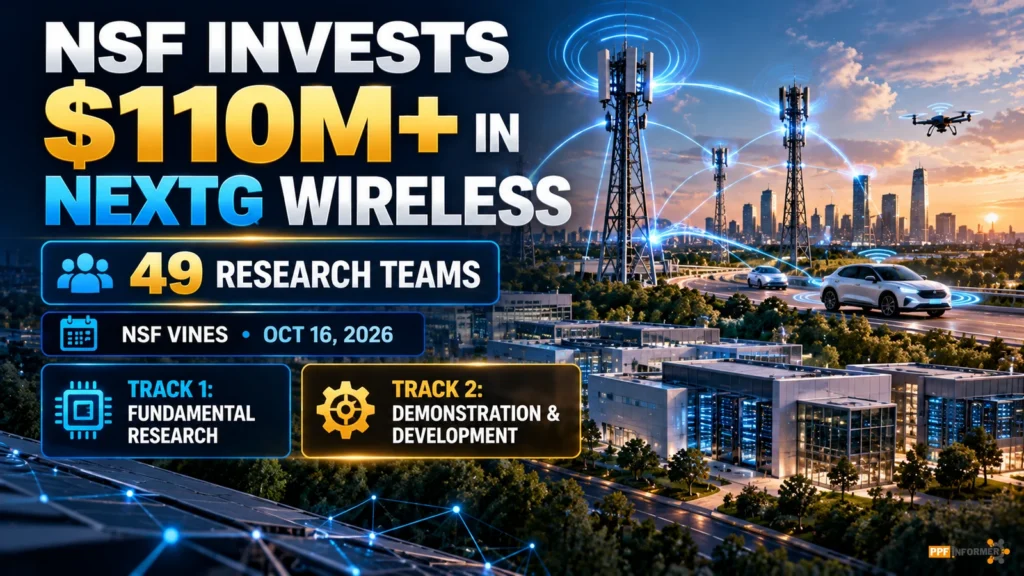
NSF VINES NextG wireless research is advancing: The U.S. National Science Foundation announced more than $110 million for 49 research teams working on next-generation wireless networks on October 16, 2026. These NSF VINES NextG wireless awards are part of NSF VINES, a program designed to connect advanced networking research with practical needs in data centers, health care, autonomous vehicles, manufacturing and other industries. The money funds research and development; it does not mean a nationwide 6G network is ready to launch.
The announcement is significant because future connectivity is not only about downloading a movie faster. Emerging systems may need reliable communication between moving machines, remote sensors, hospital equipment and computing infrastructure. The NSF’s approach asks researchers to identify the actual performance problems in those settings before claiming a new network design will solve them.
Here is what the funding supports, how the two tracks differ, which applications may benefit and what evidence would be needed before the research changes daily life.
NSF VINES NextG wireless: What was announced?
On October 16, the NSF said its first Verticals-enabling Intelligent NEtwork Systems investment exceeds $110 million and supports 49 teams. The program is known as NSF VINES. Its stated purpose is to improve the performance and capabilities of advanced wireless communication systems and connect that work to sectors whose requirements are not fully served by existing networks.
The award announcement describes two tracks. One supports use-inspired fundamental research. The other supports technology development, demonstrations and translation toward real-world adoption. The agency identifies collaboration among universities, companies and public agencies as part of the program’s design.
These are research awards, not a government purchase of a finished consumer network. The NSF has not said that the 49 teams will all build the same system, use one common radio standard or deliver a commercial product by a single date. The funding figure also should not be divided evenly among teams to imply each receives the same amount; individual award terms may differ.
What does “NextG” mean, and is it the same as 6G?
NextG is a broad term for next-generation networking technologies. It includes research into the systems, software, radio techniques, architectures and integration methods that may shape wireless networks beyond current deployments. The term does not necessarily identify one finished generation or one specific technical standard. For a different perspective on existing wireless spectrum and satellite connectivity, read our coverage of the Starlink mobile spectrum deal; that commercial agreement is separate from these NSF research grants.
6G is commonly used for the next major generation of mobile communications after 5G, but the eventual standards and commercial products depend on technical agreements, testing and deployment decisions. A university demonstration of a promising algorithm is not the same as a phone or carrier network that ordinary customers can use.
In practice, future networks may combine terrestrial radio, fiber-connected computing, specialized local systems and software that adjusts to changing conditions. Researchers can explore these ideas without promising that every one will appear in the next consumer handset. The NSF’s emphasis is on application requirements rather than a marketing label.
Why speed is only one measure
Peak download speed attracts attention because it is easy to compare. Many industrial applications care more about predictable delay, reliability, energy use, coverage, security or the ability to support large numbers of devices. A remote-control system that occasionally stalls may be unusable even if its average data rate is impressive.
Likewise, a sensor network that sends tiny measurements all day may benefit more from low power consumption and dependable coverage than from maximum throughput. Designing for these different goals can require tradeoffs. A network optimized for one setting may not be ideal for another.
How the two NSF VINES tracks work
Track 1: Fundamental research inspired by real uses
Track 1 is intended to support novel networking techniques and solutions. Researchers can investigate new approaches to communication, control, coordination and network performance. The work may be early-stage and need further validation before anyone can deploy it commercially.
Use-inspired research means that the questions come from practical needs even when the answers are not yet ready for a product. For example, a team could study how wireless links behave when many moving devices share limited radio resources. The resulting insight might influence future designs, but the NSF announcement does not identify that hypothetical example as a particular funded project.
Early research can also produce negative results that are useful. A proposed technique may work well in simulation but poorly when real interference, mobility or hardware limits appear. A credible research program should be able to report such limits rather than selecting only the most flattering tests.
Track 2: Demonstrations and technology translation
Track 2 focuses on moving networking advances toward use. The NSF says these teams must identify an emerging industry whose needs current networks do not adequately meet. They are expected to develop solutions, demonstrate innovations in real-world settings and plan for future partnerships or commercialization.
This creates a stronger connection between laboratory claims and practical constraints. A system that looks efficient in a controlled environment may face unpredictable traffic, weather, radio interference, equipment cost or maintenance demands in an actual factory or hospital. Demonstration work can reveal which improvements survive those conditions.
The NSF describes Track 2 as operating at higher technology-readiness levels than basic research. That does not mean every project is nearly market-ready. Readiness depends on the maturity of the individual technology, the scope of the demonstration and what remains to be tested.
Where could advanced wireless networks matter most?
Data centers and distributed computing
Modern computing systems rely on rapid movement of information between processors, storage and users. Advanced wireless links may offer flexibility in some specialized environments, but they do not automatically replace high-capacity wired connections inside data centers. The research challenge is to identify cases where wireless networking adds useful mobility, resilience or deployment options without introducing unacceptable delay or interference.
For AI infrastructure, a future network might help connect edge devices to computing resources or coordinate distributed sensors. Those are potential applications, not outcomes proven by the October awards. The real test will be performance under realistic workloads and a clear comparison with existing alternatives.
Remote health care
Remote monitoring and some clinical systems require secure, dependable connectivity. A delayed or missing reading can have consequences that ordinary video buffering does not. Researchers therefore need to evaluate not just throughput but continuity, latency variation, privacy and recovery when a link fails.
Better wireless communication could eventually support new care models, particularly where specialists and patients are far apart. However, networking improvements alone cannot guarantee better medical outcomes. Devices, clinical validation, regulations, staffing and patient access all matter. No patient benefit should be claimed until the relevant system has been tested.
Autonomous vehicles and connected transportation
Vehicles and roadside systems may exchange information about traffic, road conditions or coordinated operations. Such communication can be useful, but a vehicle must still operate safely when a wireless signal is weak or unavailable. A future network cannot be treated as a substitute for robust onboard safety systems.
Research could examine how connections perform at high speeds, across cell boundaries and in crowded urban environments. Results would need to be measured under representative conditions, not only in an empty test corridor. The NSF names connected autonomous vehicles as an application area, not as a promise of imminent fully driverless travel.
Smart manufacturing
Factories may use sensors, robotics and quality-control equipment that communicate continuously. Wireless links can simplify reconfiguration when production lines change, but reliability and timing requirements can be strict. A system that drops a message at the wrong moment can interrupt operations.
Potential benefits include easier deployment of mobile equipment and better visibility into machine conditions. Yet an industrial buyer would still need evidence about uptime, integration with existing equipment, cybersecurity and total operating cost before replacing proven connections.
Precision agriculture and disaster response
Agricultural networks may cover wide areas with sparse power and limited backhaul. Disaster-response systems may need to function after ordinary infrastructure has been damaged. These environments pose very different problems from a dense city center, illustrating why one universal performance target is insufficient.
Researchers can explore resilient routing, adaptable coverage and efficient sensor communication. Any claimed benefit must account for installation, maintenance and affordability. A technically impressive prototype that requires expensive equipment may be unsuitable for a small farm or a local emergency team.
What technical problems must researchers solve?
Reliability under real interference
Wireless systems share a physical environment. Walls, moving equipment, weather, competing transmissions and distance can change link quality. Research results need to show how systems respond when conditions deteriorate, not just how they perform at their best.
Security across connected devices
Adding networked sensors and controllers creates more endpoints that must be authenticated, updated and protected. A faster network does not inherently make devices safer. Designers need secure defaults, strong identity management and ways to limit damage if one device is compromised.
Energy efficiency
High performance can demand more computation, radio activity or specialized hardware. In battery-powered devices, those costs may be unacceptable. Researchers should report performance per unit of energy alongside headline speed figures, especially for remote sensors and portable equipment.
Interoperability and standards
Equipment from different suppliers must communicate reliably if a technology is to scale. A closed demonstration using one vendor’s components can be valuable research, but broader adoption may require open interfaces, standards compliance and repeatable tests across vendors.
Economic feasibility
Even a successful prototype needs a business case. Installation cost, training, spectrum access, replacement cycles and maintenance can determine whether an improvement is adopted. A system that performs better in the lab may still lose to a cheaper existing technology in a real procurement decision.
Who is involved in the NSF VINES effort?
The NSF lists industry and government collaborators including Ericsson, Intel, Qualcomm, the Department of Homeland Security, the Department of Defense’s research and engineering office, and the National Institute of Standards and Technology. It also names international partners from Finland, India, Japan and Sweden.
The partnership structure matters because universities can investigate basic principles, companies can contribute engineering and deployment experience, and government organizations can identify public-interest or national-security requirements. Their participation does not mean each partner endorses every project or that the NSF has selected one commercial technology winner.
International collaboration can help researchers compare approaches and work toward interoperable systems. At the same time, sensitive technology may involve export controls, security review or other restrictions. The October announcement does not provide a detailed policy framework for every cross-border activity.
When could Americans actually use the results?
The NSF VINES NextG wireless announcement marks a funding and research milestone. It does not give a consumer launch date for a new wireless generation. Track 1 discoveries may need years of additional engineering. Track 2 demonstrations may progress faster in some specialized environments, but commercial deployment still requires validation and investment.
It is reasonable to expect reports, prototypes and demonstrations before widespread products. It would be speculative to assign a specific year for nationwide NextG coverage based solely on these awards. Network generations typically depend on standards, compatible devices, infrastructure investment and carrier decisions that extend beyond a research grant.
The near-term value may be better evidence about what industries need and which approaches work. A careful evaluation should ask what baseline was used, whether results were reproduced independently, what conditions were tested and whether the improvement remains meaningful when costs are included.
What should the public watch for next?
First, look for the published descriptions of individual VINES awards and the problems each team is addressing. Second, look for measurable demonstrations rather than general claims about “revolutionary” connectivity. Third, compare results across realistic scenarios, including failures and difficult environments. Finally, watch whether promising systems influence standards, partnerships or procurement decisions.
For students and early-career engineers, the awards highlight research areas worth exploring: wireless systems, signal processing, distributed computing, security, embedded hardware and applied networking. Funding to research teams does not equal a confirmed hiring announcement. Interested applicants should check university labs and employers for actual positions.
Frequently asked questions
Did the NSF announce a $110 million 6G rollout?
No. It announced more than $110 million for 49 research teams working on NextG advanced wireless systems. Research funding is not a nationwide network deployment contract.
What is NSF VINES?
It is the Verticals-enabling Intelligent NEtwork Systems initiative, designed to develop networking innovations and test their relevance to industries that need dependable advanced communications.
What is the difference between Track 1 and Track 2?
Track 1 supports use-inspired fundamental research. Track 2 focuses on technology development, demonstration and translation toward real-world applications.
Will future networks make autonomous cars safe?
Connectivity may help certain vehicle systems, but it cannot by itself guarantee safe autonomous driving. Vehicle engineering, onboard systems, validation and regulation remain essential.
Is there a confirmed date for commercial products?
Not in the October 16 NSF announcement. The timeline will vary by project, industry and future standardization and deployment decisions.
Fact, analysis and future possibilities
Verified fact: NSF announced more than $110 million for 49 VINES teams across two tracks on October 16, 2026. Analysis: connecting research to concrete industry needs may make demonstrations more useful than a speed-only contest. Future possibility: successful techniques could eventually improve specialized networks in factories, hospitals, transport and other sectors. The last point is a possibility, not a documented outcome.
For NSF VINES NextG wireless, the larger lesson is that tomorrow’s connectivity will be judged by whether it solves difficult, measurable problems at a sustainable cost. The VINES program is a substantial investment in finding those answers, not evidence that they have already been found.
Primary sources
U.S. National Science Foundation, October 16, 2026 funding announcement; NSF official research and award information.


Leave a Reply