

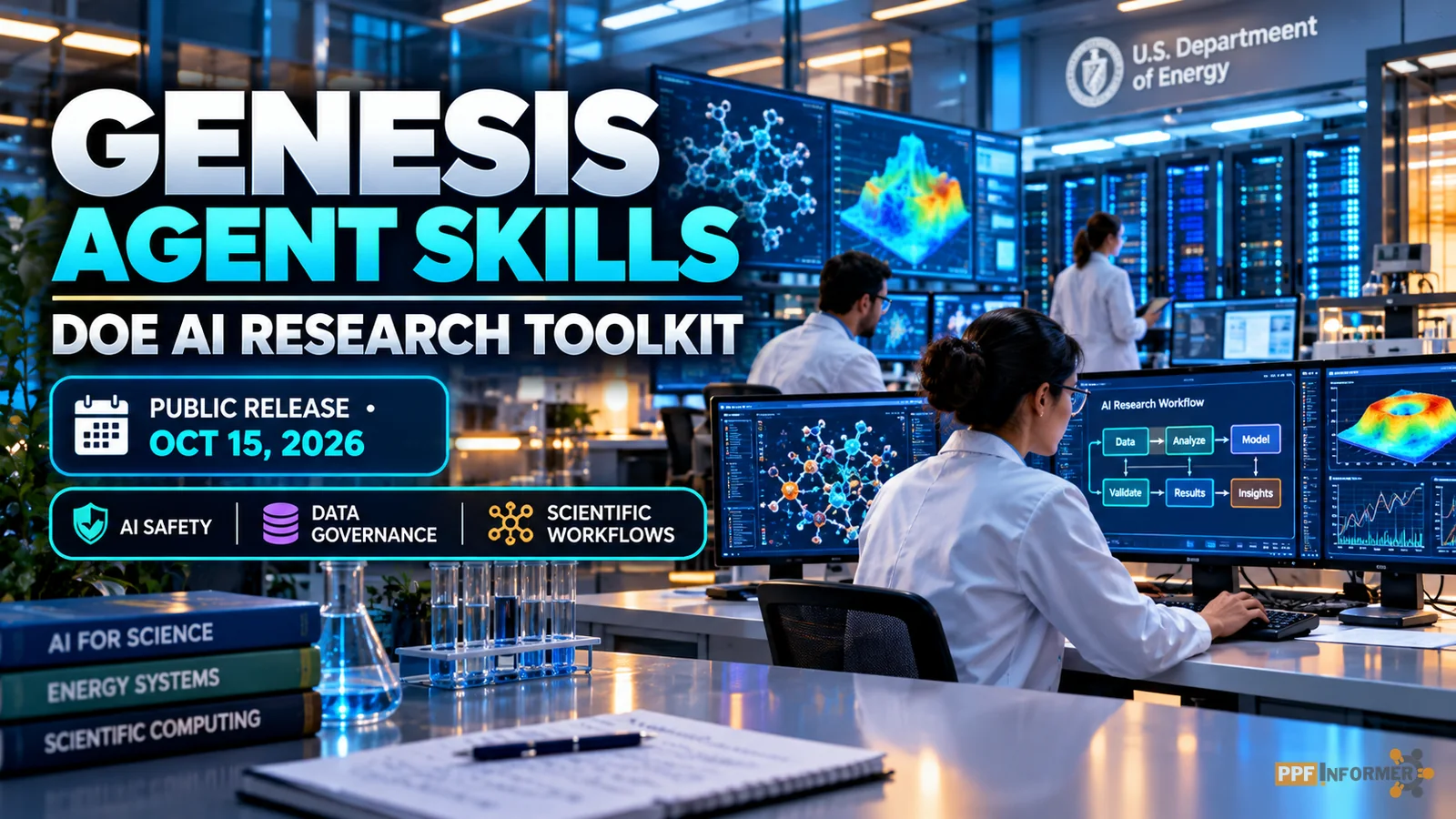
The U.S. Department of Energy released Genesis Agent Skills on October 15, 2026, describing a public collection of reusable instructions, workflows and technical resources for scientists working with AI coding assistants. The release is intended to help researchers build, evaluate and govern AI-assisted scientific systems. It is an early infrastructure component of the federal Genesis Mission, not an announcement that an autonomous AI scientist has solved a major research problem.
The Genesis Agent Skills release is not a scientific breakthrough by itself. A set of reusable skills can make technical work more consistent and easier to review, but scientific discovery still depends on data quality, correct methods, independent validation and accountable researchers. DOE says the package is publicly available through a government-hosted GitLab repository. The department has not published a universal benchmark showing that every scientific task becomes faster or more accurate.
Genesis Agent Skills: What did DOE release?
Genesis Agent Skills are reusable guidance packages designed to work with AI coding tools. According to DOE’s October 15 announcement, they cover areas including AI safety, evaluation and monitoring, data governance, scientific workflows and multi-agent systems. The package was developed by contributors across the national laboratory system through the ModCon initiative and the American Science Cloud effort.
In plain English, a skill is a way to make a coding assistant follow relevant technical guidance for a specific kind of task. A researcher might ask for help understanding a complex dataset or reviewing a codebase. Instead of treating every request as an isolated conversation, an assistant equipped with the relevant skill can draw on reusable workflow instructions and resources.
That does not mean the assistant automatically has permission to open any laboratory file, run arbitrary software or publish scientific results. Actual access depends on the environment in which the tool is used, the permissions configured by the institution and the capabilities of the underlying assistant. DOE’s announcement describes intended uses; it does not establish that every installation has the same connectors or execution rights.
Why scientific AI needs more than a powerful model
Scientific computing differs from ordinary question answering. A numerical result may depend on a dataset version, instrument calibration, preprocessing choice, physical unit, random seed or library version. Two plausible-looking answers can disagree because they used different assumptions. A general-purpose model can explain an algorithm while still overlooking a domain-specific constraint that changes the conclusion.
Genesis Agent Skills aim to reduce that gap by placing specialized guidance closer to the moment a task is performed. The practical value is not that the model suddenly becomes infallible. It is that a team can specify which checks, documentation and review steps belong in a workflow, then use those expectations repeatedly.
For example, a scientist comparing simulations may need consistent unit conversions, documented input parameters and a way to flag physically impossible outputs. A good workflow makes those requirements visible. The assistant can help carry them out, but a human still decides whether the assumptions match the experiment.
How an AI research skill could fit into a workflow
Step 1: A researcher states a scientific question
In a Genesis Agent Skills workflow, a useful request defines the problem, available evidence and expected output. “Analyze these measurements” is less precise than asking whether a particular signal changes across a controlled set of conditions, with uncertainty estimates and a description of missing data. A skill can encourage this structure before the assistant writes code.
Step 2: The assistant selects relevant guidance
DOE says a plain-language request may activate guidance related to data handling or code safety. Conceptually, this is a routing step: identify the type of task and apply an appropriate workflow. It is not proof that the routing is perfect. If a request is ambiguous, the system should ask for clarification or limit what it does rather than silently choose a high-impact action.
Step 3: Tools process data within permissions
When authorized tools are available, an assistant may help produce code or analyze a dataset. In a well-controlled environment, the code should be inspectable, the input source recorded and sensitive files protected. It should be possible to tell which operations actually ran and which were merely suggested in text.
Step 4: Outputs are checked against independent criteria
A scientific result needs more than a coherent explanation. Teams can compare outputs with known test cases, reference implementations, conservation laws, statistical expectations or measurements from a different method. Unexpected results should be investigated rather than automatically presented as discoveries.
Step 5: The team records provenance
Reproducibility requires a record of what data was used, which transformations occurred and what software produced the result. The record may also include model and skill versions, prompts, approvals and human corrections. Without provenance, a useful result can become difficult to verify or extend.
Why evaluation and monitoring are central
DOE identifies agent evaluation and monitoring as subjects covered by Genesis Agent Skills. These are different activities. Evaluation asks how well a system performs on defined tasks, ideally before deployment. Monitoring watches behavior during real use and helps detect failures, unexpected tool calls or changes in quality.
A laboratory could begin with a small set of tasks that have known answers: reading a file format, checking a numerical calculation, identifying a missing dependency or producing a reproducible plot. The team should measure not only whether the final answer looks right, but whether the system used permitted inputs and generated verifiable work.
For scientific tasks without a known answer, evaluation is harder. A model may generate a novel hypothesis that sounds reasonable but is not testable. The correct response is to define a validation pathway, not to score novelty as accuracy. Human review remains especially important when conclusions could affect public safety, expensive experiments or regulated research.
Monitoring can also help detect regressions when the underlying model, tool permissions or skill instructions change. A workflow that worked last month may behave differently after an update. Version control and repeatable test cases allow a lab to notice those changes before relying on a new result.
Data governance: the hard problem behind scientific automation
DOE lists data governance among the technical areas addressed by Genesis Agent Skills. Scientific datasets can carry restrictions that are easy to miss in a conversational interface. Examples include personally identifiable information, confidential industry measurements, unpublished results, contractual data-sharing conditions and security-sensitive research materials.
A responsible deployment should define who can access each dataset, what may be copied into an AI system, which outputs can leave the institution and how records are retained. These decisions cannot be outsourced to a prompt alone. They require institutional policy, technical controls and clear responsibility for exceptions.
Data lineage is another concern. If a tool combines two datasets with different collection methods, the output may appear mathematically precise while concealing a mismatch. A reusable skill could remind researchers to check metadata and compatibility, but the underlying evidence must still be examined. “AI-assisted” is not a substitute for documenting the source of every important variable.
What are multi-agent scientific systems?
A multi-agent system assigns different subtasks to separate AI-driven components. One component might retrieve documentation, another inspect code and a third check an output against constraints. This can make a complex process more modular. It can also introduce new failure paths when one component accepts an unverified claim from another.
For that reason, a multi-agent workflow needs explicit boundaries. Which component can write files? Which one can access external services? What happens if two agents disagree? Who approves a costly or irreversible action? A system that merely divides work among several models is not automatically more trustworthy than a single well-supervised assistant.
DOE’s announcement identifies multi-agent systems as a supported topic, but it does not establish that the released package contains a complete, autonomous laboratory platform. Readers should avoid equating a library of skills with a fully operational scientific robot or an end-to-end discovery engine.
Who built the public release?
The department says the package came from the Baseline AI R&D Capabilities team within ModCon, with contributors from multiple national laboratories. The effort is co-led by researchers associated with Pacific Northwest National Laboratory and Lawrence Berkeley National Laboratory. The PNNL announcement emphasizes that the resources are intended for a broad research community, not only one institution.
DOE says the public may explore the catalog, contribute improvements and adapt workflows. Public availability is useful for transparency, but it does not by itself prove that every component is independently audited, safe for sensitive data or compatible with every coding assistant. Researchers should inspect repository documentation and applicable license terms before using a package in a production environment.
How does this differ from the earlier Genesis Mission funding news?
Previous announcements described the mission’s investments and compute-related commitments. PPF Informer covered that financial context in its Genesis Mission AI compute pledge explainer. The October 15 update is different: it describes a public technical resource intended to help people work with AI-assisted scientific systems.
Funding can support infrastructure and research. Reusable workflows can help scientists make use of that infrastructure. But the two should not be confused. A commitment of computing resources does not mean a validated tool already exists, and a new software release does not prove that promised scientific outcomes have been achieved.
What can researchers do with the release now?
DOE says the package is publicly available through a government-hosted Genesis Agent Skills repository. An interested researcher can begin by reviewing the official catalog and documentation, identifying a relevant low-risk workflow and checking its dependencies and terms. The exact installation and integration steps should come from the current repository, not from a generic tutorial that may describe a different version.
Before using a skill with real laboratory data, a team should test it on synthetic or non-sensitive material. It should confirm what files the tool reads, what code it executes, what network access it requires and how its output is logged. A small test with a known answer is a safer starting point than connecting an unreviewed assistant to a critical experiment.
Institutions may also benefit from a review checklist covering security, accessibility, scientific validity and reproducibility. The checklist is a recommended practice, not a feature DOE has promised to implement automatically. Clear local standards make it easier to compare tools as the ecosystem evolves.
Where the opportunity is strongest
Many laboratories spend substantial time on routine technical work: cleaning files, checking scripts, tracing data provenance, reviewing documentation and reproducing earlier analyses. Consistent assistance with these tasks could free researchers to focus on experimental design and interpretation. That is a plausible benefit, but it needs to be measured in actual research settings.
Interoperability is another possible advantage. If teams agree on reusable practices for handling data and evaluating code, collaborators may find it easier to exchange workflows across institutions. However, shared instructions cannot eliminate differences in instruments, computing environments, access policies or scientific methods.
For Genesis Agent Skills, the strongest near-term success measure may be fewer avoidable errors and clearer documentation rather than spectacular autonomous discoveries. A modest improvement in reliability can be valuable in science, particularly when the same workflow is repeated by many people.
What could go wrong?
One risk is automation bias: researchers may accept a fluent answer without checking the underlying evidence. Another is hidden coupling, where a skill depends on a specific software version or data format and fails silently when conditions change. A third is excessive permission, where a tool has more access than its task requires.
Scientific data can also contain unusual patterns that a general-purpose model misinterprets. Missing values, unit mismatches and sample-selection effects can make a result look convincing while changing its meaning. A reusable workflow helps only if it contains relevant checks and users actually follow them.
Finally, an open repository can change over time. Contributors may improve a skill, but new dependencies or revised instructions can introduce regressions. Version pinning, review and testing are necessary before a laboratory treats any update as trustworthy.
What happens next for AI-assisted science?
Confirmed: DOE announced the public release of Genesis Agent Skills on October 15 and described the subjects the package is intended to cover. The resources are part of the Genesis Mission’s shared research infrastructure effort.
Analysis: Reusable, inspectable guidance could help scientific teams standardize parts of AI-assisted computing. Its value will depend on integration quality, domain-specific checks and researchers’ ability to reproduce results.
Prediction, not a confirmed outcome: If independent teams validate the workflows and contribute improvements, future versions could support broader collaboration across laboratories. The timing, scale and scientific impact of such adoption are unknown.
Important evidence to watch includes public examples with reproducible data, independent evaluations of error rates, clear documentation of permissions and real adoption by research groups. Announcements about future capability are less informative than demonstrated results that another team can repeat.
Frequently asked questions
Is Genesis Agent Skills a new AI model?
No. DOE describes a public collection of reusable technical guidance and workflows intended to work with AI coding tools, not a newly trained standalone foundation model.
Is Genesis Agent Skills publicly available?
Yes. DOE says the package is available through its government-hosted GitLab repository for researchers, developers and the public to explore.
Does the toolkit automatically discover new medicines or materials?
No such result is established by the October 15 release. Scientific discoveries still require domain expertise, experimental validation and independent review.
Can a lab safely connect the package to confidential data?
Not without review. Institutions should inspect the actual code, dependencies, permissions, licensing and data-governance rules before any sensitive deployment.
The bottom line
Genesis Agent Skills offers a practical step toward making AI-assisted scientific work more structured, but it is not a shortcut around the scientific method. The most useful question is whether researchers can trace, test and reproduce the work an AI assistant helps them perform. If the public toolkit makes those practices easier, it may become an important part of future research infrastructure. That impact remains to be demonstrated.
Primary sources: U.S. Department of Energy, October 15, 2026; Pacific Northwest National Laboratory announcement; official government GitLab project.