

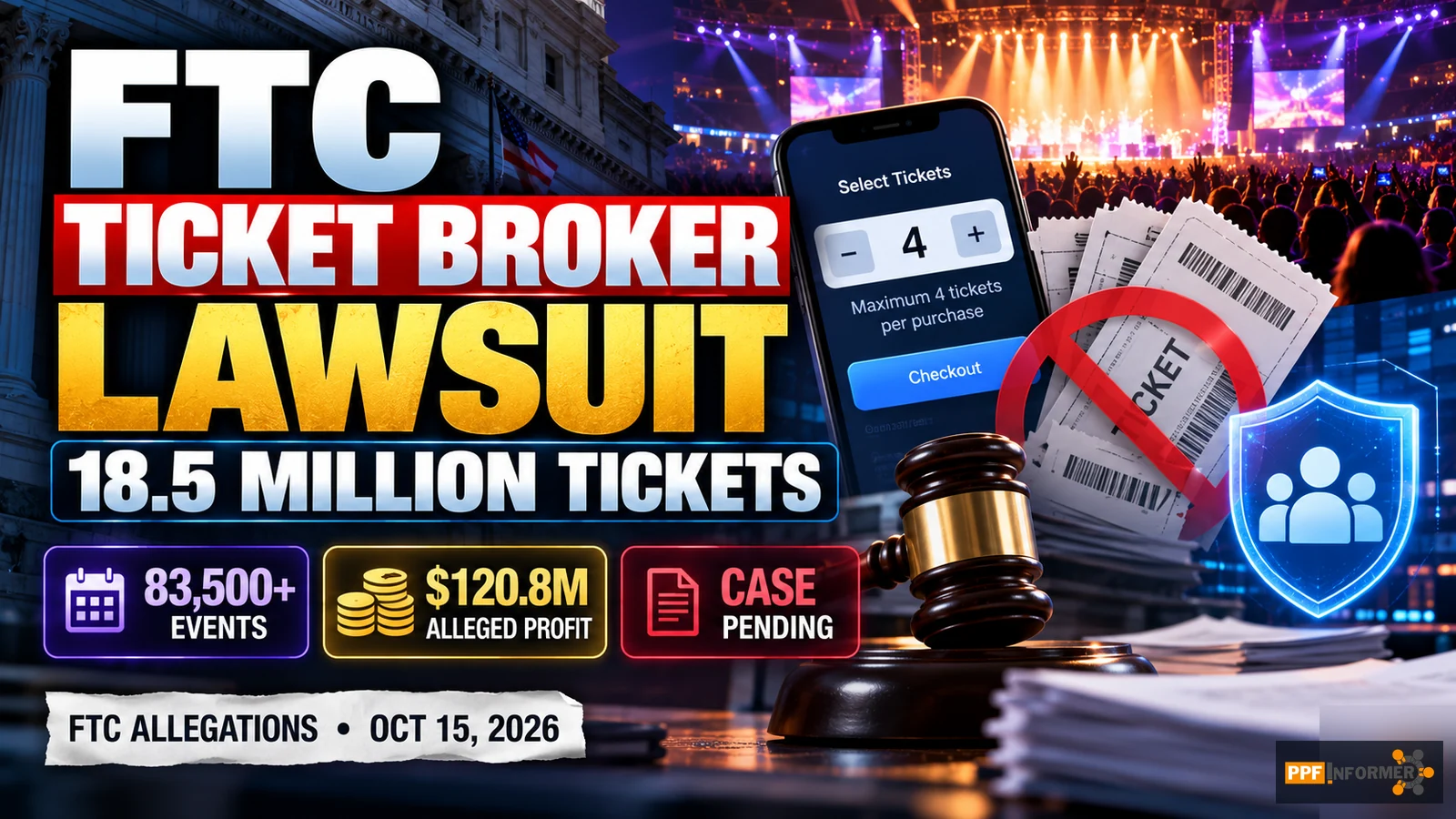
The FTC ticket broker lawsuit announced October 15, 2026, alleges that REPS & Company used prohibited methods to buy more tickets than event sellers allowed, then resold tickets for substantial profits. Federal officials say the broker acquired more than 18.5 million tickets at a cost exceeding $1.3 billion. These are allegations in a newly filed case, not findings of liability.
For U.S. concertgoers and sports fans, the case highlights a familiar problem: a ticket can appear unavailable at face value and then reappear at a higher price on a resale marketplace. The lawsuit does not prove that any particular buyer was overcharged or entitle everyone who bought a resale ticket to a refund.
FTC ticket broker lawsuit: What did the agency announce?
The Federal Trade Commission said it referred a complaint to the U.S. Department of Justice, which filed the case in federal court in the Southern District of California. The defendants include REPS & Company and three executives named in the complaint. The government alleges violations of the Better Online Ticket Sales Act, often called the BOTS Act.
That law addresses circumvention of security systems used by ticket issuers to enforce posted ticket limits or purchasing rules. Its existence does not mean every resale is unlawful. The legal question in this case is whether the methods used to obtain tickets violated the protections in the statute.
How many tickets and events are involved?
The FTC ticket broker lawsuit alleges that REPS purchased more than eight tickets for at least 83,500 events and amassed more than 18.5 million tickets since 2022. Officials allege the company spent more than $1.3 billion acquiring tickets and made at least $120.8 million in resale profit.
The agency described one example involving a Beyoncé concert in Kansas City in 2023. The complaint alleges that 1,300 accounts were used to buy 7,624 tickets, generating approximately $833,000 in profit. Those figures come from the government’s complaint and should not be presented as independently audited company results or a court’s final conclusions.
These numbers also require careful interpretation. Spending on tickets is not the same as profit. The number of events is not the number of victims. And the filing does not establish that all 18.5 million tickets were bought through the same alleged method.
What methods does the government allege?
The FTC says ticket issuers use controls such as purchase limits, account checks and monitoring of payment credentials or device information. The complaint alleges REPS used large numbers of accounts, identity details belonging to others, virtual payment methods, proxy services and multiple browser sessions to work around those controls.
The agency further alleges that the broker changed account details after some purchases were blocked or canceled. Those claims are part of the government’s case and will be subject to the legal process. Readers should not confuse a regulatory accusation with a proven criminal conviction.
Why ticket limits matter to ordinary buyers
Ticket limits are intended to prevent a small number of purchasers from acquiring a disproportionate share of an event’s initial supply. When the limit works, more fans may have a chance to buy tickets through the original seller. When it is bypassed, inventory can shift quickly to resale channels where asking prices may be much higher.
In this case, resale prices should not be confused with evidence of wrongdoing: they can rise for legitimate reasons, including strong demand and limited venue capacity. The lawsuit focuses on alleged circumvention, not on proving that every resale price above face value is illegal. That distinction matters for consumers trying to understand what regulators are targeting.
What should fans do when buying tickets?
Start with the artist, venue or team’s official ticket page, and verify the seller’s domain before entering payment information. Compare the final total, including mandatory fees, rather than judging an offer by its headline price. Save the listing, receipt, transfer confirmation and any promises about seats or delivery.
If using a resale platform, read its refund and ticket-validity policies carefully. A listing that says “guaranteed” may still contain conditions about timing, replacements or proof of invalid entry. Avoid sending money through an off-platform payment request that removes the protections available through the original checkout.
Fans should also beware of messages claiming that this lawsuit automatically qualifies them for compensation. The agency’s October 15 release announces litigation, not a general consumer refund program. Do not pay a fee to join a supposed settlement or share account credentials with an unsolicited caller.
Is the ticket broker lawsuit connected to an existing refund?
No automatic refund has been announced under the FTC ticket broker lawsuit. The government is seeking court relief in this case, but the final outcome is unresolved. If a verified redress program is established later, details should appear on the FTC’s official site or in court records. Until then, any specific refund eligibility claim would be premature.
The FTC case page identifies the proceeding and makes related filings available. It is the best place to check whether the status changes from pending to a judgment, settlement or dismissal.
What happens next?
In the FTC ticket broker lawsuit, the court will consider the government’s allegations and the defendants’ responses. Possible outcomes depend on evidence, legal arguments and judicial decisions. The FTC’s referral and the Justice Department’s filing establish that a case exists; they do not predetermine its result.
Ticket issuers may also revisit how they enforce limits, but the announcement does not prove that a specific new verification requirement is coming. Predictions about mandatory ID checks, pricing caps or immediate changes to ticket platforms would be speculative.
Frequently asked questions
Is ticket reselling illegal in the United States?
No. Resale is not automatically illegal. This complaint concerns alleged circumvention of technical measures used to enforce purchasing limits, under the BOTS Act.
Did the FTC prove REPS broke the law?
No. The case was filed on October 15, 2026, and remains pending according to the FTC case page. The allegations must be resolved through the legal process.
Will concertgoers get refunds?
No general refund program was announced with this lawsuit. Consumers should follow official FTC updates rather than unsolicited compensation messages.
Bottom line
The FTC ticket broker lawsuit puts the mechanics of high-volume ticket buying under federal scrutiny. For other FTC consumer-protection litigation, see our coverage of the FTC’s Digital Forensics lawsuit. The numbers are substantial, but they remain allegations. For fans, the practical response is to use verified sellers, understand total costs and follow the court case without assuming that every expensive resale ticket was acquired unlawfully.
Sources: FTC press release, October 15, 2026; FTC case docket and status.