


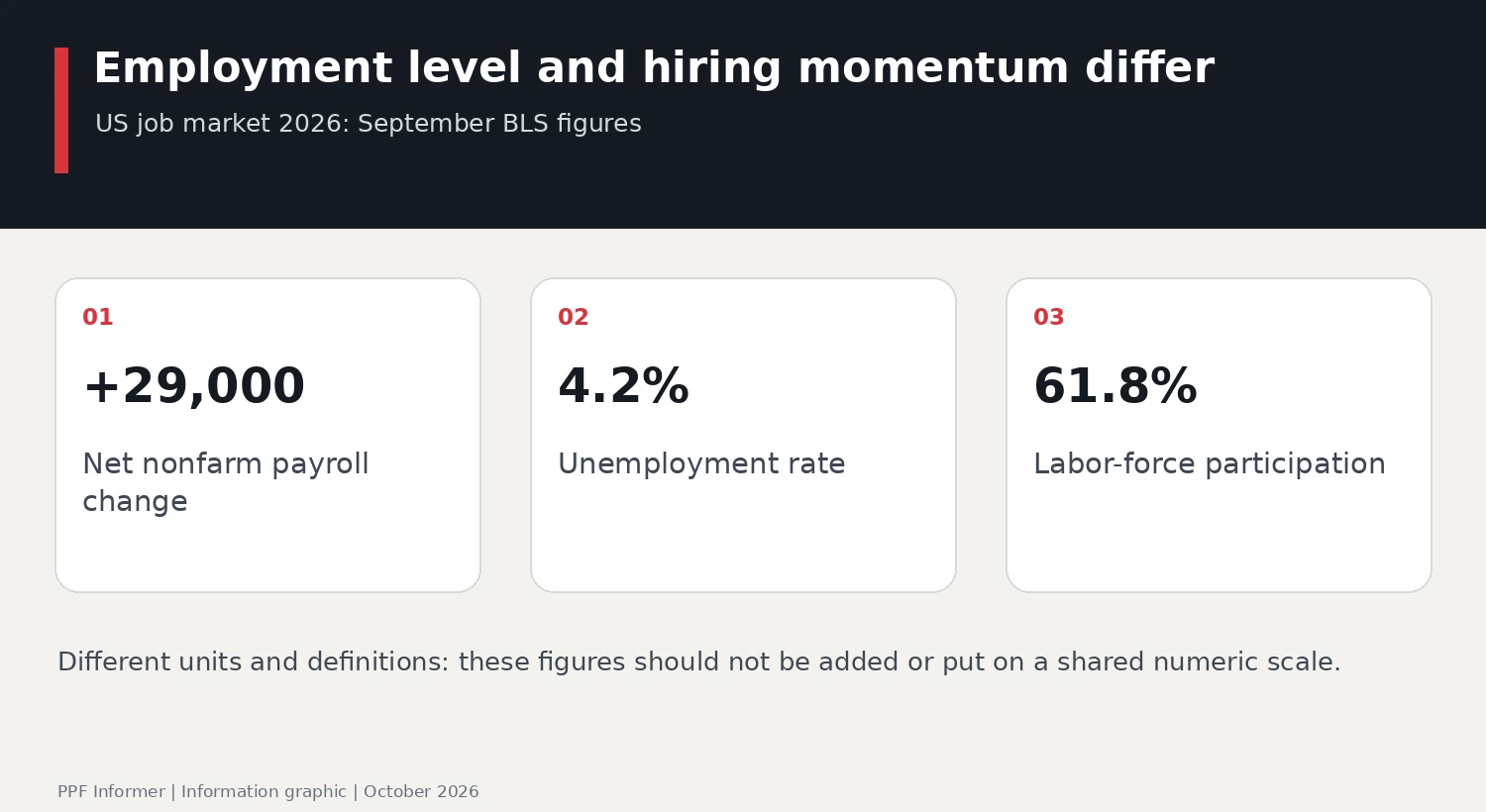
US job market 2026 update: Employers added 29,000 nonfarm payroll jobs in September 2026 while the unemployment rate was 4.2%, according to the Bureau of Labor Statistics. Those two numbers can seem contradictory: unemployment is still relatively low, yet many job seekers describe a slow, difficult hiring process.
The contradiction is mostly about the difference between employment levels and hiring momentum. A labor market can have millions of people already employed while employers simultaneously become more cautious about adding new workers.
US job market 2026: What does the September report show?
BLS reported that nonfarm payroll employment increased by 29,000 in September. The unemployment rate was 4.2%. BLS reported little change in many major industries; conditions still differed by sector.
The labor-force participation rate was 61.8%, while the employment-population ratio was 59.2%. Those figures help describe how much of the working-age population is participating in the labor market and how many are employed.
One month should never define the US job market 2026 outlook. Payroll estimates are revised, industry conditions differ, and hiring can change quickly. Still, a 29,000 payroll increase is a clear signal of slower job creation than workers experienced during stronger expansion periods.
Data note: The report was released on October 2. Its July and August payroll revisions reduced combined job growth by 60,000. Monthly estimates can change as more employer reports arrive; revisions are part of the measurement process.
Why can hiring feel slow even when the economy is still employing many people?
The simplest explanation is that employers can keep existing workers while becoming cautious about new commitments. That creates a labor market where layoffs are not necessarily surging across every industry, but hiring is also not moving fast enough to give applicants abundant choices.
Analysis: For a job seeker, cautious hiring can mean longer interview processes, more competition for attractive openings and fewer situations where companies feel pressure to hire immediately.
For employers, caution may reflect uncertainty around demand, interest rates, automation, AI investment, labor costs or company-specific budgets. The result is a market that can feel stable from inside a job and frustrating from outside one.
US job market 2026: Why 4.2% unemployment can mislead
The unemployment rate measures the share of the labor force that is unemployed and actively seeking work. It does not measure how many applications a person must submit, how long a hiring process takes or how well available openings match a worker’s location and skills.
A software engineer, retail worker and registered nurse can experience the same national unemployment rate very differently. Hiring demand is local and occupational, while the headline rate is national.
The unemployment rate also does not include every person who wants a job. BLS separately tracks people outside the labor force who say they currently want work. That broader context matters when interpreting whether a labor market feels easy or tight.
US job market 2026: What do openings and hires show?
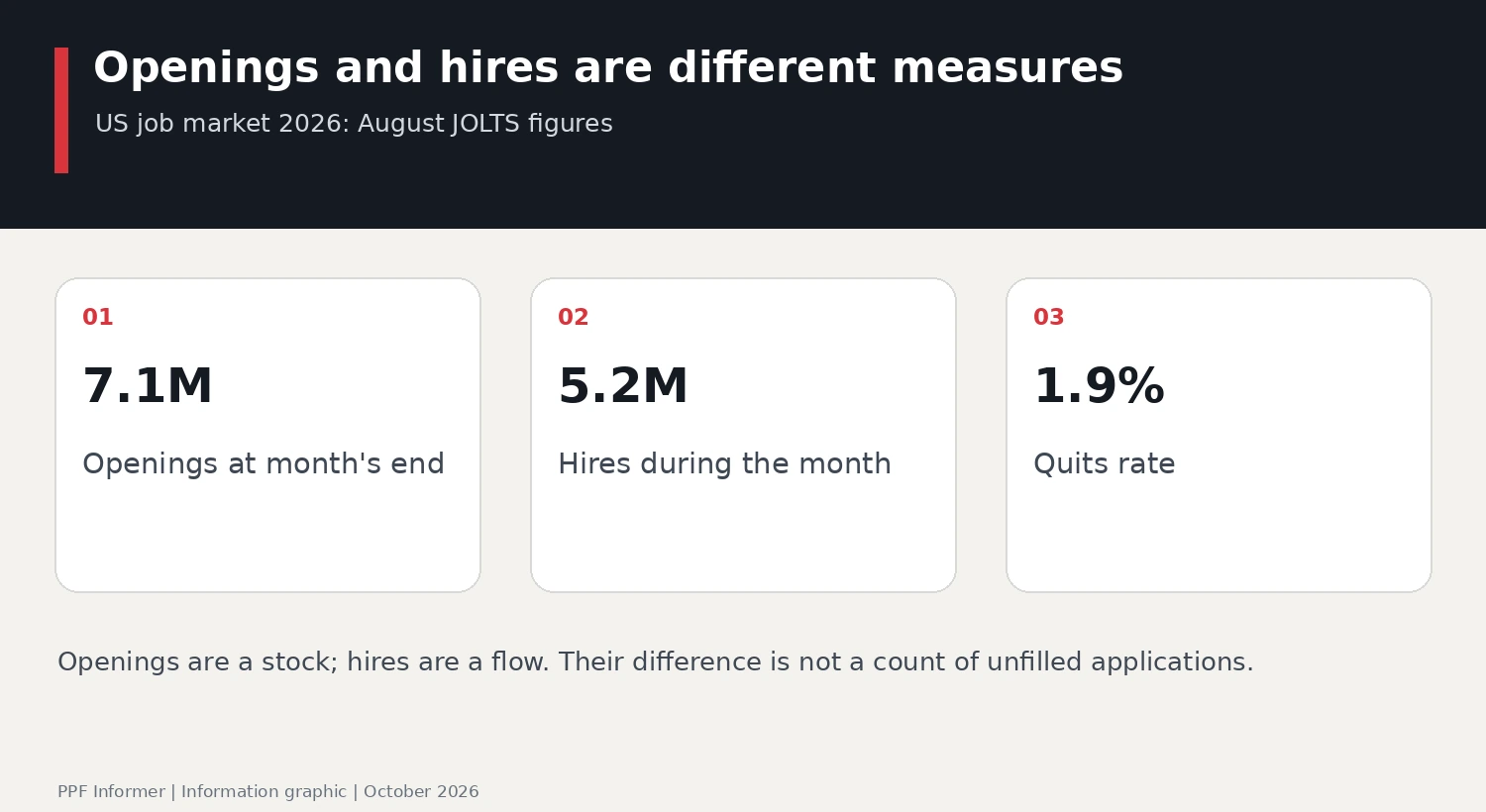
BLS’s Job Openings and Labor Turnover Survey provides another view by tracking openings, hires, quits and separations. The August 2026 release reported 7.1 million openings and 5.2 million hires. The quits rate was 1.9%, while layoffs and discharges totaled 1.6 million. These August figures should not be presented as September data.
When openings remain available but actual hires are muted, applicants may see many listings without experiencing equally strong hiring velocity. That does not automatically mean the postings are fake. Some roles are hard to fill, some companies hire slowly, and some openings remain posted while budgets or headcount approvals change.
Job seekers assessing the US job market 2026 should avoid judging conditions only by how many listings appear on a search page. The quality, age, employer activity and fit of those openings matter more.
Why job seekers report more friction
Analysis: Where openings attract many qualified applicants, employers can become more selective. The national report does not measure applications per vacancy or the number of interview rounds. That can lead to stricter screening and more steps before an offer. Automated application systems can also make the process feel impersonal, especially when candidates receive little feedback.
Another source of frustration is mismatch. A candidate may be qualified broadly but still be competing against people whose experience matches a specific stack, certification, industry or location more closely.
That is why a national labor statistic and an individual’s experience can both be true at the same time.
Remote work increases opportunity and competition
Remote and hybrid work remain important parts of the U.S. employment landscape. Analysis: The September payroll headline alone does not establish how remote hiring is changing. Candidates should examine actual work-location requirements rather than assume every role in a digital occupation is remote.
Remote roles expand the number of jobs a candidate can apply for, but they also expand the employer’s applicant pool. A position that once competed locally can now attract candidates from across the country.
For applicants, that makes differentiation more important. A generic resume may be less effective than one that clearly maps experience to the specific business problem described in the job posting.
Which US job market 2026 signals should applicants track?
Job seekers should watch several indicators together:
- Payroll growth: whether employers are adding jobs overall.
- Job openings: the number of positions employers say they want to fill.
- Hires: whether those openings are translating into actual employment.
- Quits: a useful signal of worker confidence and mobility.
- Industry employment: whether the candidate’s sector is expanding or contracting.
- Wage growth: whether employers still need to compete aggressively for talent.
US job market 2026: How should job seekers respond?
Practical guidance: Build a search around fit and feedback rather than application counts alone. Applying to hundreds of loosely matched roles can create activity without improving outcomes.
Applicants should prioritize current openings where their experience clearly matches the employer’s needs. Resume bullets should show outcomes, not only responsibilities. A strong application explains what changed because of the candidate’s work: revenue, cost, time, risk, traffic, conversion, reliability or customer outcomes.
Networking also becomes more valuable when hiring slows. A referral or direct conversation can help a candidate understand whether a role is genuinely active and what the hiring manager values most.
For professionals in technology and digital fields, demonstrating current skills matters as AI changes workflows. That does not mean every worker needs to become an AI engineer. It does mean candidates should be able to explain how they use modern tools responsibly to improve their work.
For candidates considering infrastructure roles, our cloud-native jobs guide offers occupation-specific context. National payroll totals alone do not establish demand or pay for a particular technical role.
Should workers panic about the September number?
No single monthly report justifies panic. The responsible interpretation is that U.S. hiring momentum was subdued in September while unemployment remained relatively low.
Workers should pay attention to several months of data, revisions and sector-specific signals rather than treating one release as proof of either a boom or a collapse.
What should we watch next?
The next important signals include future payroll reports, JOLTS data, wage growth, unemployment claims and company-level hiring announcements. If payroll growth remains weak while hiring and openings also decline, that would strengthen the case that the labor market is cooling more broadly.
If hiring rebounds while unemployment remains near current levels, September may look more like a soft month than the start of a deeper deterioration.
US job market 2026: Read the measures before drawing a conclusion
Data guide: Payroll employment and unemployment come from different surveys. The payroll measure tracks jobs at employers. The household survey helps describe people’s employment status. They can move differently without either survey being meaningless. A person holding more than one job is another reason that a count of jobs is not identical to a count of workers.
The US job market 2026 headline also describes a net payroll change. It is not the number of people hired during September. Employers can hire many people while other jobs end. The net change records the balance. This helps explain why a small payroll gain can coexist with millions of hires in a separate labor-turnover release.
Openings are not the same thing as immediate opportunities
August JOLTS openings are measured at the end of the month; hires cover activity throughout the month. They also describe August, while the payroll headline describes September. Do not subtract the two JOLTS totals and label the difference as jobs rejected by applicants. The measures have different timing and definitions.
For the US job market 2026, a better use of the numbers is to ask whether several signals tell a consistent story over time. Compare like measures across releases and watch revisions. A single listing on a job board belongs to a much smaller question: whether that particular employer has an active, suitable role.
Turn the US job market 2026 outlook into a focused search
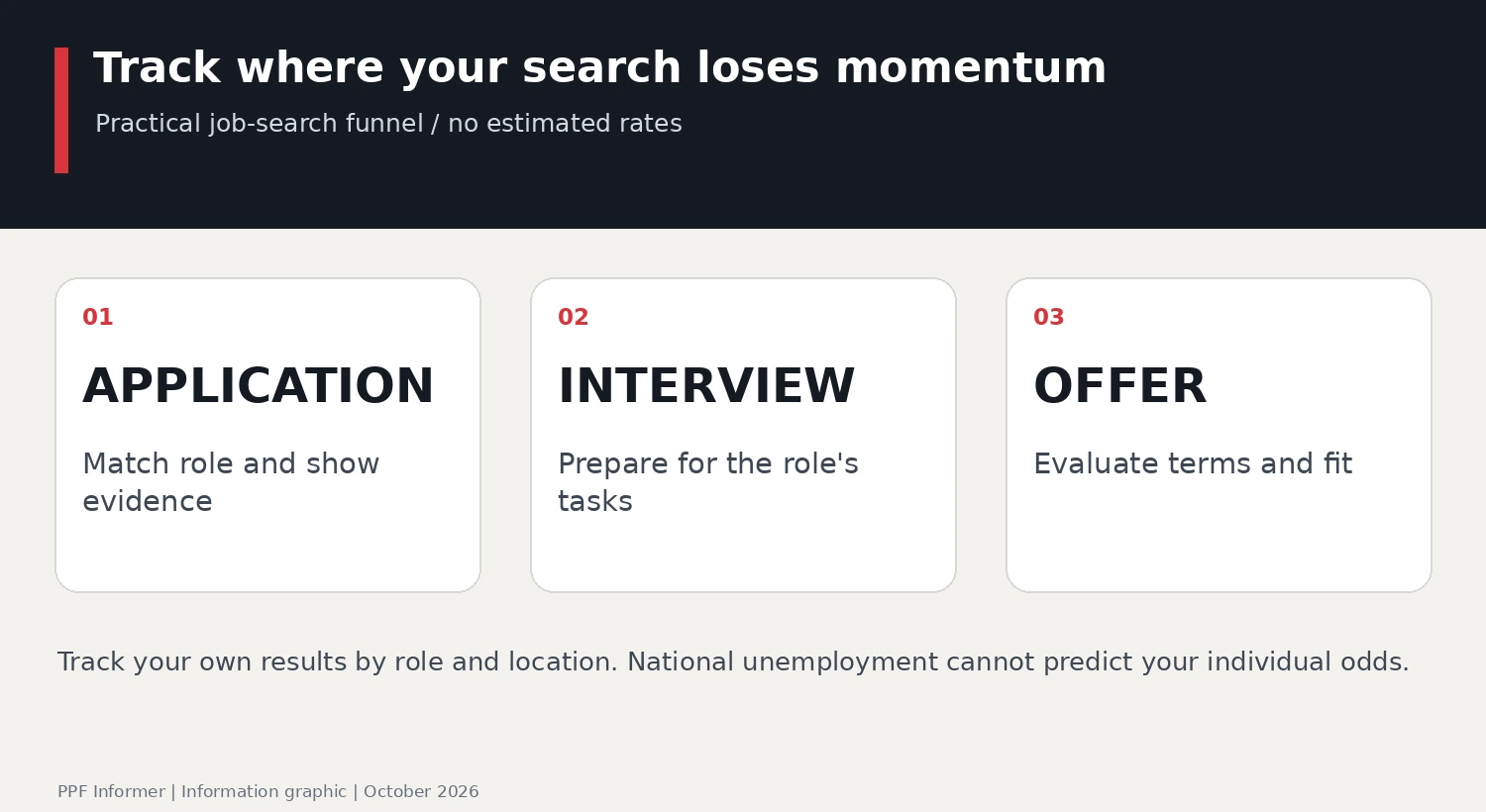
Practical guidance: Group applications by role, location and seniority. Track when you applied, whether the employer replied and where the process stopped. If you mix very different roles into one total, it becomes difficult to learn what is working. A small number of well-matched applications can provide clearer feedback than a large undifferentiated list.
When applications produce few interviews, review targeting and the evidence in your resume. When interviews produce few offers, review preparation, examples and fit for the actual role. These are diagnostic questions, not a claim that every rejection is the candidate’s fault. Employers can pause hiring or change requirements for reasons an applicant cannot see.
The US job market 2026 should inform expectations, not turn every search decision into a reaction to one release. Choose a reasonable review interval, update your approach using actual responses and preserve time for skills or work samples that address the roles you want. Record progress toward a suitable job rather than only the number of submissions.
How can applicants check a posting’s legitimacy?
Look for the role on the employer’s own careers page and verify who is contacting you. The FTC’s job-scam guidance warns about requests to pay for a job and fake-check arrangements. A difficult hiring market can make urgent promises tempting, but urgency is not evidence that an offer is real.
US job market 2026: Frequently asked questions
Does a small payroll gain mean there are no jobs?
No. A net change describes the balance of job additions and losses. It does not say that hiring stopped. For your search, occupational demand and an employer’s actual vacancy matter alongside the national headline.
Can the unemployment rate tell me how long my search will take?
No. It is a national measure, not an estimate for your experience, location or profession. The US job market 2026 can feel different to two candidates with different skills even when they read the same unemployment rate.
Should I assume AI caused every slow hiring decision?
No. The aggregate data do not assign a reason to each employer’s choice. Treat automation as a possible factor where there is specific evidence, rather than use it as a universal explanation for the US job market 2026.
What should readers check in the next release?
Look at the new payroll estimate, revisions and changes in the same supporting measures. A stronger conclusion comes from repeated evidence, not just a more dramatic headline. Keep the release month visible when comparing unemployment, openings, hires and quits.
What the numbers mean for your search
The U.S. job market can have a 4.2% unemployment rate and still feel difficult for applicants because the headline unemployment rate measures a different thing from hiring speed. September’s 29,000 payroll gain points to soft hiring momentum, which helps explain longer searches and stronger competition for desirable roles.
Source: Labor-market figures are from the U.S. Bureau of Labor Statistics September 2026 Employment Situation. Openings, hires and separations are from the August 2026 JOLTS release. Career guidance above is editorial analysis, not a measured result from these surveys.