


The AI agent economy describes an emerging shift in business software in which AI systems can do more than answer questions: they can use tools, work across applications and complete multi-step tasks. OpenAI released its Agents API in public beta on September 10, 2026. Microsoft’s September 25 Work IQ announcement described a preview starting September 30, with rollout continuing through October. These are product milestones, not proof that most companies have already adopted autonomous workflows.
The important shift is from using an app to delegating an outcome. Instead of opening several tools manually, a worker may increasingly tell an agent what needs to be done and let the agent coordinate the required systems.
What is the AI agent economy?
The AI agent economy is the emerging market around software that can plan tasks, use tools and take actions on behalf of users or organizations. Traditional AI chat is mostly reactive: a person asks a question and receives an answer. An agent can continue working after the initial request.
OpenAI’s Agents API, for example, is designed for long-running cloud agents that can manage context, use tools and coordinate subagents. Microsoft is building business-data layers such as Work IQ so agents can understand enterprise context and act across business systems.
Analysis: These launches make agent infrastructure more accessible. Adoption, operating costs and reliability still need to be tested in each business.
AI agent economy: How could software use change?
Today’s knowledge worker often moves among email, CRM, spreadsheets, project management, analytics and communication tools. Every application has its own interface, data model and workflow.
An agent can potentially sit above those interfaces. A user might ask, “Find our highest-risk renewals, summarize the causes, draft outreach and update the CRM.” The agent would need to pull data, reason across it, use several tools and record the result.
That changes the role of the app interface. The software still matters, but the human may interact with it less directly. The agent becomes an orchestration layer between intent and execution.
AI agent economy: What changes for SaaS companies?
Software companies have traditionally competed for user attention: better dashboards, easier workflows and more daily engagement. Agents introduce a different competition. A product may need to be easy for an AI system to use, not only easy for a person to click.
That increases the importance of APIs, structured data, permissions, reliable actions and machine-readable documentation.
A SaaS product that integrates well with major agent platforms could gain distribution even if users spend less time inside its native interface. A product that remains closed may risk being bypassed when customers prefer automated workflows.
Distribution could become more important than the interface
Before the emerging AI agent economy, software distribution depended on search, app stores, sales teams and ecosystems. Agent platforms may become another distribution layer.
If a user asks an agent to complete a task, the agent may select among available tools. That raises a new business question: how does a software company become the trusted tool an agent chooses?
The answer may involve technical integrations, reliability, pricing, security certifications and reputation rather than traditional brand marketing alone.
AI agent economy: How could software pricing change?
In the AI agent economy, seat-based pricing still assumes a person is the primary user of software. Agents complicate that model. One employee could delegate work to several agents, or one agent could perform tasks across multiple systems.
Analysis: An agent can perform more work without adding another employee seat. Vendors may therefore consider consumption or task pricing alongside subscriptions. This is a possible business-model change, not a pricing policy shared by every vendor.
Future pricing may blend subscriptions, agent seats, task volume, compute usage and outcomes. Different software categories will adapt differently, but the basic economic unit is likely to become more flexible.
AI agent economy: Why governance matters
Model layer: Businesses also need to distinguish model access from workflow control. Our Reflection Beam AI explainer examines open weights, coding-agent evaluation and the infrastructure needed for deployment.
As agents gain access to enterprise systems, the risks become more serious. An agent that can draft an email is useful; an agent that can send payments, change customer records or modify production infrastructure requires much stronger controls.
Organizations need identity, permissions, audit logs, approvals, data boundaries and monitoring. Microsoft’s Work IQ announcement describes governed actions that follow required approvals and operate within the user’s permissions. Businesses should verify the controls of each product rather than assume that the word ‘agent’ guarantees safe execution.
This is likely to become a major software category in its own right: businesses will need systems not only to build agents, but also to govern them.
What does the AI agent economy mean for small businesses?
For a concrete industry example, see our coverage of Canary Technologies’ AI use in hospitality. A specific service workflow is a more useful comparison than a broad claim that agents can automate an entire business.
Small businesses may benefit because agents can reduce the amount of manual coordination required across sales, support, marketing and administration.
A small team could use agents to summarize leads, prepare follow-ups, reconcile information across systems or generate routine reports. The value is not necessarily replacing an employee. It is reducing repetitive work that consumes limited staff time.
The challenge is avoiding automation that is too complex for the business to supervise. Small companies should start with narrow workflows where inputs, permissions and success criteria are clear.
Will apps disappear?
Probably not. Interfaces remain important for oversight, configuration, exceptions and complex decisions. But the amount of time users spend navigating menus could decline.
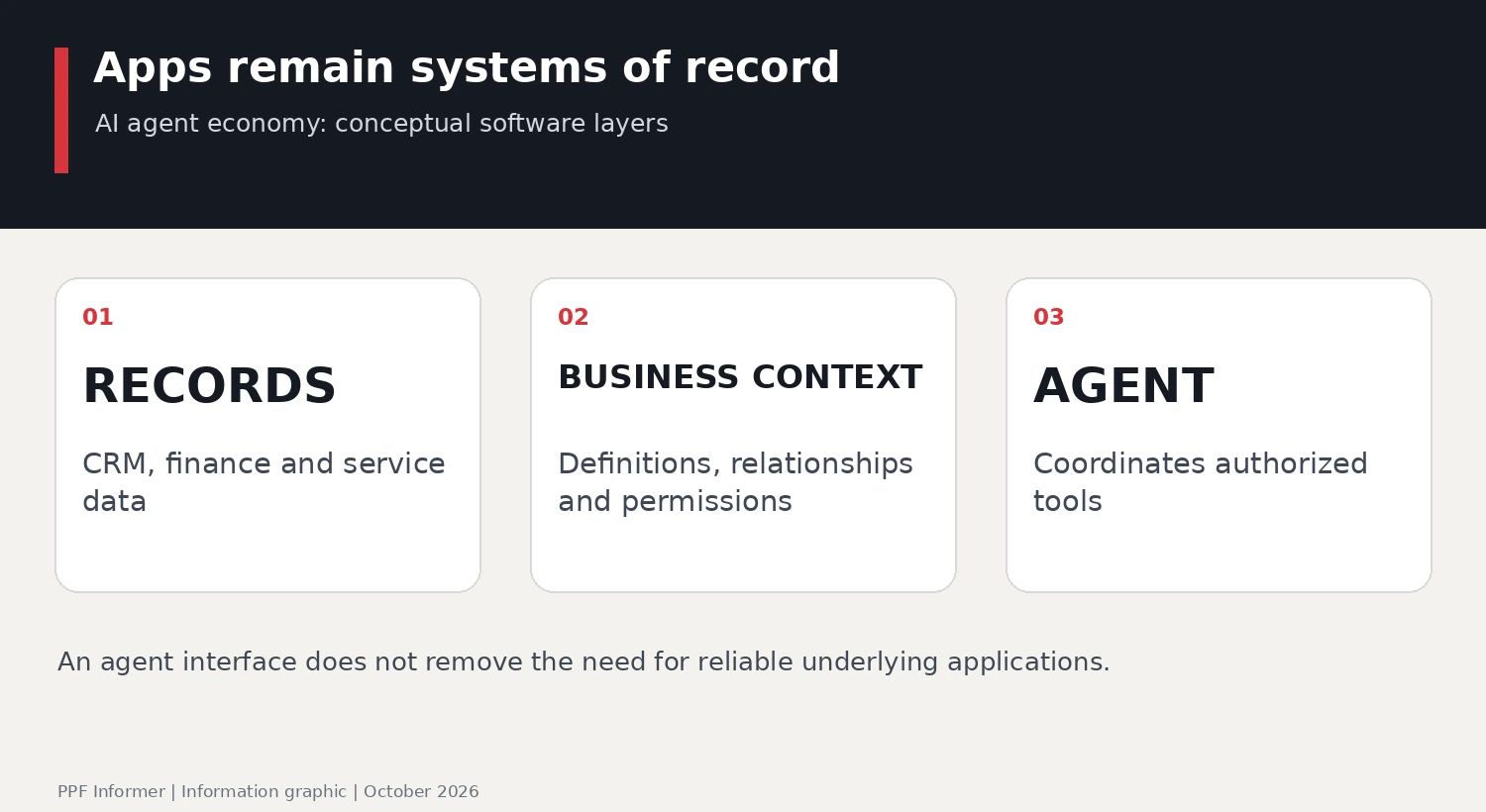
Applications may increasingly become systems of record and action behind an agent layer. Human interfaces will remain, but they may no longer be the only—or even primary—way work is initiated.
AI agent economy: How to evaluate a pilot
Practical guidance: Choose one repeatable task with a clear output: a renewal summary, an internal support draft or a reconciled report. Record how long the task currently takes and how often a person must correct it. Give the agent only the access required for that task.
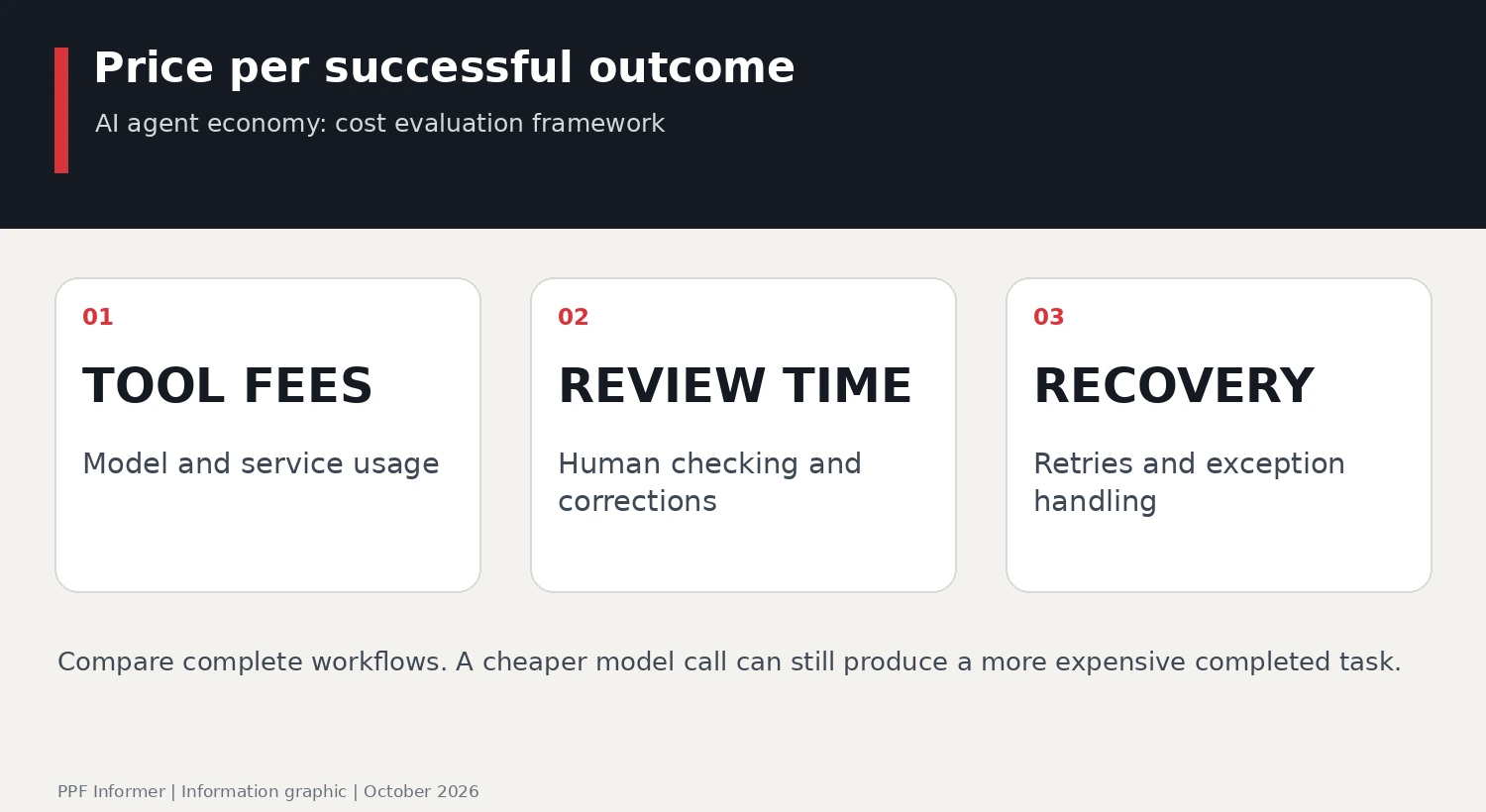
Compare completed work, not demonstration speed. Include setup, tool fees, failed runs and review time. A task that takes less machine time can still cost more if a manager must inspect every result. Agree on a stop condition before expanding the pilot.
Keep customer communications and material record changes under review until the team has evidence that the workflow behaves reliably. A system that can propose a useful action is valuable even when it is not ready to execute that action alone.
What comes next?
The next stage will be defined by interoperability, reliability and economics. Businesses will want agents that work across tools without exposing sensitive data or creating uncontrolled actions.
Software vendors will need to decide whether to build their own agents, expose their capabilities to outside agents, or do both.
As that competition develops, the winners may not simply be the companies with the most impressive chat experience. They may be the companies whose data, actions and governance fit naturally into agent-driven workflows.
AI agent economy: Build a business case around completed work
Business analysis: Start with a task that a person can define and check. Specify the input, acceptable output, permitted systems and stopping point. A request to automate an entire department is hard to evaluate because it hides many separate decisions. A defined task makes it possible to compare an agent with the existing workflow.
In the AI agent economy, the relevant cost is the cost of a successful outcome. Include model and tool usage, human review, setup and recovery from failures. A low price per model call does not establish a low price per completed task. Conversely, a more expensive call can be worthwhile if the complete workflow needs fewer corrections.
Use an exception case before approving a larger pilot
Try incomplete records, contradictory instructions and an unavailable tool. Decide what the agent should do in each case before testing it. Asking for review or reporting a blocked task can be the correct outcome. Counting only uninterrupted demonstrations can hide the situations that create the most operational risk.
For an AI agent economy pilot, keep an execution record with the requested task, tools used, proposed changes and final result. The record should help a person understand what happened without reconstructing the entire conversation. It should also identify a partial result so that a retry does not duplicate an action.
Permissions are part of the product, not an afterthought
Illustrative workflow: A renewal assistant might read account information, prepare a summary and propose a follow-up. Sending the message or changing commercial terms can require a separate approval. The example is a way to define scope, not a claim that every product implements the same approval rules.
The AI agent economy becomes more useful when systems distinguish between reading, proposing and executing. Those stages can share context while having different permissions. A person should be able to see the intended change and its target before approving a consequential action. The underlying system must enforce that boundary rather than rely only on wording in a prompt.

Keep the source application authoritative
A CRM or finance application still holds records that other people and processes depend on. An agent’s summary should not quietly become a competing source of truth. Link decisions back to the relevant records and preserve their existing ownership, validation and access rules. Otherwise, an apparently convenient interface can create conflicting business data.
In the AI agent economy, integration quality therefore matters beyond the number of connected tools. Check whether an action respects required fields, whether it reports failure accurately and whether repeated requests can be handled safely. A connector that reads data successfully may still need separate validation before it can modify that data.
Questions a buyer should ask an AI agent vendor
- Which task is supported today, and which features are still planned?
- Which systems can it change, and under whose permissions?
- Where are approval and cancellation boundaries enforced?
- What happens when a tool times out or returns incomplete data?
- How are costs, completed tasks and failures reported?
- Can the team export its records and move to another provider?
These questions test a specific product’s operating behavior. The AI agent economy is not a single platform with one standard definition of a task, one price or one reliability guarantee. Read the actual service terms and test the workflow you need before treating a broad product category as a purchasing specification.
AI agent economy: Practical questions
Is every chatbot an agent?
No. A conversational interface can answer questions without using tools or taking action. The distinction that matters for a business is what the system is authorized and able to do, not the name used in its marketing.
Will agents eliminate software subscriptions?
That is not established. Vendors may introduce task, usage or outcome pricing, but applications still provide records and capabilities. The AI agent economy could change how those services are purchased without making every existing subscription disappear.
What would show that a pilot is ready to expand?
Repeated useful results, manageable exceptions, enforceable permissions and a cost advantage after review time would support expansion. A fast demonstration alone would not. Treat growth in the pilot as a decision based on evidence rather than a necessary consequence of adopting an agent.
What is established, and what is still a forecast?
Confirmed: Agent infrastructure and business-context previews are available from major vendors. Outlook: They could change the center of gravity in business software. The core question is shifting from “Which app should I open?” toward “What outcome should I delegate?” That transition affects SaaS distribution, pricing, interfaces, security and the way companies organize digital work.
Sources: Agent infrastructure and enterprise-adoption context are based on OpenAI’s Agents API announcement and Microsoft’s official Work IQ announcement.