

Google’s Project Suncatcher has moved from a research concept to an in-orbit experiment. On October 1, 2026, a prototype satellite built with Planet launched aboard SpaceX’s Transporter-18 mission. Google says it has established contact with the satellite and that it is operating as expected.
The long-term goal is ambitious: test whether space could eventually host scalable machine-learning infrastructure. In other words, Google is exploring whether some future AI compute could move off Earth and run in orbital satellite networks powered largely by sunlight.
What is Project Suncatcher?
Project Suncatcher is Google’s research moonshot exploring whether machine-learning compute could be scaled in space. The concept involves solar-powered satellites equipped with Tensor Processing Units, or TPUs, connected into a larger computing network.
Project Suncatcher was announced in 2025 as an early research effort. In 2026, Google progressed to an orbital test. The current prototype is not a space data center. It is a research satellite intended to collect real-world information about how AI hardware behaves under the physical conditions of space.
Project Suncatcher: Why put AI computing in space?
AI infrastructure requires enormous amounts of electricity, cooling and physical capacity. As models and workloads grow, companies are spending heavily on data centers, power-generation agreements and transmission infrastructure.
Space offers a radically different environment. Satellites can access sunlight for much longer periods than ground-based solar installations, and they do not need to compete for terrestrial land in the same way.
The trade-off is obvious: nearly every other part of operating hardware becomes harder. Launching equipment is expensive. Repairs are difficult. Radiation is stronger. Communication links have physical limits. Heat management is complicated because space is a vacuum.
The biggest attraction: access to solar power
Google’s 2025 research overview says a solar panel in the right orbit could be up to eight times more productive than on Earth. That does not mean an orbital computer automatically gets eight times the usable energy of a terrestrial data center, but it highlights the energy opportunity.
Ground-based solar power is interrupted by night, weather, atmosphere and geographic constraints. Carefully designed orbital systems can spend more time in sunlight and avoid clouds.
If solar collection, storage and compute can be integrated efficiently, space could potentially provide a new location for energy-intensive workloads without placing the same demand on local terrestrial grids.
Why the engineering is much harder than the concept sounds
An AI data center on Earth can replace a failed server, add cooling capacity or send technicians into a rack. An orbital system cannot assume any of those conveniences.
Hardware must survive launch vibration, radiation, temperature cycles and a vacuum. Components must operate reliably for long periods with limited physical servicing.
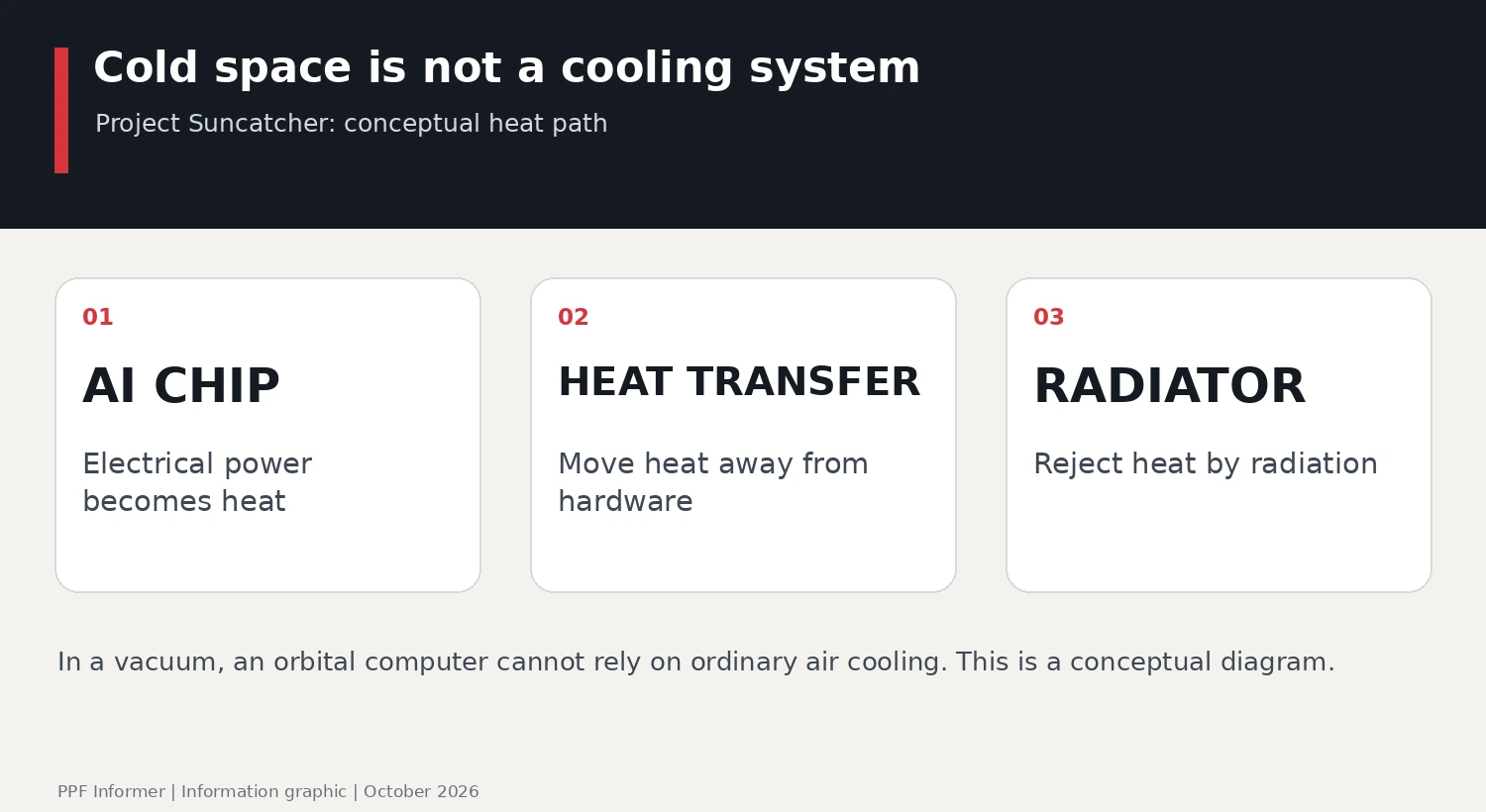
Thermal management is especially counterintuitive. A cold surroundings temperature does not provide air cooling in a vacuum. NASA’s thermal-control reference explains that heat exchange with the outside environment is driven by radiation. Moving heat from a chip to a radiator and then rejecting it remain design constraints.
Another challenge is mass. Every kilogram sent to orbit costs money and affects launch planning. Terrestrial data centers can use heavy power and cooling equipment that would be impractical to launch.
Can modern AI chips survive space radiation?
That is one of the questions Project Suncatcher’s current mission is designed to answer more directly. Google’s prototype will gather data on how TPUs respond to radiation and thermal extremes during real spaceflight.
Earth’s atmosphere and magnetic environment shield ground hardware from much of the radiation present in space. In orbit, energetic particles can damage electronics or cause transient errors. NASA’s radiation guidance distinguishes single-event effects from cumulative dose effects; a successful short test does not establish lifetime reliability.
Engineers can mitigate those risks through shielding, redundancy, error correction and hardware design, but every mitigation adds weight, complexity or cost. Real in-orbit data is therefore much more valuable than relying only on laboratory tests.
How would an orbital AI network work?
A future Project Suncatcher system would likely require many satellites rather than one giant spacecraft. The satellites could carry compute and energy hardware while using high-speed links to exchange data.
That creates a distributed-computing problem at orbital scale. Workloads would need to be divided, scheduled and synchronized across moving nodes.
Communication between satellites may eventually rely heavily on optical links because laser-based systems can move large amounts of data without traditional radio-spectrum constraints. But maintaining reliable alignment and network performance across a dynamic constellation is difficult.
The system would also need ways to move data between Earth and orbit. Some AI workloads can tolerate delay; others cannot. That means orbital compute would not be equally suitable for every application.
Would latency make space AI useless?
Not necessarily. Low Earth orbit is much closer than geostationary orbit, so communication delay can be lower than many people assume. Still, terrestrial fiber remains the better choice for many latency-sensitive workloads.
Orbital compute could be more attractive for workloads that are highly parallel, energy-intensive and less dependent on instant interaction with an end user.
Training, batch inference, scientific simulations or space-native sensing are examples of workloads researchers may evaluate differently from interactive consumer chat.
Could space-based AI ever be cheaper?
The baseline remains infrastructure on Earth. Our cloud computing guide provides context for the hosting and scaling services an orbital system would eventually need to compete with.
Today, terrestrial data centers are overwhelmingly more practical. They benefit from mature supply chains, repair access, fiber networks and established electricity infrastructure.
Project Suncatcher’s economics could change only if launch costs fall substantially, satellite manufacturing becomes more standardized, orbital power advantages are large enough and the hardware can operate for long periods without service.
Another factor is terrestrial power scarcity. If AI demand creates severe grid constraints in major data-center regions, alternatives that currently look expensive may become more competitive.
Environmental questions will matter too
Project Suncatcher does not remove environmental impact. Satellites must be manufactured and launched, and large constellations raise questions about orbital debris, astronomy and end-of-life disposal.
Any serious comparison between terrestrial and orbital AI infrastructure would need to examine the full lifecycle rather than only the electricity used during operation.
Why Google is testing Project Suncatcher now
Moonshot research works by testing the hardest assumptions early. Google does not need to know that orbital AI will definitely become commercial before learning whether the underlying hardware can survive and operate effectively.
The Project Suncatcher prototype is therefore valuable even if giant orbital compute clusters remain years away. It can provide data about radiation, thermal behavior, communications and hardware reliability that simulations cannot fully capture.
How to judge the next Project Suncatcher results
Editorial analysis: A launch milestone answers a different question from a computing milestone. Getting a satellite into its intended environment is necessary, but it does not by itself tell us how much useful work the chips can complete. Readers should look for results that connect hardware behavior to actual workloads.
The first useful measure would be sustained operation. Can the system complete a workload repeatedly, not merely turn on once? Reporting should distinguish a short successful run from an extended operating period. Both are useful evidence, but they support different conclusions about reliability.
The next measure would be error handling. A chip that detects an error and repeats a calculation may remain useful, yet the repeated work uses time and energy. Performance should therefore include retries and recoveries. A headline about chips surviving radiation would leave an important gap if it omitted whether their outputs remained dependable.
Thermal behavior is another separate test. A computer might finish a brief task and then need to cool before the next run. That can be appropriate for an experiment, but a future service would need to explain its duty cycle: how much of the available time is spent doing useful computation. Peak performance alone would not answer that question.
Finally, a distributed system would need end-to-end results. Moving information between nodes, synchronizing work and returning outputs are part of computing, not optional extras. A demonstration that works on one processor should not be described as evidence that a large orbital cluster will have the same economics.
What a fair comparison with Earth should include
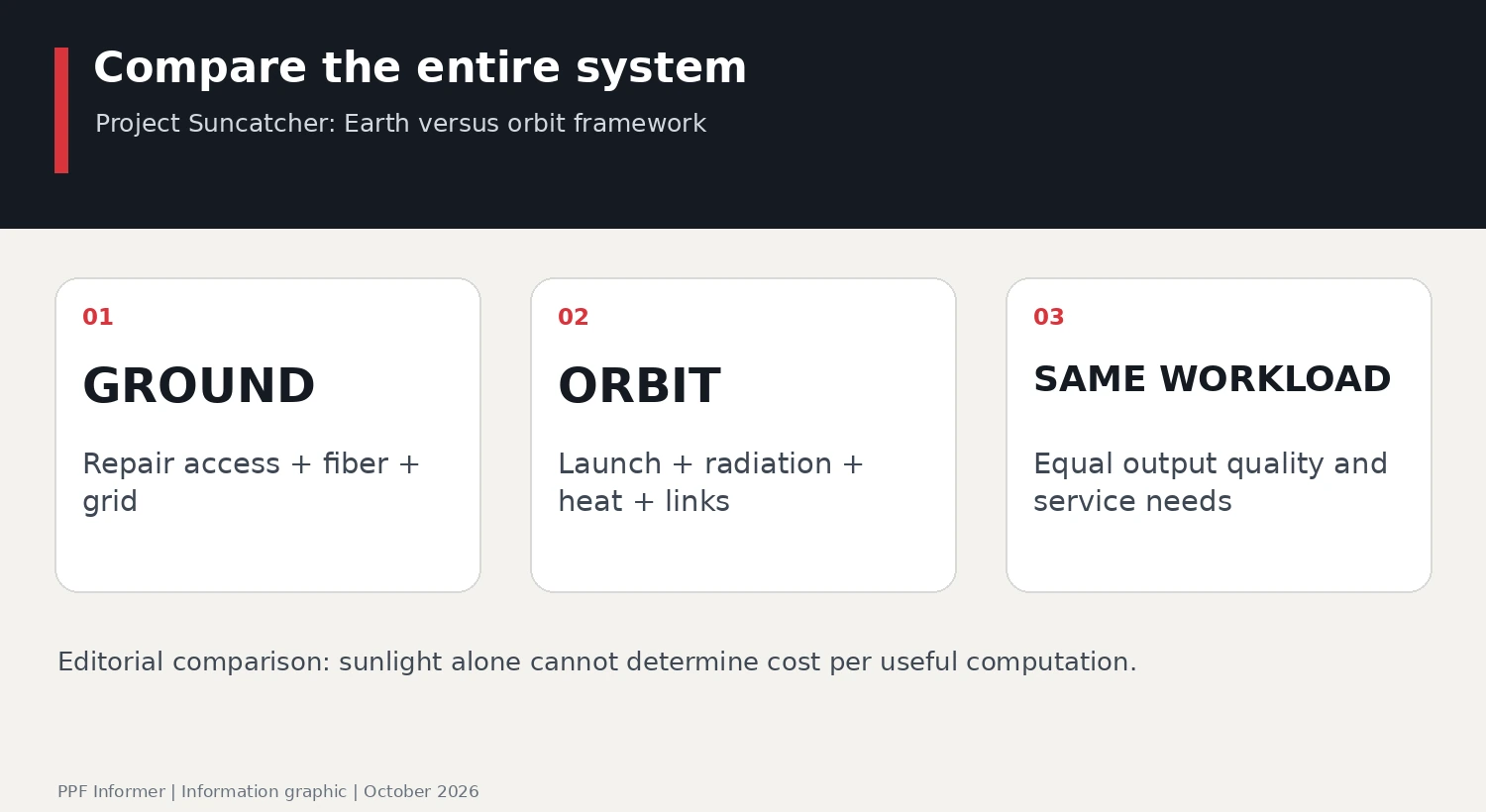
Analysis: An orbital proposal and a terrestrial facility should be compared using the same workload, output quality and service requirements. Comparing a satellite’s energy supply with a ground facility’s entire operating budget would mix unlike measures.
A useful comparison would include hardware, launch, power collection, communications, ground operations, replacement capacity and the cost of failed or interrupted work. It would also identify which costs are measured and which are assumptions about future prices. A projection based on cheaper launches is a scenario, not a present-day price quote.
Hardware upgrades deserve their own treatment. A ground operator can replace equipment in stages. An orbital operator would need a plan for introducing new capacity and retiring older equipment. That affects both financial returns and the amount of material that must be launched over time.
The customer question is equally important: what specific task benefits enough to justify the added complexity? A successful research satellite may create scientific value even when a commercial service is not yet attractive. Those two outcomes should be evaluated separately rather than forced into a single success-or-failure headline.
What readers should watch for next
Look for published workload results, measured operating limits and clear explanations of what the mission did not test. Follow-up experiments that address several nodes, communications or longer-duration operation would answer different questions from this first launch.
No published launch confirmation should be read as a promise that ordinary cloud workloads will soon move off Earth. The useful story is the progression from a design to evidence. Each result can narrow uncertainty without settling every issue, and a limitation discovered in orbit can be as valuable for the research program as a successful test.
Project Suncatcher: What is the realistic timeline?
There is no credible reason to expect ordinary AI data centers to move into orbit soon. Project Suncatcher is still a research program, and Google describes it as a long-term moonshot.
The next few years are more likely to involve experimental satellites, specialized hardware tests and increasingly complex demonstrations.
Outlook: A commercial orbital AI infrastructure network would require major advances in launch economics, power systems, thermal engineering, networking, chip reliability and regulatory coordination.
So the useful way to view Project Suncatcher is not as an imminent replacement for terrestrial data centers, but as an experiment testing whether a new infrastructure category could eventually exist.
Project Suncatcher: A reader’s evidence checklist
Technical guide: Separate the spacecraft milestone from the computing milestone. Google’s launch update confirms a prototype in orbit and contact with it. Sustained workload performance, multi-node scaling and a commercial service are additional claims that need their own evidence. The diagram shows that distinction rather than presenting all three as completed steps.

Why does orbital cooling require a radiator?
A running processor produces heat. In a vacuum, that heat must be moved through the system and rejected through radiation. Project Suncatcher therefore faces a cooling-design problem even in cold surroundings. The useful measurement is how the hardware behaves during continued operation, not merely the temperature of the environment around it.
Does more sunlight prove cheaper AI computation?
No. Project Suncatcher would need to account for launch, equipment, communications, operations and replacement as well as collected energy. The comparison must use an equivalent workload and service requirement. A solar-power opportunity is one input to that comparison, not its conclusion.
What would make the next Project Suncatcher update useful?
Measured runtime, error handling, useful completed work and stated limits would help readers judge progress. Results should identify what was directly measured and what remains a projection. A smaller experiment can resolve an important engineering uncertainty without proving that a full commercial orbital network is ready.
What this first mission can tell us
Project Suncatcher is significant because Google has taken the concept of space-based AI compute into orbit with a real hardware experiment. The potential advantage is access to abundant solar energy and a new physical location for future computing capacity. The obstacles—radiation, heat, networking, launch cost and maintenance—remain enormous.
Sources: Mission status and technical context are based on Google’s October 1, 2026 Project Suncatcher update and Google’s official Project Suncatcher research materials.