


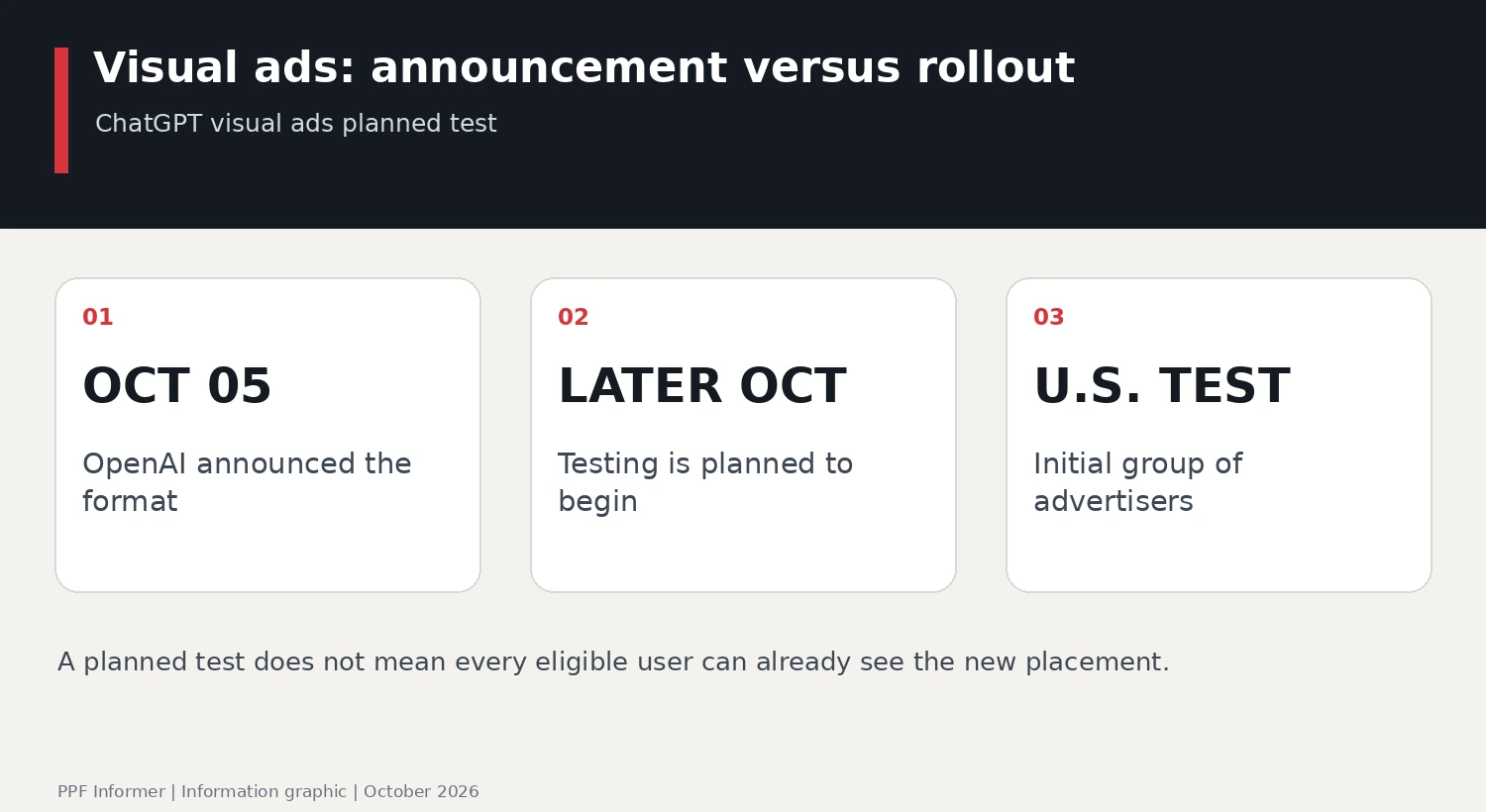
ChatGPT visual ads will begin testing in the United States later in October 2026, initially during image generation. OpenAI announced the format on October 5. The company says these sponsored visuals will be labeled and kept separate from the image a user creates. This is an announced test, not a feature already available to every U.S. user.
The announcement is important because ChatGPT is increasingly becoming a place where users research products, compare options and make decisions. That creates a new type of advertising environment: ads can appear closer to an active decision process rather than only beside a search result or social feed.
What are ChatGPT visual ads?
The ChatGPT visual ads announcement describes sponsored images showing products, services or experiences. Initial testing will involve a selected group of advertisers during ChatGPT image generation. OpenAI has not announced an exact start date or a universal rollout date for this format.
The company is also expanding advertising measurement and developing additional brand-suitability tools. Those additions are meant to give businesses more confidence about campaign performance and the contexts in which their ads appear.
Who may see the ads?
OpenAI’s current user-facing ads FAQ says ads may appear on Free and Go accounts. Plus, Pro, Business, Enterprise and Edu accounts remain ad-free. Accounts identified as belonging to people under 18 are excluded.
Those are the broader ads eligibility rules. They do not mean every eligible account will receive the new visual placement as soon as testing begins. Availability and the presence of a relevant ad can vary.
ChatGPT visual ads: What changes for users?
The most visible change with ChatGPT visual ads is that ads may become more visually expressive. Instead of relying only on text, an advertisement can use a richer presentation when the format is relevant to the user’s exploration.
OpenAI says ads remain separate from the assistant’s answers. The company also states that conversations remain private from advertisers and that users retain control over their ad experience.
Analysis: That separation matters because users may treat an assistant’s output as task guidance. A paid placement needs to be recognizable at a glance. The new format therefore puts additional attention on clear labeling, relevance and the boundary between sponsored content and the assistant response.
Why the new format matters for brands
For advertisers, AI conversations offer a different signal from traditional browsing. A person may be comparing products, planning a purchase, learning about a service or narrowing a decision inside a single conversation.
That does not mean every conversation should become commercial. It does mean that when a commercial intent is already present, an advertiser may be able to reach a user at a more useful moment.
Brands evaluating ChatGPT visual ads will likely care about three things: whether the placement is relevant, whether people engage with it, and whether the environment is suitable for the brand. OpenAI’s measurement and suitability work is aimed directly at those questions.
How advertising measurement is expanding
OpenAI says it is expanding measurement tools and partnerships. Independent measurement is important because advertisers need more than impressions. They want to know whether placements lead to attention, consideration and eventually business outcomes.
OpenAI’s measurement announcement covers tools for connecting campaigns to actions such as purchases, leads and sign-ups. It also describes early work on incrementality: whether advertising causes additional business outcomes rather than merely receiving credit for them. Brand suitability pilots with DoubleVerify and Integral Ad Science are being developed; these are not a guarantee that every placement has already passed an independent audit.
Those challenges include context. A search ad typically sits next to a short query and a list of results. An AI conversation can include many turns, changing intent and sensitive personal context. Measurement therefore has to be useful without turning private conversations into advertiser-accessible data.
What OpenAI says about privacy and answer independence
OpenAI’s stated advertising principles include three points that matter most to users: answers remain independent, conversations remain private, and users remain in control.
OpenAI says its advertising systems are separate from the chat model and that advertisers cannot shape, rank or alter answers. However, privacy from advertisers does not mean conversation context is never used to match an ad. Its advertiser documentation describes contextual matching and, when enabled, personalization signals.
Users should check the labels on ChatGPT visual ads. A sponsored item is commercial content even when it appears in a highly relevant context. Treating it as an advertisement, rather than as part of the assistant’s neutral answer, remains the right mental model.
ChatGPT visual ads: What can users control?
Eligible users can manage personalization through Ad Controls, dismiss a placement, report it or view why it appeared. Turning personalization off does not remove advertising; current-chat context can still inform ad selection. Controls and availability depend on region and account eligibility.
Practical takeaway: Treat a sponsored product as a paid suggestion. Compare its price, suitability and seller terms with other options before acting. Seeing an advertisement does not establish that the item is the best answer to your original request.
What this means for the wider digital experience
Analysis: Advertising has followed users from print to web search, then to social feeds, streaming platforms and creator ecosystems. Conversational AI is becoming the next interface where that transition is playing out.
The difference is that AI tools often sit deeper in a task. A user might ask for help comparing laptops, planning a trip or choosing software. A relevant ad in that flow could be useful, but it could also become intrusive if the platform fails to protect trust.
That creates a difficult product-design problem. The best advertising experience will need to be clearly labeled, limited, relevant and easy to dismiss. Too much commercial pressure could reduce the usefulness of the underlying assistant.
What should businesses do now?
Related analysis: Advertising changes how a business reaches a customer; agents change how software completes work. Our AI agent economy guide examines that separate shift in workflows, pricing and business evaluation.
Businesses interested in the channel should avoid treating ChatGPT Ads as just another display placement. The stronger approach is to think about the decision users are trying to make and whether the advertised product genuinely helps with that task.
Creative assets may also need to change. A visual ad designed for a conversation should explain value quickly and clearly rather than depend on a long landing-page funnel to create context.
ChatGPT visual ads: A user’s verification checklist
Practical guide: First identify what you are looking at. A generated image fulfills your request. A sponsored placement promotes an advertiser. A helpful-looking product image does not stop being an ad because it appears near an AI task. Check the label and the destination before deciding whether to click or buy.
For ChatGPT visual ads, OpenAI says the sponsored visual will remain separate from the image being created. That is a statement about the planned format. It should not be interpreted as a promise that every version of the interface will look like an unofficial mockup shared online. The diagram below explains the boundary rather than claiming to reproduce the final screen.

Check the announcement date and actual availability
The ChatGPT visual ads announcement is dated October 5, with an initial U.S. test planned later in the month. If a post claims that all users already have the feature, compare it with the announced rollout. Test eligibility, subscription eligibility and seeing a particular ad are three separate things.
A person can be on an eligible plan without receiving every experimental format. A person can also see advertising in ChatGPT without seeing this new visual placement. That distinction prevents an existing text advertisement from being mistaken for proof that the October image-generation test has started for everyone.
Privacy, personalization and ad removal are different controls
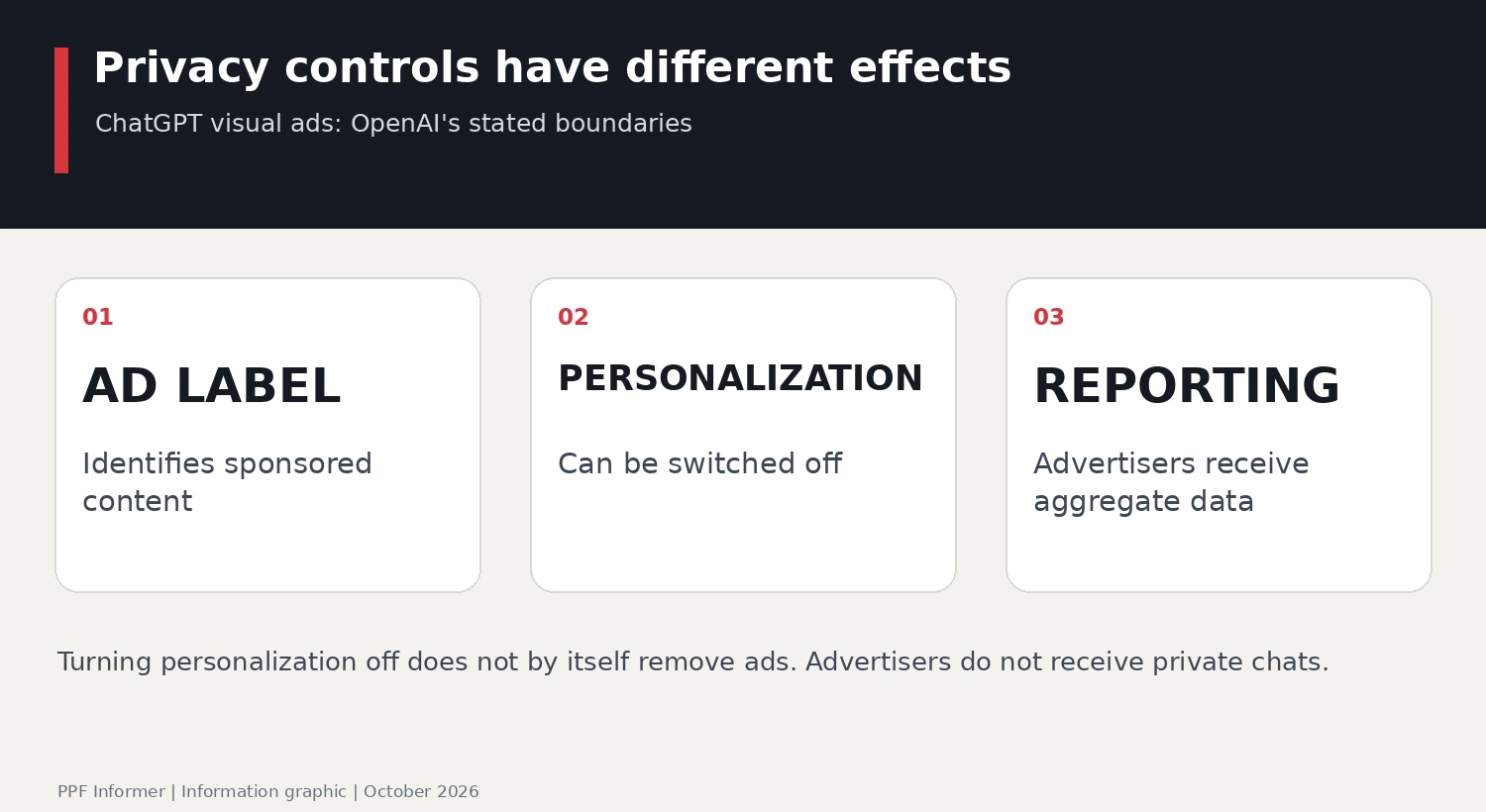
The OpenAI help page says turning personalization off still allows ads based on the context of the current chat. That switch limits the use of other signals; it is not an ad-removal switch. Readers should check the description of the control they are changing rather than infer its effect from its name.
OpenAI also describes an Ads-Free option for eligible Free users with lower usage limits and reduced feature access. Its availability depends on the test region and account. That is another distinct choice, alongside an ad-free paid plan. This article is explaining the tradeoff, not recommending a subscription purchase.
For ChatGPT visual ads, the privacy question has two parts. What information can the platform use to select an ad? What information does an advertiser receive? OpenAI’s stated privacy boundary says advertisers do not receive private conversations. That does not mean a chat’s context has no role in ad selection. Those claims concern different data flows.
Treat a sponsored offer as a commercial claim
Check the actual seller, price and terms on the landing page. Do not assume that the assistant has independently verified every claim inside an advertisement. A label helps identify commercial content, but the user’s evaluation of an offer still matters. Save the relevant terms if the decision involves a meaningful purchase.
What brands should measure before expanding a test
Marketing analysis: A campaign can generate clicks without generating useful customers. Before testing ChatGPT visual ads, define what counts as a business result: a qualified inquiry, a completed order or another action that can be checked in the advertiser’s own system. Keep the definition stable while comparing creative versions.
Attribution asks which interaction receives credit for an observed result. Incrementality asks whether the campaign created results that would otherwise not have happened. A reporting dashboard can help with the first question without settling the second. Do not treat a low attributed acquisition cost as automatic proof of causal business lift.
For a small ChatGPT visual ads test, record spend, qualified outcomes and the review period. Include repeat customers separately when the business is trying to acquire new customers. These are recommended evaluation steps, not performance figures from the October rollout. No return-on-investment estimate for your business can be inferred from the format announcement.
Match the landing page to the visual claim
A product image may suggest a use, setting or benefit that needs explanation. Make the destination clear about what is sold, what is included and any important limitations. A visually appealing placement with a confusing page can create attention without confidence. Brands should review the ad and landing page as one customer journey.
ChatGPT visual ads also create a suitability question for advertisers. A relevant commercial topic can become sensitive as a conversation develops. OpenAI says its placement guardrails and brand-suitability work address that environment. Advertisers should check which controls are available to their account instead of assuming that every announced pilot is a finished product.
ChatGPT visual ads: Questions to ask during the rollout
Can advertisers buy a better answer from ChatGPT?
OpenAI says advertising does not influence the assistant’s answers. A sponsored visual is a separate commercial placement. If you want to judge an answer, examine its evidence; if you want to judge an ad, examine the seller’s claims and terms.
Are ChatGPT visual ads automatically a new growth channel?
No format guarantees demand, conversions or profit. The right question is whether a controlled test reaches a relevant audience and produces verified outcomes at an acceptable cost. Early availability may also be limited, so a business should not build a launch plan around access it has not confirmed.
What would count as a meaningful update?
Confirmed availability, published control changes or clearer measurement documentation would add useful evidence. Another announcement about ChatGPT visual ads is not necessarily proof of a broader rollout. Check what changed, who can access it and which claims remain the company’s stated plans.

How to read a small ChatGPT visual ads test without overstating it
Measurement guide: Write down the outcome definition before the campaign starts. If the goal is a qualified inquiry, a form submission is only the first event. Someone still needs to check whether the inquiry matches the business’s qualification rules. If the goal is a completed purchase, distinguish an order from a canceled order or refund. Changing the definition after seeing results makes the comparison harder to trust.
For ChatGPT visual ads, keep campaign spending and verified outcomes in the same period and scope. Cost per verified outcome is campaign cost divided by the number of those outcomes. When there are no verified outcomes, report that fact rather than display a misleading acquisition cost. A small test with one outcome can also be highly sensitive to that single result.
Return on ad spend uses attributed revenue relative to ad spending. It is not the same as profit. Product costs, fulfillment, returns and other expenses can change whether a campaign is worthwhile. Those concepts apply to evaluating a channel; they are not measured performance claims about OpenAI’s October test.
Check the comparison before drawing a conclusion
A test that changes the creative, audience, offer and landing page at once cannot clearly identify which change caused an observed difference. Keep a record of the versions used. Note when an offer changes or a tracking problem occurs. This is especially useful during a format rollout, when access and product behavior may still be developing.
For a ChatGPT visual ads evaluation, compare equivalent outcome definitions and avoid mixing new customers with all customers when acquisition is the goal. A campaign may receive credit for a returning buyer who was already planning to purchase. That possibility is why attributed results and incremental results answer different questions.
Also identify the observation window. Some users buy quickly; others return later. A short report can therefore miss later outcomes, while an excessively broad window can assign credit too generously. Use the measurement settings actually available to the account and describe their limits. Do not invent a universal conversion window for a format whose full rollout details remain unconfirmed.
What belongs in a useful pilot report?
A useful report states the dates, eligible audience, creative versions, spending and outcome definition. It then reports verified results and the main uncertainties. If the sample is small, say so. If a tracking issue prevents a reliable conclusion, preserve that limitation instead of filling the gap with a forecast.
For ChatGPT visual ads, separate format observations from business conclusions. A clear label or relevant visual can improve the experience without proving a profitable campaign. A positive campaign result can be promising without establishing that every business will benefit. The next decision should depend on what the test measured, which conditions may change and whether another controlled test can resolve the remaining uncertainty.
ChatGPT visual ads: What remains uncertain?
OpenAI has confirmed the planned U.S. testing window and the initial image-generation setting. It has not confirmed a broad launch date, a global rollout timetable for this visual format, or how often each user will encounter it. Outlook: Future expansion is possible, but it should be treated as a possibility rather than an announced schedule.
Source: Details are based on OpenAI’s official October 5, 2026 announcement.