

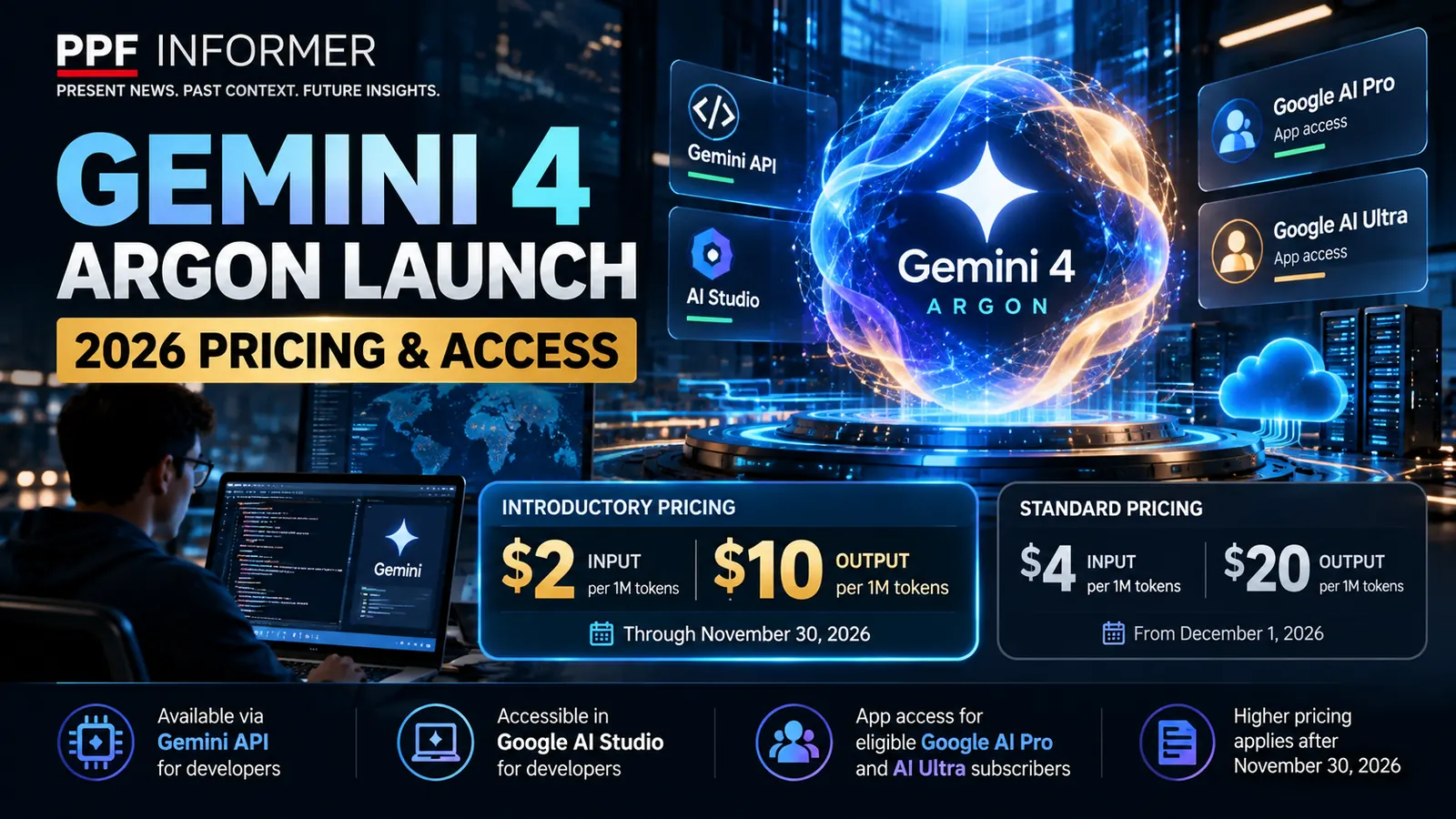
The Gemini 4 Argon launch on October 13, 2026, brings Google’s frontier AI model to developers, enterprises and eligible Google AI subscribers. Here is what the release actually changes, how much its API costs and what remains unverified.
Gemini 4 Argon launch: What changed on October 13?
The Gemini 4 Argon launch marked Google’s October 13, 2026 announcement, positioning it as a frontier AI model for complex, multi-step work. The company says it is available through the Gemini API, Google AI Studio and enterprise products, with access for eligible Google AI subscribers in the Gemini app, AI Mode in Search and Antigravity. This is a product launch, not a promise that every user or every country receives identical features at the same time. Availability, account tiers and regional terms matter. For U.S. readers, the immediate news is that developers and businesses can now evaluate a newly released model against their existing systems rather than waiting for a future preview. Google describes applications spanning software engineering, financial analysis, legal work, cybersecurity and scientific tasks. These are categories of potential use, not guarantees of accuracy in regulated or high-stakes decisions.
What does Gemini 4 Argon cost?
The Gemini 4 Argon launch includes introductory API pricing of $2 per million input tokens and $10 per million output tokens through November 30, 2026. The published standard prices after that date are $4 and $20 respectively. Cached input tokens are listed at a 95 percent discount during the introductory period. Token pricing is not the same as the final cost of an application: longer prompts, generated output, tool calls, repeated attempts, orchestration and monitoring can all change a project’s bill. An organization processing many documents should test representative workloads before estimating a monthly budget. Google AI subscription access and enterprise contracts can have separate conditions from direct API billing. Developers should check the current pricing and model documentation before committing production spending, particularly because the introductory rates have a defined expiration date.
Who can use it now?
The Gemini 4 Argon launch offers several access routes, but eligibility differs by product and plan. API users can look for the model identifier gemini-4-argon in the Gemini developer platform. Business customers can evaluate it through Google Cloud offerings. Eligible paid subscribers may encounter Argon inside Google’s consumer and work products. That does not make all experiences interchangeable. An API call may offer a different interface, control surface, quota or privacy setting from an end-user app. A business should verify data-handling terms for the specific product it chooses, not infer enterprise protections from a consumer demonstration. For a developer comparing platforms, the practical first step is a small, reproducible test set using prompts from the actual workflow. Test output correctness, latency, tool use, failure handling and costs rather than relying on the marketing description alone.
Why is Google emphasizing complex work?
For teams evaluating the Gemini 4 Argon launch, many real tasks require more than a single answer. A software agent may need to read a repository, plan changes, run tests, inspect failures and revise code. A finance assistant may need to compare documents while preserving numerical context. A legal research tool must distinguish a relevant source from a plausible-sounding invention. Google says Argon is tuned for deeper multi-step reasoning and claims strong performance on specialized evaluations, including the Vals Index. Benchmark leadership is a vendor-reported claim until readers inspect methods and independent reproductions. Performance can also vary across languages, domains and prompts. In the United States, the most important operational question is whether the model improves a measurable task such as successful test completion, verified citations or human review time. Bigger benchmark numbers alone do not answer that question.
How does the model affect coding and agent tools?
Google says Argon can be used in Antigravity and other developer environments, where an AI assistant can carry out connected steps rather than only generate snippets. For software teams, the attractive use cases include identifying bugs, drafting changes, explaining code and preparing tests. None of these should bypass code review or access controls. An agent with permission to edit files, call APIs or change cloud resources can make costly mistakes even when its explanation sounds confident. Teams should begin in a sandbox, limit credentials, record actions and require approval for destructive changes. Evaluate not just the first attempt but how reliably the agent recovers from a failed command or ambiguous requirement. A model that performs well on isolated code questions may still struggle with large repositories and long-lived sessions.
What does it mean for businesses?
For enterprises, the Gemini 4 Argon launch adds another candidate for internal assistants, document analysis and workflow automation. Its value will depend on integration, governance, reliability and the amount of employee time it actually saves. Buyers should compare it with models already deployed, using the same tasks and scoring rules. They should also review whether confidential data can be processed under the intended product terms. Financial, legal and healthcare workflows deserve especially careful human oversight because a convincing but incorrect answer can have real consequences. Google highlights early enterprise users and a program for vetted cybersecurity defenders. Such examples show interest and deployment pathways, but they do not prove every organization will see the same gains. A cautious pilot with a defined success metric is more informative than a broad rollout driven by launch excitement.
What remains unproven?
Independent evaluations after the Gemini 4 Argon launch will help clarify where this model performs best and where it falls short. Open questions include hallucination rates on specialized U.S. documents, consistency across long workflows, real-world inference latency and how costs change after the promotional period. Vendor comparisons can depend on selected test sets, prompting strategies and access to tools. Readers should distinguish three levels of evidence: Google’s published specifications are verifiable statements about its product; Google’s benchmark results are company claims; and future adoption or productivity effects are predictions. No single score establishes superiority across every task. Organizations should preserve the ability to switch providers when practical and avoid building critical workflows around undocumented behavior. The model’s usefulness will be judged by what users can repeat, not by one Gemini 4 Argon launch-day demonstration.
What should U.S. developers do next?
For teams following the Gemini 4 Argon launch, first read the official model card, developer guide and pricing page for the product being used. Second, assemble a representative evaluation set that includes difficult cases, failures and sensitive inputs. Third, measure quality, speed and cost against the current baseline. Fourth, test permissions, logging, data retention and escalation to a human reviewer. Finally, review the published November 30 pricing cutoff before projecting longer-term economics. For consumers, check the Gemini app or subscription details rather than assuming free access. For businesses, start with a narrow task where errors can be caught and benefits measured. Gemini 4 Argon is a notable new entrant in the frontier-model market; whether it is the right choice is a question for controlled testing, not marketing slogans.
Related coverage and official sources
For related coverage, read our Google Gemini Agent for Work guide and Claude Haiku 5.5 analysis. Those products have distinct capabilities and access terms.
Primary references: Google announcement and Google Cloud pricing and access details.