

Updated October 11, 2026.
Claude Haiku 5.5 pricing and features: October launch
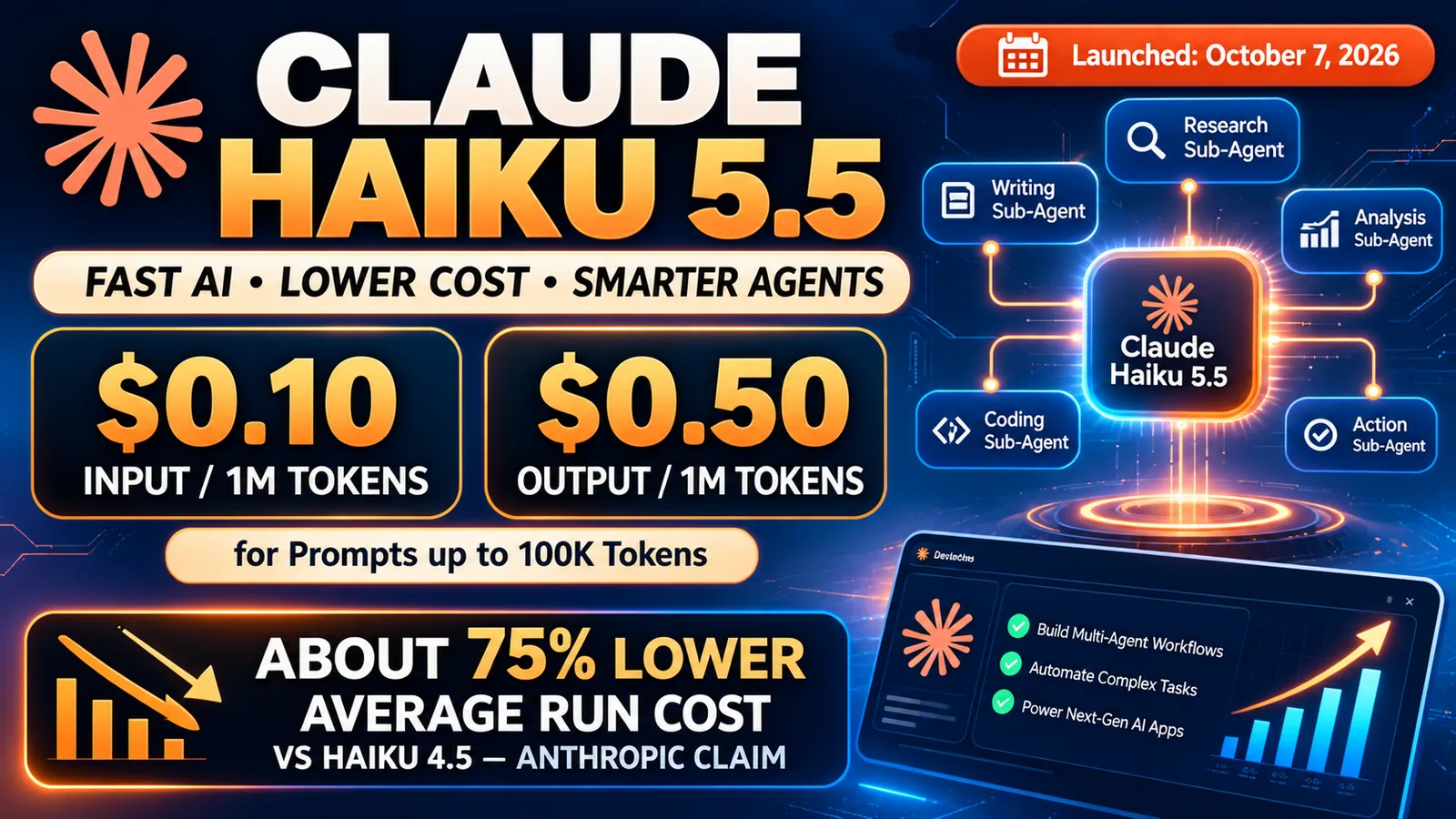
Claude Haiku 5.5 pricing and features: Anthropic introduced Claude Haiku 5.5 on October 7, 2026, positioning it as its fastest and most capable small model. The release targets high-volume tasks such as document summaries, classification, data lookups, customer support and smaller steps within larger AI-agent workflows. Anthropic says the model costs around 75% less to run on average than Haiku 4.5, but that percentage is the company’s claim and depends on the workload.
For Claude Haiku 5.5 pricing and features, the significance is not that a small model suddenly replaces every frontier model. It is that developers can choose a faster, lower-cost system for routine work and reserve larger models for the difficult decisions. That split can make an automated application more responsive and reduce wasted inference spending.
What is Claude Haiku 5.5?
Haiku is Anthropic’s lightweight model family. Haiku 5.5 is designed for tasks where speed, predictable cost and high throughput matter more than maximum reasoning depth. In an application serving thousands of customers, even a small reduction in latency or token cost can change what features are economically practical.
Examples include sorting incoming support requests, extracting fields from documents, checking database records, summarizing messages and providing short answers in a customer-facing interface. The model can also act as a helper, or subagent, to a more powerful system handling an extended task.
That does not make it appropriate for every workload. Complex software engineering, high-stakes decisions and tasks requiring extended reasoning may still benefit from a larger model and additional human checks. Choosing a model should start with a test set that reflects real customer requests.
Claude Haiku 5.5 pricing and features: API costs
For prompts up to 100,000 tokens, Anthropic lists Haiku 5.5 at $0.10 per million input tokens and $0.50 per million output tokens. Cache reads are listed at $0.01 per million tokens and cache writes at $0.125 per million tokens for that prompt tier. Pricing changes for prompts above 100,000 tokens, so users should consult the current model pricing table before budgeting.
Anthropic compares these figures with Haiku 4.5, which it lists at $1.00 per million input tokens and $5.00 per million output tokens. The company also reports average run costs around 75% lower, reflecting more than the headline per-token difference. Total cost depends on token usage, caching, retries, tool calls and how much work an agent performs.
Claude Haiku 5.5 pricing and features can encourage developers to process more data or run more frequent checks. That is useful, but it also makes cost controls important. A loop that calls a model thousands of unnecessary times can still be expensive even if each call is cheap.
Claude Haiku 5.5 pricing and features for AI agents
Agentic software often divides a large task into smaller steps. A coordinating model may decide what needs to happen next, while specialist helpers retrieve information, classify records, format outputs or check whether a tool result is usable. Not every step needs the most powerful available model.
Claude Haiku 5.5 pricing and features make it suited to those lower-cost roles. Anthropic says it pairs well with its Sonnet 5.5 and Opus 5.5 models as a subagent on coding work. For a developer, that suggests a workflow in which a larger model plans a change while a smaller one searches documentation, summarizes logs or extracts details from files.
The Claude Haiku 5.5 pricing and features approach can reduce average cost, but benefits must be measured. More subagents can also introduce coordination overhead, additional tool calls and error propagation. A good evaluation compares the entire task’s accuracy, elapsed time and expense, not only the speed of an individual model response.
What early evaluations show—and what they do not
Anthropic’s announcement includes customer reports from organizations testing Haiku 5.5 on practical workflows. Some customers describe improved classification, document question answering or faster responses compared with earlier small models. These are useful signals, but they are not a substitute for independent testing on a new user’s own data.
One example in the launch materials concerns a CRM audit task where Anthropic reports strong average results across three runs. Another customer describes improved performance on a set of document queries. Those examples show why the company emphasizes business workloads rather than only general chat benchmarks.
Benchmark scores depend on the task definition, scoring rules, prompts and tools provided. A model that excels at extracting a date from a contract may still struggle with a multi-hour software project. Teams should create a representative test set, include failure cases and record how often a human must correct the output.
The bigger models still have a role
Anthropic explicitly distinguishes Haiku 5.5 from Sonnet and Opus on complex agentic coding. Larger models remain better suited to some long-horizon engineering tasks and decisions that require more careful reasoning. A cheaper model is not automatically a better model if mistakes create costly downstream work.
Consider a support system that uses Haiku to label an incoming issue, retrieve the right help article and draft a response. That can be a reasonable first layer. If the issue involves billing disputes, sensitive account changes or ambiguous instructions, a stronger model or human reviewer may be appropriate.
The same principle applies to coding. Haiku may help gather context and perform routine transformations, while a larger model handles architecture and final verification. The best routing policy depends on how much a mistake costs and whether the workflow can detect it before acting.
Sonnet 5.5 cache pricing also changed
The launch included a separate pricing change for Claude Sonnet 5.5. Anthropic cut the model’s cache-read price by half to $0.10 per million tokens, saying this can reduce the cost of many agentic workloads by around 20%. This is distinct from Haiku 5.5’s own pricing and should not be mixed into a single model comparison.
Prompt caching matters when an application repeatedly uses the same instructions, reference documents or project context. Reusing cached material can reduce redundant processing. The actual savings depend on how often requests share context and how the provider bills cache creation, storage and reads.
Developers evaluating the update should calculate costs using their real input lengths, output lengths, cache-hit rates and expected request volumes. A small spreadsheet can be more reliable than applying a marketing percentage to every request.
Availability and developer tools
Anthropic says Claude Haiku 5.5 is available through its platform and supported cloud partners, including Amazon Web Services, Google Cloud and Microsoft Azure. On Anthropic’s platform, the model identifier is claude-haiku-5-5. Availability, permissions and regional access can differ across providers.
The company also announced updates to its Python and TypeScript SDKs that add beta support for computer use and browser use. These features expand the ways a model can interact with software, but they also increase the importance of permission boundaries, action logs and user approval for sensitive operations.
Separately, Anthropic announced monthly API credits for eligible Max and Team subscribers. Those credits have plan-specific conditions; they should not be interpreted as universal free API access. Developers should check their own plan and billing dashboard before launching a production workflow.
Safety and privacy questions developers should ask
Anthropic says Haiku 5.5 improves alignment compared with Haiku 4.5 and applies cybersecurity and biology safeguards. It also notes that its cyber safeguards differ from those on some larger models. Those are provider-described safety measures, not a guarantee that every output is accurate or that every integration is secure.
When connecting any AI model to email, customer records or financial systems, start with least-privilege access. Give the model only the data and tools needed for the current task. Require explicit confirmation before irreversible actions and log important decisions for later review.
For customer-facing use, protect private data, avoid putting secrets in prompts, and review retention and compliance terms with the actual hosting provider. A model’s quality benchmark cannot answer whether a particular business deployment meets legal or security requirements.
How Haiku 5.5 fits the open-versus-closed model race
Haiku 5.5 is a hosted model offering, while some competing systems publish weights that developers can deploy themselves. Those are different product choices. Hosted models can reduce operations work and provide managed updates; open-weight models may provide more control over hosting and customization.
For a separate example of the open-weight approach, see PPF Informer’s earlier analysis of Reflection Beam’s 501-billion-parameter model. Beam’s scale and deployment needs are very different from Haiku’s small-model economics, but both releases reflect demand for capable models that can serve practical agent workloads.
Businesses should compare capability, total cost, latency, governance, vendor dependence and operational effort. The winning choice may be a combination of models rather than a single system used for every task.
Who should test it first?
Teams reviewing Claude Haiku 5.5 pricing and features for high-volume repetitive work are natural early candidates. Customer-support departments can test classification and short replies; analytics teams can test data extraction; developers can try it for documentation searches and codebase summaries. These tasks have measurable success criteria and can be reviewed before any external action is taken.
Begin with a sample of real but appropriately sanitized tasks. Measure accuracy, latency, total tokens, tool calls and escalation rate. Compare the new model against the existing workflow. If the smaller model saves money but doubles the number of human corrections, the apparent savings may disappear.
Once the results are reliable, expand gradually and keep a fallback for difficult cases. This staged approach is more useful than deploying a new model to every customer interaction on the strength of launch-day benchmarks alone.
Frequently asked questions
Is Claude Haiku 5.5 available now?
Anthropic says it is available on its platform and through supported cloud providers as of October 7, 2026.
Is Haiku 5.5 better than Sonnet 5.5?
Not universally. Haiku emphasizes speed and cost for smaller tasks; Sonnet remains stronger for some complex agentic work.
Does Haiku 5.5 cost less than Haiku 4.5?
Yes, according to Anthropic’s published API pricing. Total application savings depend on workload and usage patterns.
Can it be used in browser automation?
Anthropic announced beta SDK support for browser and computer use, subject to the relevant platform features and safeguards.
Bottom line
Claude Haiku 5.5 is a timely example of a broader AI shift: the practical value of a model depends on the work it can complete reliably per dollar and per second. The model’s low pricing and subagent focus may help developers build more affordable automation, but claims about performance should be tested in production-like conditions.
For another recent AI model aimed at a different workflow, read our Google Gemini agent for work coverage. These products target different use cases.
Primary source: Anthropic’s October 7, 2026 Claude Haiku 5.5 announcement and pricing table.