

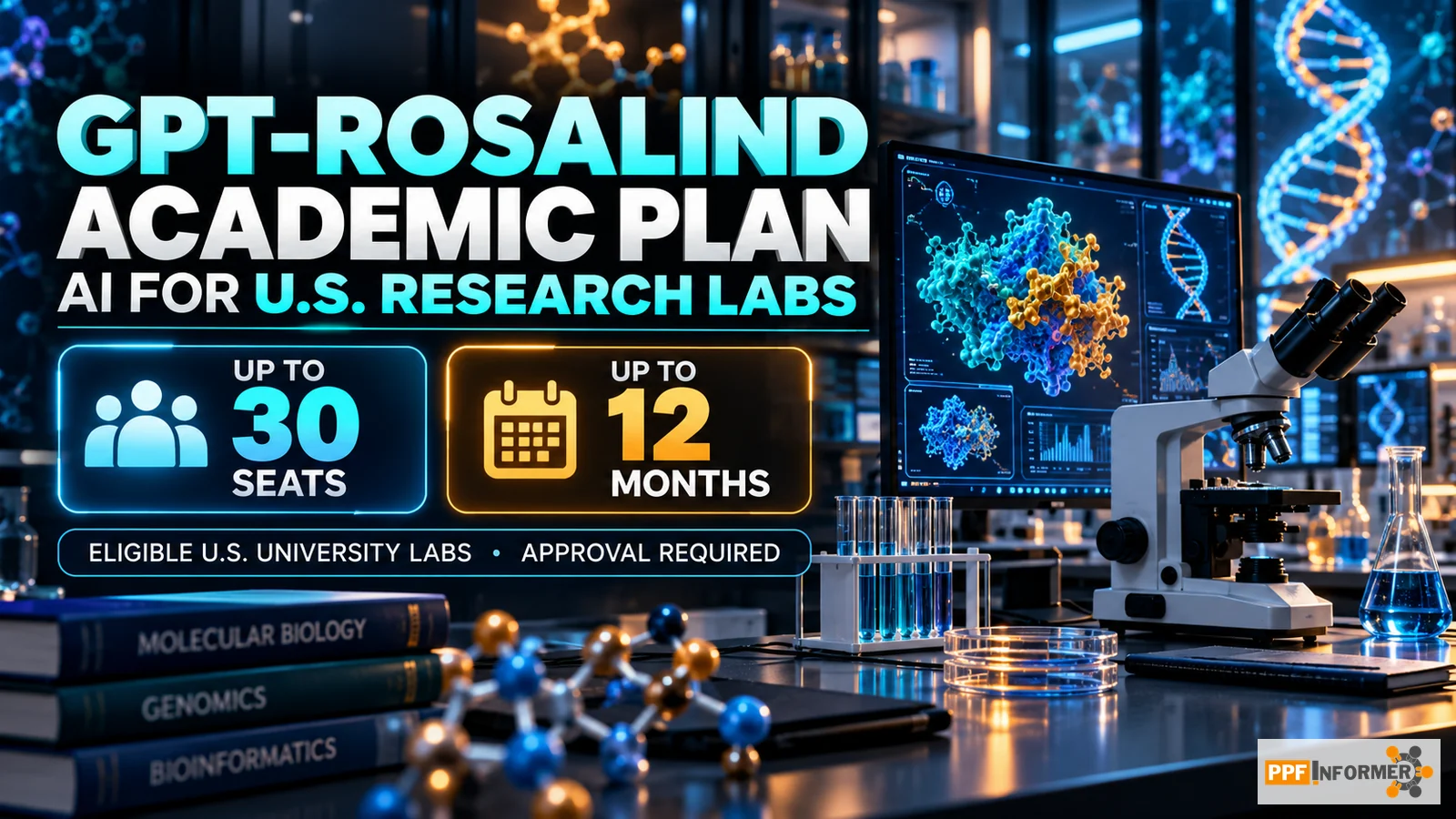
GPT-Rosalind Academic Plan, announced October 15, 2026, offers eligible research laboratories at U.S. universities up to 30 Business Standard seats at no charge for as long as 12 months. The program also offers access to GPT-Rosalind, a specialized AI model for life-sciences research, but that access requires separate trusted-access approval. It is not an unrestricted public release, and API access is not included.
The GPT-Rosalind Academic Plan gives American scientists a lower-cost route to experimenting with advanced research tools. For readers outside university research, the announcement is not a new free ChatGPT tier or a consumer medical product. The details matter because the words “free access” can conceal substantial eligibility and oversight conditions.
GPT-Rosalind Academic Plan: Who qualifies?
The GPT-Rosalind Academic Plan is a sponsored access program for qualified academic laboratories. According to OpenAI’s October 15 announcement, a verified principal investigator or laboratory lead may apply on behalf of a U.S. university lab. Approval can provide up to 30 named Business Standard seats for a maximum of 12 months, subject to plan limits and program requirements.
GPT-Rosalind itself is described as a specialized life-sciences model. Its companion Rosalind Workbench coordinates research-oriented tools across fields such as medicinal chemistry, genomics and laboratory assistance. A workbench is not a physical laboratory. It is software that helps organize information and tool use within a research workflow.
Researchers can also use other commercially available frontier models included with the plan, within the applicable usage limits. The specialized model has an additional approval gate. Institutions with an existing OpenAI Enterprise agreement must use their university’s Enterprise access route instead of the ordinary lab application.
Who can apply, and what is actually free?
For the GPT-Rosalind Academic Plan, the announced audience is academic labs at U.S. universities. The application is led by a principal investigator or lab lead, not by individual students registering independently. The stated offer is up to 30 seats at $0 per user per month for up to one year. “Up to” means a smaller lab may have fewer seats, and approval is not automatic.
It is important to distinguish the Business Standard seats from GPT-Rosalind permission. An approved lab must still receive trusted-access approval before using the specialized model. The company also says API access is not part of this academic offer. Researchers planning automated pipelines should therefore avoid assuming their existing scripts can call the model programmatically through this plan.
OpenAI says research data shared through the GPT-Rosalind Academic Plan is not used to train its models by default. That is a meaningful policy statement, but universities should still examine their own data-handling obligations, human-subjects rules, contracts and information-security policies before sharing sensitive materials with any external service.
What kinds of research could benefit?
Drug and protein discovery
A laboratory comparing possible drug molecules may need to organize chemical properties, published findings and computational hypotheses. An AI research assistant could help scientists navigate those sources and structure comparisons. It cannot replace the experimental evidence needed to establish whether a compound is safe or effective.
Genomics, diagnostics and RNA research
For labs studying the GPT-Rosalind Academic Plan, other potential applications include exploring genetic datasets, evaluating possible disease biomarkers, interpreting literature about RNA therapies and planning which scientific questions require additional evidence. In these settings, the model’s useful role is assisting the researcher’s reasoning and information workflow, not declaring a clinical diagnosis.
Vaccines, agriculture and environmental science
The announcement also identifies vaccine research, antimicrobial resistance, crop resilience, animal health and conservation as relevant areas. These subjects can involve sensitive biological information, which helps explain why the specialized model is distributed through a screened program rather than unlimited public access.
How the trusted-access review works
OpenAI says it verifies the legitimacy of the institution and the identity of the lead researcher, examines their appointment and research context, and establishes responsibilities for the laboratory lead and a designated institutional safety contact. It also describes monitoring and enforcement after activation. Those checks may add administrative work for laboratories, but they are central to how the company says it will balance legitimate science with misuse prevention.
The GPT-Rosalind Academic Plan raises practical questions for university administrators: Which datasets may be uploaded? Who is allowed to access them? How long will outputs and records be retained? Who checks AI-generated citations and code? What happens when a team member leaves? The launch announcement does not answer every institution-specific question, so local governance remains essential.
Why a specialized model is different from a general chatbot
When comparing the GPT-Rosalind Academic Plan with general chatbots, remember that those chatbots can summarize papers and explain terminology. A research-focused system is intended to connect reasoning to domain-specific tools and workflows. That may reduce the time spent switching between databases, scripts and documents. But a sophisticated interface does not turn a prediction into a measurement. In science, a proposed mechanism must still survive independent testing.
For example, a model might suggest that a change in a protein structure could alter a biological interaction. A researcher must then assess whether the underlying evidence supports the suggestion, whether alternative explanations exist, and whether the experiment can actually distinguish among them. Without those checks, a plausible answer may be no more than an attractive hypothesis.
The strongest use cases are likely to be those where researchers can trace outputs back to trustworthy data and reproducible methods. A useful question is not simply whether the system writes a convincing explanation, but whether it helps a lab reach a better, testable scientific decision.
What this means for smaller U.S. university labs
The GPT-Rosalind Academic Plan addresses a setting where compute budgets, software licenses and specialized expertise can be real barriers to exploring advanced AI. A sponsored program could let smaller teams evaluate tools without committing to a full commercial subscription for every researcher. That potential benefit is an inference from the pricing and access structure, not proof that participating labs will publish more discoveries.
Labs should plan a limited evaluation before making AI assistance central to a project. Choose a low-risk research task, define success criteria, document human review and compare the output with the team’s normal workflow. Keep a record of incorrect suggestions as well as useful ones. For an example of how AI research claims need independent checking, see our coverage of OpenAI mathematical research and proof checks. If the pilot saves time without weakening evidence standards, it may justify broader use.
What has not been demonstrated?
The GPT-Rosalind Academic Plan announcement establishes the offer and describes intended scientific uses. It does not establish that GPT-Rosalind can independently discover an approved drug, improve patient outcomes, or produce error-free research. Examples of labs exploring the technology are not controlled studies proving a universal performance advantage. Researchers should look for reproducible evaluations rather than treating marketing examples as final scientific validation.
Nor does the 12-month sponsorship guarantee permanent free access. Universities should budget for the possibility that the terms, usage limits or available products change after the sponsored period. The company has not promised that every applicant will be accepted.
How an eligible lab should prepare
Before applying to the GPT-Rosalind Academic Plan, confirm that the institution is a U.S. university and determine whether it already has an Enterprise agreement. Next, identify the principal investigator or authorized lab lead who will submit the request. Define a legitimate research use case and identify who will oversee safety and access. Finally, check institutional rules for unpublished data, patient information, intellectual property and external AI tools before starting a pilot.
OpenAI’s official program announcement and application guidance are the primary starting points. Applicants should use those instructions rather than third-party sign-up offers that promise immediate unrestricted access.
Frequently asked questions
Is GPT-Rosalind free for everyone?
No. The announced sponsorship is for eligible U.S. university research labs, with verification and separate approval for the specialized model.
How many researchers can join?
An eligible lab may receive up to 30 named Business Standard seats, according to the October 15 announcement.
Does the offer include API access?
No. OpenAI explicitly states that API access is not included at this time.
Can AI-generated research replace laboratory validation?
No. AI can support information gathering and hypothesis development, but scientific conclusions still require appropriate evidence, reproducible methods and human oversight.
The bottom line
The GPT-Rosalind Academic Plan is a concrete access announcement, not proof of a scientific breakthrough. Its significance is that eligible American research teams may now test a specialized AI system under sponsored terms and structured safeguards. The real measure of success will be whether those teams can use it to produce more reliable, reproducible research—not merely faster text.
Primary source: OpenAI, October 15, 2026: Bringing GPT-Rosalind to academic research labs.