

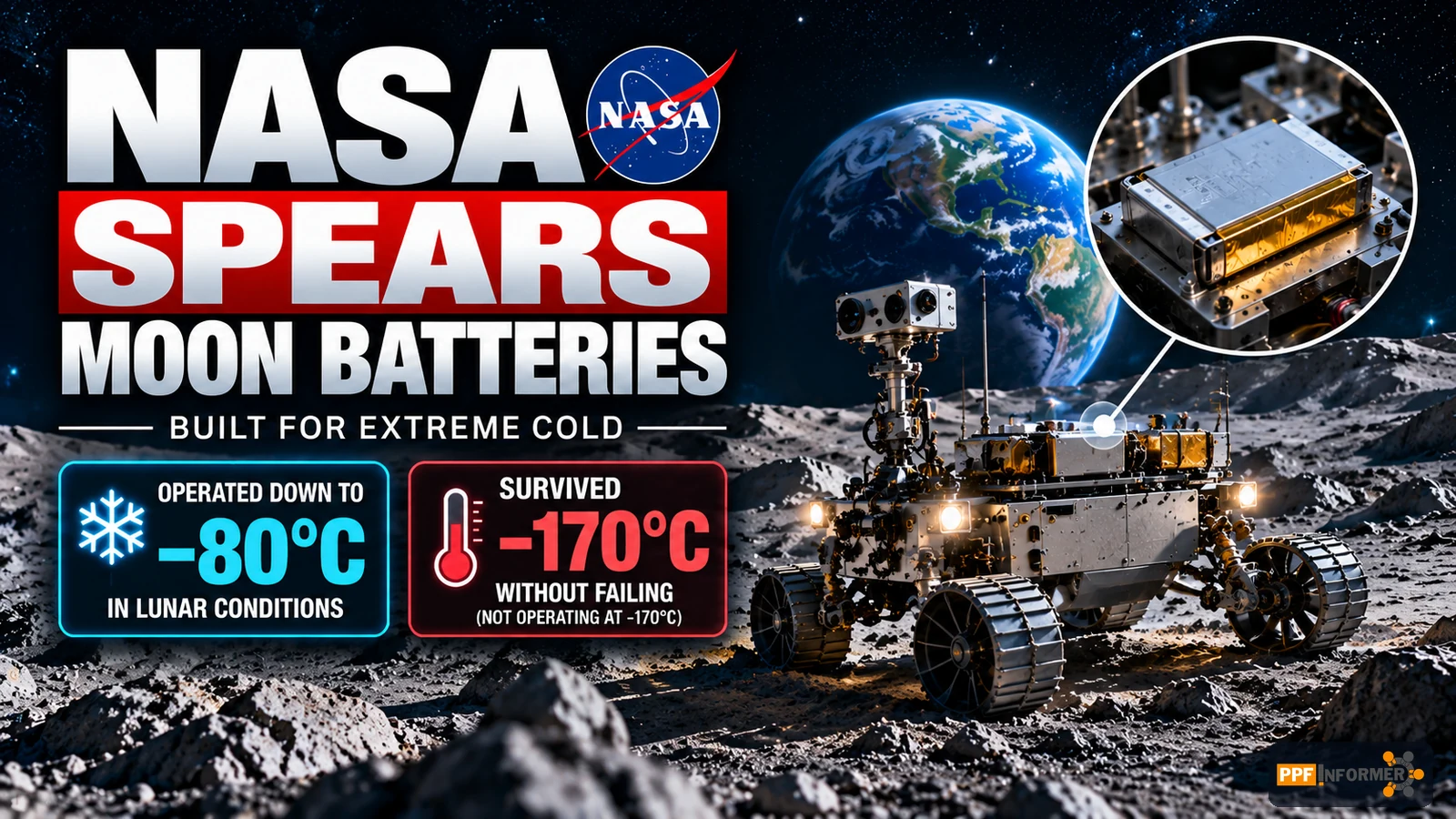
NASA SPEARS Moon batteries — October 15, 2026: NASA researchers have reported a promising step toward batteries that could survive the Moon’s brutal temperature swings. In an October 14 update, the agency described tests of prototype solid-state cells developed under a project called SPEARS, short for Solid Power for Extreme Environment Adaptability and Resilience in Space. The cells operated down to minus 80 degrees Celsius with reduced performance and survived exposure to even colder conditions without damage. That is an important engineering result, but it is not the same as demonstrating a flight-ready battery that can deliver power continuously through the coldest lunar night.
The NASA SPEARS Moon batteries tests matter because future missions will need more than occasional electricity. Astronauts, rovers, scientific instruments and emergency systems may spend long periods away from sunlight. Batteries must store energy, withstand repeated thermal cycles, remain safe and restart after exposure to temperatures that would disable many familiar devices. NASA’s research addresses several of those problems, while leaving others for future testing.
NASA SPEARS Moon batteries: What is the project?
The NASA SPEARS Moon batteries project is a research effort focused on developing solid-state batteries for harsh space environments. NASA’s Glenn Research Center in Ohio leads the project, with testing and materials work at Langley Research Center in Virginia and flight-hardware development at Ames Research Center in California. NASA says the project began in 2026 with research-and-technology funding and could eventually move toward commercial collaboration.
Its core idea is straightforward: replace the liquid electrolyte used in many conventional lithium-ion batteries with a solid material, such as a ceramic or polymer. An electrolyte allows ions to move between electrodes during charging and discharging. Changing that material can alter how a battery responds to temperature, pressure, safety risks and mechanical stress. It does not automatically make the battery better in every respect; the whole cell must still be engineered and tested.
NASA sees possible applications ranging from a small emergency power pack to a rover or a scientific instrument operating in a permanently shadowed crater. Those uses have very different requirements. An emergency pack may need to sit unused for long periods and then work reliably. A rover may require repeated high-power bursts, frequent charging and sustained operation. A sensor might need only a modest but extremely predictable supply of energy. One chemistry is unlikely to be optimal for every task.
Why is the Moon so hard on batteries?
The Moon has no thick atmosphere to moderate temperatures the way Earth’s atmosphere does. Surface conditions vary sharply with sunlight, terrain and location. NASA notes that some south-polar nighttime environments can reach about minus 200 degrees Celsius, or minus 328 degrees Fahrenheit. Other exposed areas may become very hot in sunlight. A battery that functions comfortably in a climate-controlled laboratory can fail when moved into this environment.
At low temperatures, electrochemical reactions slow down and materials change behavior. In liquid-electrolyte cells, conductivity can fall and freezing or other phase changes can disrupt operation. High temperatures introduce different concerns, including accelerated degradation and safety risks. Spacecraft also face vacuum conditions that require careful packaging and materials choices. Engineers must think about the full system, not simply whether a cell can turn on during a single test.
There is another difficulty: the timing of sunlight. A solar-powered vehicle may have plenty of energy during a bright period but little or none when a crater wall blocks the Sun. Storage then becomes essential. A battery that must be heated continuously just to survive the night consumes part of the energy it is supposed to preserve. Reducing that survival-heating requirement could therefore have value beyond the cell itself.
What did NASA’s October 14 tests show?
NASA SPEARS Moon batteries underwent thermal-vacuum tests on small prototype cells at Langley Research Center. According to the agency, the cells operated well up to 80 degrees Celsius and down to minus 60 degrees Celsius, with somewhat reduced performance down to minus 80 degrees Celsius. That establishes a measured operating range for these prototypes under the tested conditions.
NASA also reported that the cells survived exposure to temperatures as high as 100 degrees Celsius and as low as minus 170 degrees Celsius without sustaining damage. For NASA SPEARS Moon batteries, survival is different from operation. The agency explicitly notes that the batteries do not function while at minus 170 degrees Celsius; they can survive that cold and then be warmed to a temperature where they can operate again.
This distinction is the most important detail in the announcement. A reader who sees the minus-170 figure might assume a rover could keep driving at that temperature. NASA did not claim that. The tested cells still need warming before useful power delivery after such extreme exposure. The advantage is that they may not need to be kept warm continuously throughout the coldest period.
Operating temperature versus survival temperature
Operating temperature is the range in which a cell can deliver power at an acceptable level under specified conditions. Survival temperature describes exposure a cell can endure without permanent damage, even if it cannot deliver useful energy during that exposure. Engineers must measure both, and they must also consider how many times the cell can cycle between those states.
Imagine a scientific instrument that sleeps through a lunar night. If its battery survives extreme cold while inactive and can restart after brief heating, the system may need less continuous heating than a conventional design. That could save energy and reduce thermal-control mass. But the total savings depend on how much energy the restart heaters consume and how much power the instrument needs after waking.
NASA SPEARS Moon batteries: How do solid-state cells differ?
Many familiar lithium-ion batteries use a liquid electrolyte to move lithium ions between electrodes. SPEARS replaces that liquid component with a solid ceramic- or polymer-based electrolyte. The material choice can reduce problems associated with a liquid freezing, leaking or behaving poorly in vacuum. NASA’s report emphasizes the potential for operation across a broader temperature range and improved survival after exposure to extremes.
Solid-state is not a single chemistry. Engineers can pair different electrode materials with different electrolytes, producing different combinations of energy density, power output, lifespan and temperature behavior. Some solid materials may offer excellent stability but create challenges at the interface where electrodes meet the electrolyte. Others may be easier to process but have different conductivity limits. The choice is a series of tradeoffs, not a universal upgrade.
Safety also needs careful wording. Removing a flammable liquid can address certain hazards, but a solid-state battery is not automatically immune to overheating, short circuits, manufacturing defects or failure under mechanical stress. A space-rated system needs tests for those conditions and protection circuits that can detect problems. NASA’s prototype results are encouraging evidence about temperature resilience, not a blanket safety certification.
What would a complete lunar battery system need?
A useful lunar battery is more than an electrochemical cell. It includes electrical connections, a protective enclosure, monitoring electronics, thermal sensors, heaters, charging controls and integration with the spacecraft or habitat. Every component must survive the environment. A battery may tolerate cold while an unprotected connector, sensor or circuit board does not. System-level testing is therefore essential.
Power engineers also have to budget energy. A rover may charge from solar panels, spend some energy on propulsion and instruments, then reserve enough energy to heat critical components and communicate. A survival-capable battery could reduce one part of that budget, but it does not create energy. It still needs a source for charging. Mission planners must compare solar generation, battery storage and, for some applications, other power sources.
For context, PPF Informer has separately examined NASA’s work on nuclear power for future space missions. Nuclear systems and batteries solve different parts of the energy problem: one may generate electricity over time, while the other stores it for later use. Their possible combination should not be mistaken for a confirmed SPEARS deployment plan.
Why mass matters so much
Every kilogram launched from Earth adds to mission complexity and cost. If a battery can survive a long cold period without continuous heating, designers might reduce insulation, heater capacity or stored-energy reserves. NASA identifies lighter designs and longer mission durations as potential benefits. The word potential is important: actual mass savings require an integrated design study, not just a successful cell test.
There can also be tradeoffs. A cell with strong low-temperature survival may store less energy per kilogram than another chemistry, or require additional electronics. Engineers need to compare complete systems at the same mission requirements. A smaller heater does not necessarily compensate for a much heavier battery, and the opposite can also be true.
Could SPEARS help astronauts and robots?
NASA lists emergency packs, drills, rovers and long-duration scientific instruments among possible applications. Consider a drill operating in a shadowed crater. It may need high power for short intervals and then remain idle for hours. A solid-state battery optimized for power could be attractive if it tolerates storage in cold conditions and reliably restarts. An instrument taking periodic measurements might instead prioritize long life and very low standby consumption.
Human safety requirements raise the standard further. An emergency device must work after long storage, vibration, radiation exposure and temperature cycling. It must also have clear indicators of charge and health. The NASA SPEARS Moon batteries announcement does not establish that the prototypes meet all those requirements. It describes research progress toward possible future equipment.
What has not yet been demonstrated?
The NASA SPEARS Moon batteries announcement does not provide a verified commercial production date, flight certification, full-size battery-pack test, lunar surface deployment or a published guarantee of thousands of charge-discharge cycles. It does not show that a battery can generate power while sitting at minus 170 degrees Celsius. Nor does it establish that the prototypes outperform every commercial solid-state cell across all relevant measures.
Important open questions include long-term degradation, performance after repeated thermal cycles, charging efficiency at low temperatures, radiation tolerance, packaging durability, energy density and cost. The report also does not provide enough comparative data to calculate a reliable percentage reduction in mission mass or cost. A responsible forecast should identify those gaps rather than turn laboratory survival into an operational promise.
Could these batteries eventually help on Earth?
NASA says the SPEARS Moon batteries effort grew out of earlier aeronautics battery research and could have uses beyond space. Potential fields include automobiles, portable electronics, drones and communications equipment. That possibility makes sense because some terrestrial devices also face extreme temperatures or demanding safety constraints. But the conditions are not identical: a phone battery optimized for price and fast charging faces different priorities from a lunar instrument designed to survive months of harsh exposure.
Commercial adoption would require reliable manufacturing, materials availability, competitive costs, certification and performance that customers actually need. A technology can succeed in a specialized aerospace role without becoming the standard battery in every electric vehicle. Conversely, some advances in materials or thermal management may prove useful even if the exact SPEARS cell design is never mass-produced for consumers.
There is also a broader research benefit. Space programs often force engineers to test systems under extreme constraints. The resulting knowledge about materials, packaging and failure modes can inform Earth-based engineering. That does not guarantee a commercial product, but it helps explain why relatively small research prototypes can matter to industries outside aerospace.
What happens next for SPEARS?
The NASA SPEARS Moon batteries project’s early phase focuses on technology development. Ames Research Center is developing test boards and electronics that could help prepare the cells for spaceflight and evaluation in space environments. That is a logical progression: after proving useful behavior in a laboratory, engineers need to test integrated hardware under conditions that better approximate a real mission.
The next meaningful milestones would include repeated thermal-cycle tests, battery-pack integration, verified performance under radiation and vibration, and eventually a flight experiment. NASA has not announced a confirmed lunar deployment date in the October 14 update. Until those milestones are documented, SPEARS should be described as promising research rather than a ready-to-install Artemis battery.
What does this mean for the future of lunar exploration?
Reliable energy storage is one of the quiet technologies that makes ambitious space exploration possible. Cameras, communications, life-support backups and rovers all depend on electricity at the right moment. If future batteries can survive lunar cold without heavy continuous heating, mission designers may gain flexibility in where equipment can operate and how long it can remain unattended.
The future scenario is plausible but conditional. It depends on whether laboratory performance scales to larger systems, whether those systems survive realistic missions and whether they offer a better balance of mass, cost and reliability than alternatives. The October 14 tests answer part of the materials question; they do not settle the entire mission-design question.
Bottom line
NASA SPEARS Moon batteries prototypes have demonstrated operation down to minus 80 degrees Celsius, with reduced performance, and survival after exposure down to minus 170 degrees Celsius. That is a meaningful step toward batteries for the Moon’s harsh environment. The breakthrough is not a cell that powers a rover continuously at the coldest temperature; it is a design that may survive deep cold and restart after warming. The next challenge is to prove the same reliability in a complete, flight-ready power system.
Primary source
NASA Langley and Glenn SPEARS research update, October 14, 2026.