

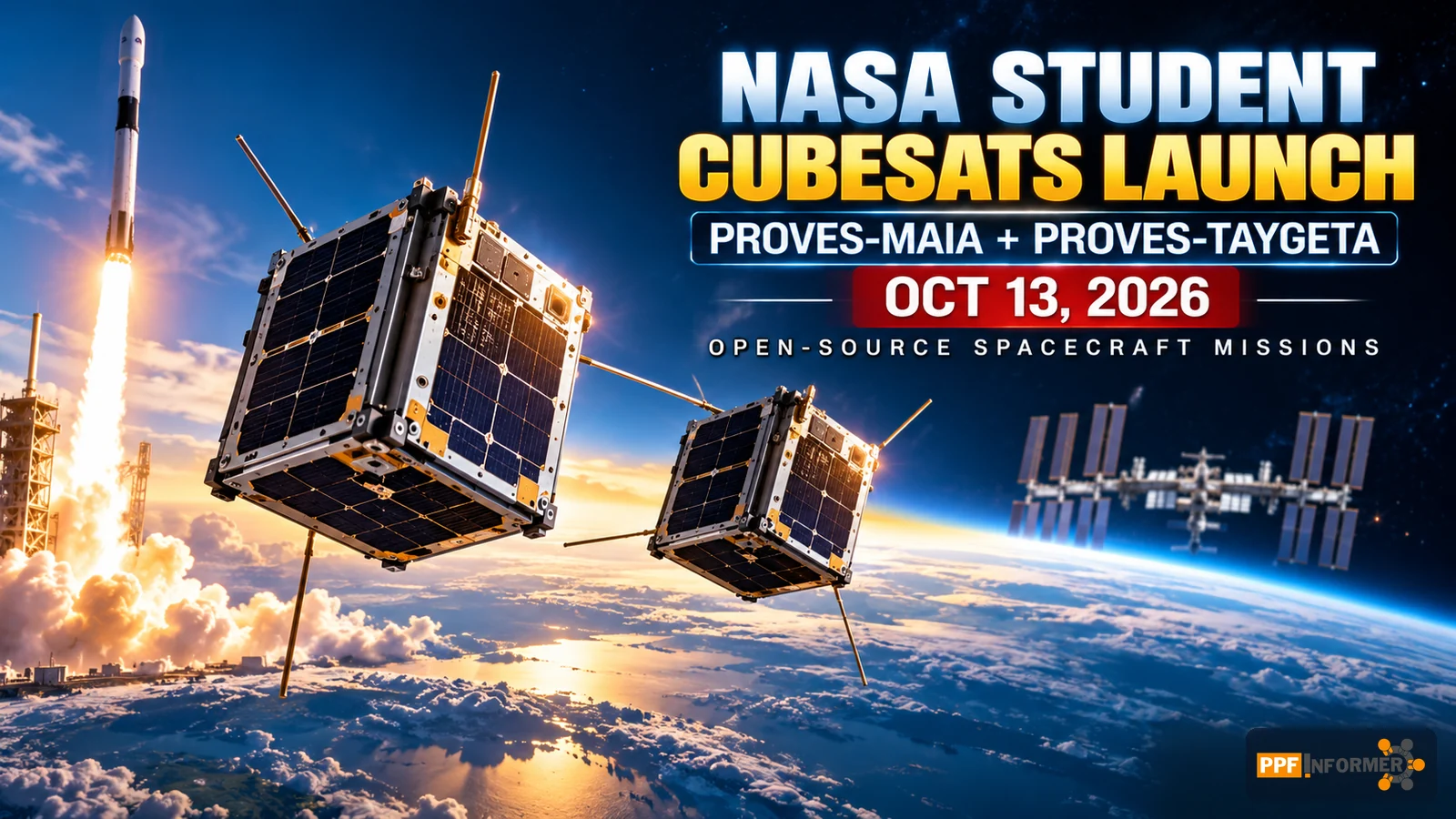
NASA student CubeSats launch news: PROVES-Maia and PROVES-Taygeta traveled toward the International Space Station on October 13, 2026, to support future open-source communications experiments. Their mission could help universities learn how to build and operate spacecraft, but the most ambitious experiments are still ahead.
NASA student CubeSats launch: What flew on October 13?
The NASA student CubeSats launch sent two small spacecraft toward the International Space Station on October 13, 2026, aboard NASA’s 35th commercial resupply mission with SpaceX. The Falcon 9 lifted off at 6:33 a.m. Eastern from Cape Canaveral Space Force Station in Florida. NASA identifies the spacecraft as PROVES-Maia and PROVES-Taygeta, members of a wider university-led program called Pleiades Five. Their missions focus on practical satellite communications, technology demonstrations and student experience. The launch is confirmed; the later in-orbit experiments are planned activities, not results already achieved. This distinction is central to understanding the news. A rocket carrying a satellite to the space station does not automatically prove that the satellite’s experimental hardware will work in orbit. Teams still need to deploy, establish communications, commission systems and collect useful data. The achievement is an important first step for the universities and a test of whether shared, openly documented spacecraft designs can make space engineering more accessible.
What is a CubeSat?
For readers following the NASA student CubeSats launch, a CubeSat is a small satellite built around standardized dimensions that allow many universities, startups and research groups to design hardware without inventing every part of a spacecraft from scratch. A CubeSat can carry radios, cameras, sensors and small computers while fitting into a compact launch and deployment system. Standardization does not make space easy: the spacecraft still faces vibration during launch, severe temperature changes, radiation, power limits and the challenge of communicating across long distances. What it changes is the starting point. Students can spend more time learning about a mission’s science and engineering questions and less time negotiating a unique mechanical interface for each flight. CubeSats also make it possible to try smaller experiments that would not justify a large, dedicated satellite. They are not replacements for every major spacecraft, but they can provide valuable demonstrations before technologies are used on more expensive missions.
Who built PROVES-Maia and PROVES-Taygeta?
NASA says PROVES-Maia is associated with Texas State University, while PROVES-Taygeta brings together Cal Poly Pomona’s Bronco Space Lab and Mt. San Antonio College in California. The NASA student CubeSats launch is part of the wider Pleiades Five effort, which centers on five PROVES spacecraft and an openly documented platform. Each team contributes its own work while benefiting from shared design decisions. For students, that means real engineering responsibilities: assembling hardware, integrating power systems, testing radios, preparing software and documenting procedures. The Texas State team assembled its spacecraft in a clean room and prepared it for vibration testing at NASA’s Johnson Space Center. Such testing is not glamorous, but it matters because even a perfectly functioning laboratory prototype can fail under launch loads. The project shows how educational missions can teach systems engineering, where every subsystem must work with the others rather than only succeeding on its own.
Why is an open-source spacecraft platform important?
An important feature of the NASA student CubeSats launch is the PROVES program’s emphasis on design files and software that other teams can study, reuse and improve. In ordinary software, open-source code lets developers learn from existing work and submit changes. In spacecraft engineering, sharing a documented hardware and software foundation can lower the barrier to building a credible mission. It may also help teams compare their results, identify mistakes earlier and avoid repeating expensive design work. However, open-source does not mean a satellite is free to build or safe to launch without testing. Hardware, clean-room access, communications equipment, environmental qualification and regulatory work all require resources. A shared design can reduce duplicated effort, but each mission still needs engineering review and verification. The potential long-term benefit is a broader pool of institutions able to train students on flight-relevant systems. Whether the model scales widely will depend on documentation quality, reliability and continued community participation.
How will PROVES-Maia communicate?
Following the NASA student CubeSats launch, PROVES-Maia is designed to relay digital messages for amateur radio operators using UHF and S-band communications after deployment and commissioning. UHF is commonly used for practical satellite links, while S-band can support other communication needs depending on equipment and mission design. The spacecraft may also participate in experiments that route messages between PROVES satellites when orbital conditions permit. Those experiments depend on several spacecraft being available, working correctly and within communication range. It is therefore inaccurate to describe a completed intersatellite network today. For the NASA student CubeSats launch, these planned tests will examine how small satellites might pass data along rather than rely on a single direct link to the ground. For amateur radio participants, this could create an unusual opportunity to help test communications from a real spacecraft. Participation details should come from the project team, not from unverified social-media instructions.
What will PROVES-Taygeta test?
Among the NASA student CubeSats launch payloads, PROVES-Taygeta carries a camera and a radiation-sensing experiment in addition to its amateur radio mission. NASA says the camera is intended to produce images from orbit that radio operators can download. A separate onboard processor will oversee an experiment making approximate measurements of radiation energies in low Earth orbit. The NASA student CubeSats launch therefore represents technology and educational objectives, not a promise of high-resolution Earth imaging or a complete radiation map. Space radiation measurements depend on the sensor, its calibration, orbit and exposure conditions. Approximate measurements can still be valuable for testing hardware, learning about the environment and developing processing methods. The camera can help students understand the entire chain from image capture to storage, transmission and reception. That chain is often where practical systems fail, even when individual components work correctly on a bench.
What is DRIFT, the planned satellite messaging protocol?
NASA identifies Dynamic Relay for Intersatellite Fault Tolerance, or DRIFT, as an open-source communications protocol that the Pleiades Five program plans to use for message routing between satellites. The basic concept is to give spacecraft a method of forwarding information when direct communication is not always possible. Low Earth orbit satellites move quickly relative to ground stations and to one another, so links can be intermittent. A useful routing approach must account for when another spacecraft is reachable and how to handle messages that cannot immediately be delivered. In coverage of the NASA student CubeSats launch, the term ‘fault tolerance’ should not be mistaken for proof that the planned system can survive every failure. Real testing will reveal what happens when connections drop, packets are lost or hardware is unavailable. If successful, experiments like this could inform more resilient small-satellite networks, although commercial adoption would require far more testing and engineering.
Why launch through the space station?
The NASA student CubeSats launch used a cargo mission to the International Space Station rather than a dedicated rocket solely for the student program. For more details on the resupply flight, read our SpaceX CRS-35 launch coverage. NASA’s CubeSat Launch Initiative provides opportunities for eligible educational and research spacecraft to reach space using available missions. This approach can make access to orbit more practical for small payloads, but it comes with constraints. Teams must meet strict safety, integration and schedule requirements, and the spacecraft may wait for deployment after arriving at the station. Launching with cargo is therefore only one stage in the mission timeline. It does not mean that the CubeSats were immediately released into their operational orbits at liftoff. Readers should watch for separate confirmation of deployment and first contact before treating the experiments as active. This separation between launch, delivery and operational status is important across space news, where headlines sometimes compress several distinct milestones into one event.
What can students learn that a classroom cannot teach?
The NASA student CubeSats launch illustrates how a flight project requires students to make decisions under real constraints. They must balance battery capacity against radio transmission time, sensor power against thermal limits, and mission ambition against what can be tested before launch. They also have to coordinate across mechanical, electrical, software and operations teams. A classroom assignment may end when a design is submitted; a spacecraft mission continues through reviews, launch preparation, commissioning, unexpected behavior and data analysis. Students learn how to document decisions so another person can diagnose a problem months later. They also gain experience with risk: some problems can be corrected through software, while others cannot be repaired once the spacecraft is in orbit. That does not make every student mission successful, but it makes the experience unusually close to the way professional aerospace programs operate. The value is educational even if an individual experiment encounters difficulties.
Could amateur radio operators take part?
The NASA student CubeSats launch includes missions designed with amateur radio communications in mind. NASA says the teams intend to support digital message relays and make some data available for operators to request or receive. The project also plans to publish a ground-station design, which could help people understand the equipment and procedures needed to participate. However, enthusiasts should not assume that any radio can contact the satellites immediately. Frequencies, licensing rules, operating schedules, antenna requirements and deployment status all matter. In the United States, amateur radio operations are subject to Federal Communications Commission rules. Interested participants should use verified project documentation and applicable regulations rather than guessing at transmission parameters. Responsible participation could help students gather practical observations about signal reception and message delivery, while also connecting classroom engineering with a wider technical community.
What are the limits of small satellite networks?
The NASA student CubeSats launch highlights a vision of satellites relaying messages to one another, but the physics and engineering are demanding. Small spacecraft have limited electrical power, small antennas and restricted processing capacity. Their orbits change relative positions constantly, and a link that works during one pass may not be available during the next. Radio interference, atmospheric effects and onboard faults can further complicate communications. A robust network must know when to store data, when to forward it and how to avoid losing or duplicating messages. These are familiar problems in terrestrial networks, but orbital motion adds another layer of difficulty. DRIFT and the PROVES experiments can test pieces of this puzzle. They should not be described as a replacement for commercial satellite internet, emergency communications systems or large constellations. Their immediate purpose is learning and validation, not delivering a nationwide consumer service.
How might open satellite technology change the future?
If the reusable designs featured in the NASA student CubeSats launch prove reliable and well documented, more universities and small research groups could undertake modest space experiments. That could expand training opportunities, diversify ideas and help early-stage technologies reach orbit. A team studying low-cost radiation sensors might adapt the shared platform, while another team could focus on new communications software. Over time, a community of users could identify common failure modes and improve designs. This is a plausible future benefit, not an established outcome of the October 13 launch. Scaling the approach would still require dependable manufacturing, funding, safety reviews, launch opportunities and long-term project maintenance. There is also a responsible-space dimension: even small satellites add objects to orbit and must be designed with debris mitigation and end-of-life planning in mind. Openness can support collaboration, but it does not remove the need for accountability.
What should we watch after launch?
For the NASA student CubeSats launch, the next meaningful milestones are safe arrival at the space station, deployment into orbit, first confirmed radio contact and successful commissioning of the onboard systems. After that, the teams can begin reporting camera results, radiation measurements and any intersatellite messaging tests. The quality of public documentation will matter too: a successful demonstration becomes more valuable when other researchers can understand how it worked and what failed. Watch for reports from NASA, the participating universities and the official PROVES project rather than treating speculative online trackers as definitive evidence. The missions could also produce educational materials and technical lessons even if every planned objective is not achieved. Success should be judged against stated mission goals and verified results, not simply by whether the satellites reach orbit.
Bottom line: a launch, not yet a proven network
The NASA student CubeSats launch carried PROVES-Maia and PROVES-Taygeta on October 13, 2026, as part of a NASA-supported student satellite effort. The confirmed milestone is their journey toward the International Space Station aboard the SpaceX cargo mission. The planned work includes amateur radio messages, images, radiation measurements and experiments in routing data between small spacecraft. The program’s open-source approach could make practical satellite engineering more accessible, but its long-term impact remains to be tested. No one should claim that the full communications network is already operating or that future scientific results have been delivered. For U.S. students, educators and space enthusiasts, the real story is the opportunity to test reusable designs in the demanding environment of orbit.
Sources and status
Primary reference: NASA’s October 13 mission account; launch context: NASA CRS-35 launch release. Confirmed events and future objectives are distinguished throughout. Checked October 14, 2026.