

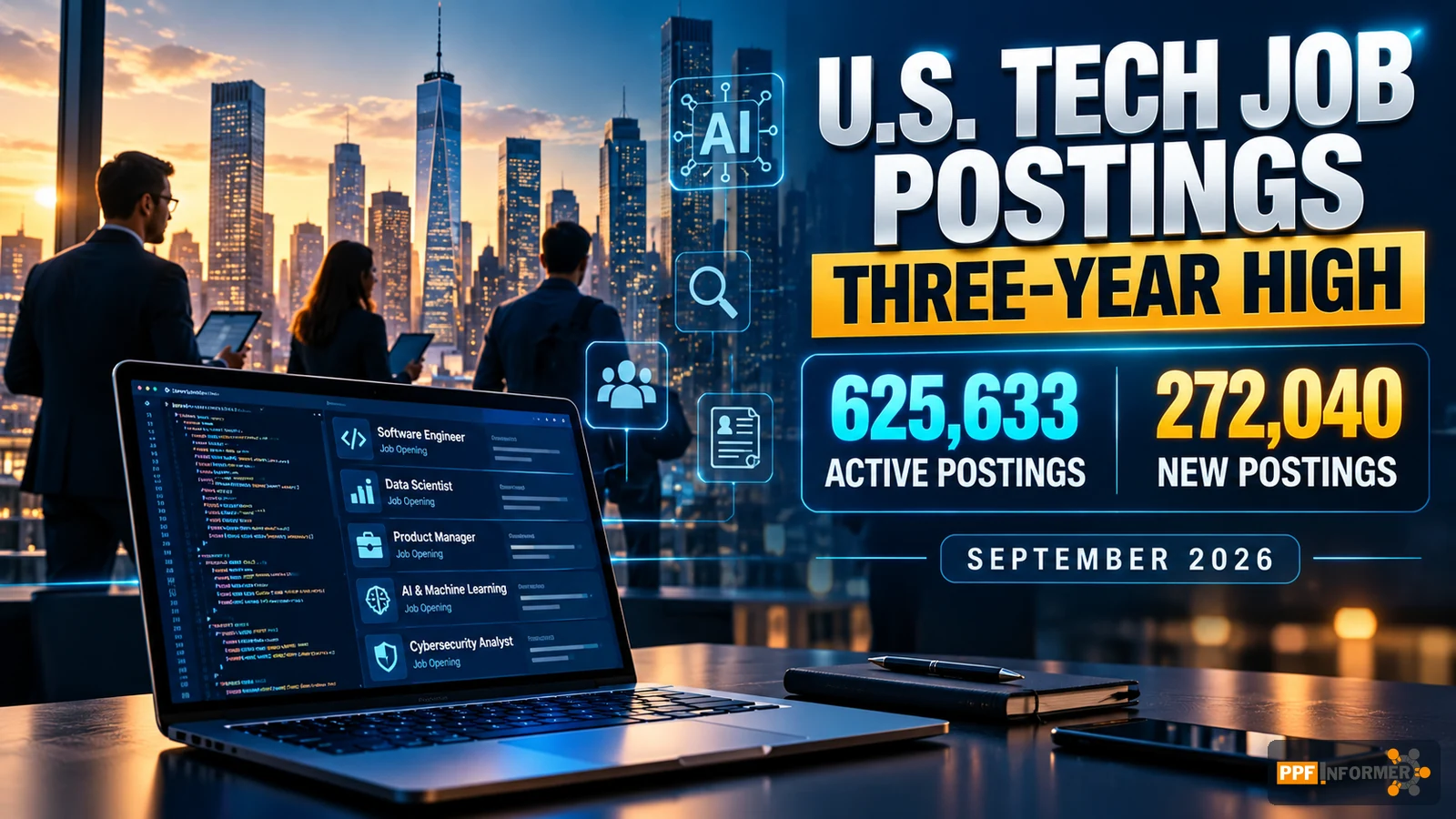
U.S. tech job postings 2026 reached a three-year high in September: employers advertised 272,040 new IT positions, while active postings reached 625,633, according to CompTIA. Here is what the numbers mean for applicants in a slow overall hiring market.
U.S. tech job postings 2026: What did the latest report find?
CompTIA’s October 2 report on U.S. tech job postings 2026 recorded 272,040 new employer postings for IT occupations in September and 625,633 active postings. The organization said the active total was the highest in more than three years. Compared with September 2025, new postings were up 16 percent and active postings were up 22.4 percent. These figures describe job advertisements tracked in the underlying labor-market data, not people who were hired. A posting can remain open for weeks, and some positions may be advertised on more than one platform. That distinction matters because the broader U.S. jobs report showed only modest payroll growth in September. The combined picture is not a simple boom or bust. Employers are still looking for specific technology skills while overall hiring remains cautious.
Which technology roles show demand?
Software developers and engineers led CompTIA’s September list with 47,598 new postings, an 8.3 percent increase from August. Systems engineers, technology support specialists, data analysts and DevOps engineers were also among the most sought-after occupations. The rise in U.S. tech job postings 2026 suggests employers continue to need people who can build, maintain, secure and support digital systems. This does not mean every applicant in those fields will receive an offer quickly. Experience, location, compensation, industry requirements and the match between skills and job descriptions still shape outcomes. A candidate searching for software engineering work may find very different conditions in a large city, a remote-only market and a local employer’s hiring pool. The useful lesson is to look beyond the broad phrase ‘tech jobs’ and identify the precise tasks employers want completed.
How big is demand for AI skills?
CompTIA counted 349,821 active postings that required AI-related skills in September, up 32,327 from August. It also identified 13,636 active postings in dedicated AI and machine-learning job titles. These categories are not interchangeable: a conventional software or business role may mention AI tools without being a specialist machine-learning position. The AI-related share of U.S. tech job postings 2026 suggests employers are integrating these skills into existing jobs, not simply replacing every occupation with a new AI title. Candidates should read the responsibilities carefully. A listing asking for AI-assisted data analysis may require spreadsheets, databases and judgment more than model training. A machine-learning engineer opening may demand strong programming, mathematics, infrastructure and evaluation experience. Matching the actual job is more effective than adding fashionable terms to a resume.
Why can postings rise while payroll growth stays weak?
U.S. tech job postings 2026 measure advertised demand; payroll data measures realized employment. A company can advertise an opening and take months to fill it, cancel it or leave it unfilled because the right candidate is unavailable. CompTIA’s analysis also reported a decline of about 10,350 jobs in the technology sector during September and a drop of roughly 6,000 in tech occupation employment across industries. Meanwhile, the Bureau of Labor Statistics reported 29,000 total nonfarm payroll jobs added nationwide in September and an unemployment rate of 4.2 percent. These measures cover different groups and use different methods, so they should not be compared as though they were the same count. Together they explain why job seekers can see many listings but still face lengthy interviews and slow decisions. For broader labor-market context, see our U.S. jobless claims report.
Where are technology jobs being advertised?
Technology hiring extends beyond software companies. Healthcare, finance, manufacturing, logistics, retail and professional services all use networks, data systems, software and cybersecurity. CompTIA reported that 16 of the 20 industries it tracked had month-over-month increases in tech postings. The distribution of U.S. tech job postings 2026 across industries offers a wider search for applicants who have focused only on famous technology brands. A hospital may need data analysts, a manufacturer may need systems engineers and a regional business may need security or support specialists. Job titles can vary between industries, so searching by skills as well as titles may reveal relevant roles. Candidates should also review whether the work is onsite, hybrid or remote before spending time on an application. A broader industry search does not guarantee success, but it can reduce unnecessary competition around a narrow group of employers.
What should applicants do this week?
To turn U.S. tech job postings 2026 into a focused job search, identify five to ten recurring requirements across real vacancies. Build a resume that demonstrates those requirements through completed work, not just keyword repetition. For example, a systems candidate might show a measurable improvement in reliability, while a data analyst might describe a report that improved decision-making. Keep portfolio examples small enough for recruiters to understand quickly and avoid publishing confidential employer information. Apply promptly to relevant positions, but do not mistake application volume for progress. Track responses and adjust the resume if employers consistently reject it before interviews. Use company career pages to verify listings and watch for scams that request payment, personal banking details or purchases of equipment before a legitimate offer.
Which skills are worth strengthening?
These U.S. tech job postings 2026 point to demand for software engineering, technical support, cybersecurity, systems administration, analytics and practical AI fluency. But a course certificate alone is not a substitute for demonstrated competence. Candidates can improve their prospects by building a small project that resembles real work: automating a repetitive report, securing a test environment, writing documented code or troubleshooting a realistic support problem. Explain the problem, constraints, decisions and results. For AI-related work, include examples of verifying outputs and protecting data, not merely generating text. Employers may value candidates who know when an AI tool is useful and when it needs human oversight. Training choices should follow the requirements of the jobs you want, not the popularity of a single technology on social media.
What should hiring managers learn?
Rising U.S. tech job postings 2026 alongside cautious hiring suggest employers should examine whether their requirements are too broad or hiring processes too slow. A role asking for every modern programming language, advanced AI expertise and years of experience may attract fewer suitable applicants than a clear description of essential work. Companies can improve hiring by distinguishing must-have skills from trainable skills and communicating pay ranges and work arrangements transparently. Practical work samples can help, provided they are short, relevant and respectful of candidates’ time. Managers should also measure how long vacancies remain open and whether advertised positions are genuinely approved. The goal is not simply to increase posting volume; it is to convert real openings into productive hires.
Bottom line: opportunity is uneven, not absent
The U.S. tech job postings 2026 data for September point to substantial advertised demand even as the wider labor market remains cautious. The headline numbers are 272,040 new IT postings, 625,633 active postings and 349,821 active listings requiring AI-related skills. These are reported job-posting measures, not confirmed hires. Applicants should focus on role-specific skills, widen their industry search and verify employers directly. Future hiring may rise or fall with economic conditions, so no one should treat one month of postings as a guaranteed trend. The most defensible conclusion is that technology demand remains substantial but uneven across roles and companies.
Sources
CompTIA’s original October 2 jobs report; U.S. Bureau of Labor Statistics September employment release. Checked October 14, 2026.