

Updated October 11, 2026.
US jobless claims October 2026: latest numbers
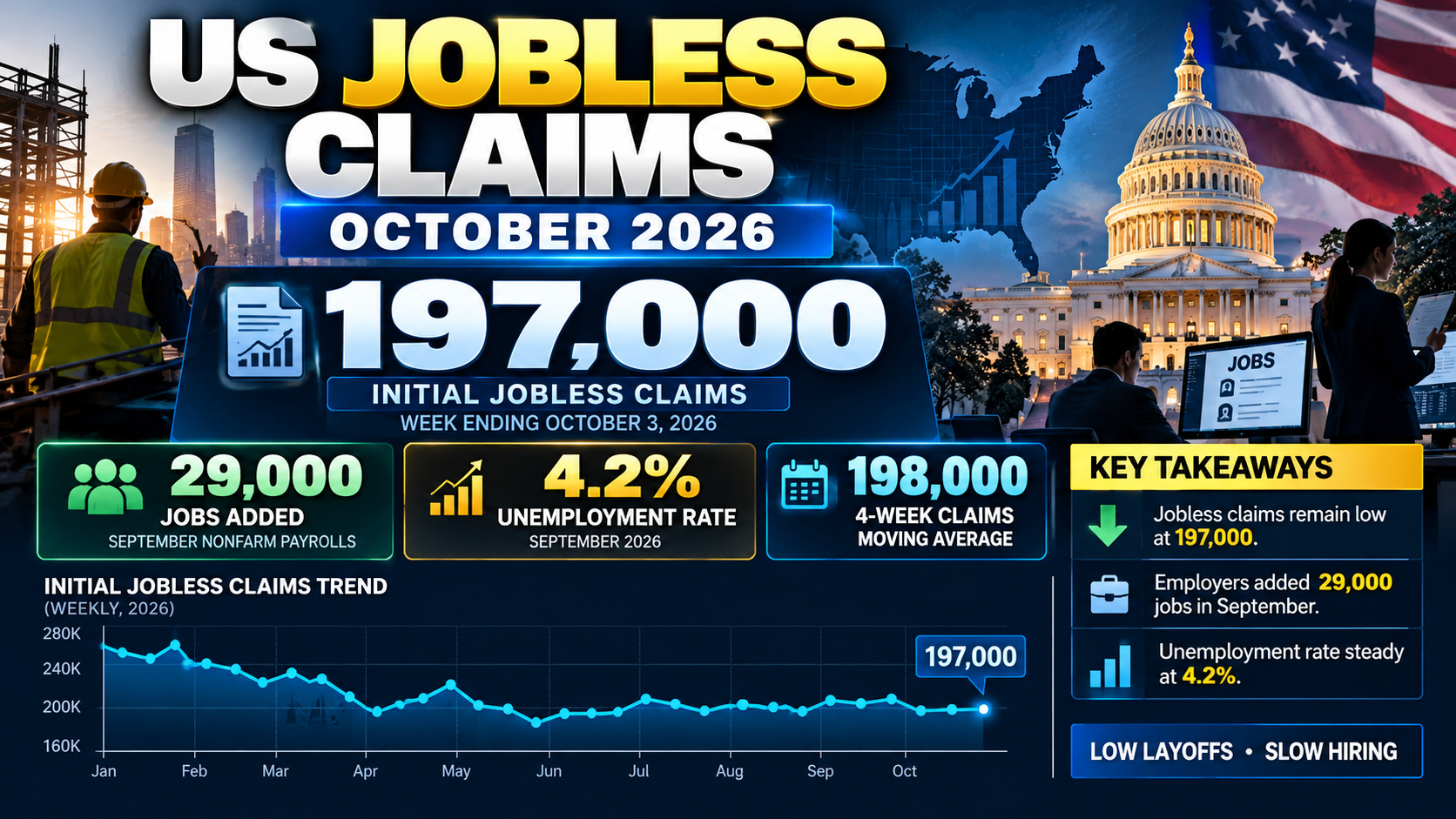
US jobless claims October 2026: New U.S. unemployment insurance claims fell to 197,000 in the week ending October 3, 2026, according to the Labor Department’s October 8 report. That was a decrease of 2,000 from the previous week’s revised 199,000. The four-week moving average declined to 198,000, down 2,500 from the prior revised average.
The US jobless claims October 2026 report points to relatively few new layoffs, but it does not prove that finding a job is easy. The September employment report showed only 29,000 new nonfarm payroll jobs and an unemployment rate of 4.2%. Together, these measures describe a labor market where employers may be keeping existing workers while adding fewer new positions.
What jobless claims measure
Initial unemployment insurance claims count people who apply for benefits for the first time during a reporting week. They are an early indicator of layoffs because claims are reported more frequently than the monthly jobs report.
US jobless claims October 2026 are not a count of everyone who lost a job. Some workers are not eligible for benefits, do not apply or may be covered under different arrangements. Claims also do not measure how many job advertisements are real, how quickly employers respond to applicants or how many candidates compete for each role.
For that reason, the US jobless claims October 2026 figure can coexist with frustration among people already unemployed or trying to switch jobs. Those experiences are not contradictory; they measure different parts of the employment process.
US jobless claims October 2026: why hiring is still slow
Companies may avoid laying off staff because replacing experienced workers is costly. At the same time, they may delay expanding headcount because demand, budgets or business conditions are uncertain. Economists sometimes describe this combination as a ‘low-hire, low-fire’ environment.
That creates an unusual experience for jobseekers. Employees with stable positions may feel secure, while someone seeking a new role faces long screening processes, fewer openings and intense competition. The weekly claims report captures the first side of that picture more clearly than the second.
September’s 29,000 payroll gain is a separate signal that hiring growth was weak. The unemployment rate remaining near 4.2% does not eliminate that concern. A single indicator cannot summarize the entire job market.
US jobless claims October 2026: four-week average
Weekly claims can move because of holidays, seasonal adjustments and temporary reporting changes. The four-week moving average helps smooth those fluctuations. The Labor Department reported a 198,000 average for the latest week, compared with a revised 200,500 in the preceding period.
The downward movement in US jobless claims October 2026 suggests new claims have stayed relatively subdued. It does not forecast exactly what will happen to unemployment next month. Claims can change quickly if major employers announce job cuts or if a regional disruption affects work.
Readers should compare several releases instead of treating one week as a decisive turning point. It is also useful to separate seasonally adjusted national data from state-level figures that can behave differently.
What about people already receiving benefits?
Continuing claims measure people who remain on unemployment benefits after an initial application. They provide a different perspective from first-time claims: how many eligible people are still receiving support while looking for work.
Recent reporting on the October 8 release indicated that continuing claims rose by about 17,000 to roughly 1.72 million for the week ending September 26. This measure is reported with a lag, so it should not be described as covering the same week as the initial claims figure.
A rise in continuing claims can reflect people taking longer to find new jobs, changes in benefit eligibility or other factors. It does not identify one cause by itself, and it is not a complete count of long-term unemployed workers.
What jobseekers should do now
Focus on roles with evidence of active hiring. A recently updated company careers page, a clear hiring manager and a specific job description are better signals than a generic listing that has been reposted repeatedly.
Tailor the top section of your resume to the role’s most important requirements. Show measurable results where possible, but do not invent achievements or keyword-stuff the document. For technical roles, include relevant projects or work samples that demonstrate the requested skills.
Use a simple application tracker. Record the role, employer, date, contact, follow-up and outcome. That makes it easier to identify which types of applications produce interviews. If response rates remain low, test a revised resume or different job titles rather than sending more identical applications.
Networking can help, but it does not require an existing personal connection. Professional associations, alumni groups, public events and thoughtful outreach to recruiters can create new conversations. Keep messages specific and respectful.
How employers can interpret the report
Employers should not assume that low claims mean every candidate is easy to find or that wages will automatically stabilize. Hiring conditions vary by occupation, location, experience level and schedule.
For teams recruiting during a slower market, clear salary ranges, realistic job requirements and timely communication can improve candidate experience. A long hiring process can still lose strong applicants even when the broader economy is adding few jobs.
Employers also benefit from reviewing whether every open role is truly approved and funded. Keeping inactive listings online can waste applicant time and weaken trust in the recruitment process.
Which upcoming reports matter?
The next weekly unemployment claims release is scheduled for October 15, 2026. The Bureau of Labor Statistics also lists September consumer price data for October 14. Inflation can influence household budgets and employer planning, although it is not a direct measure of hiring.
For a broader picture, follow monthly payrolls, unemployment, labor force participation, job openings and wage trends. Each has strengths and limitations. The next monthly employment report will provide another checkpoint, but it should not be predicted in advance.
For more context on why the job market can feel difficult even with a moderate unemployment rate, see PPF Informer’s earlier U.S. job market explainer. Readers should verify the destination before publication if the site’s permalink has changed.
Frequently asked questions
How many Americans filed new jobless claims?
The seasonally adjusted initial claims figure was 197,000 for the week ending October 3, 2026.
Does that mean hiring is strong?
No. Claims mainly track new benefit applications. Hiring is measured by other data, including payrolls and job openings.
What was the September unemployment rate?
The Bureau of Labor Statistics reported 4.2%.
When is the next claims report?
The next scheduled weekly report is October 15, 2026.
Bottom line and sources
The latest claims report shows relatively low new layoffs, not a sudden hiring boom. Jobseekers should read it alongside weak September payroll growth and use a targeted, evidence-based application strategy.
For a related example of how layoffs and hiring trends can diverge, read our FICO layoffs 2026 report. Company restructuring and nationwide unemployment claims measure different things.
Primary sources: U.S. Department of Labor unemployment insurance data dashboard; BLS September 2026 Employment Situation; BLS October release schedule.