

Updated October 11, 2026.
U.S. oil reserve exchange 2026: what the Energy Department announced
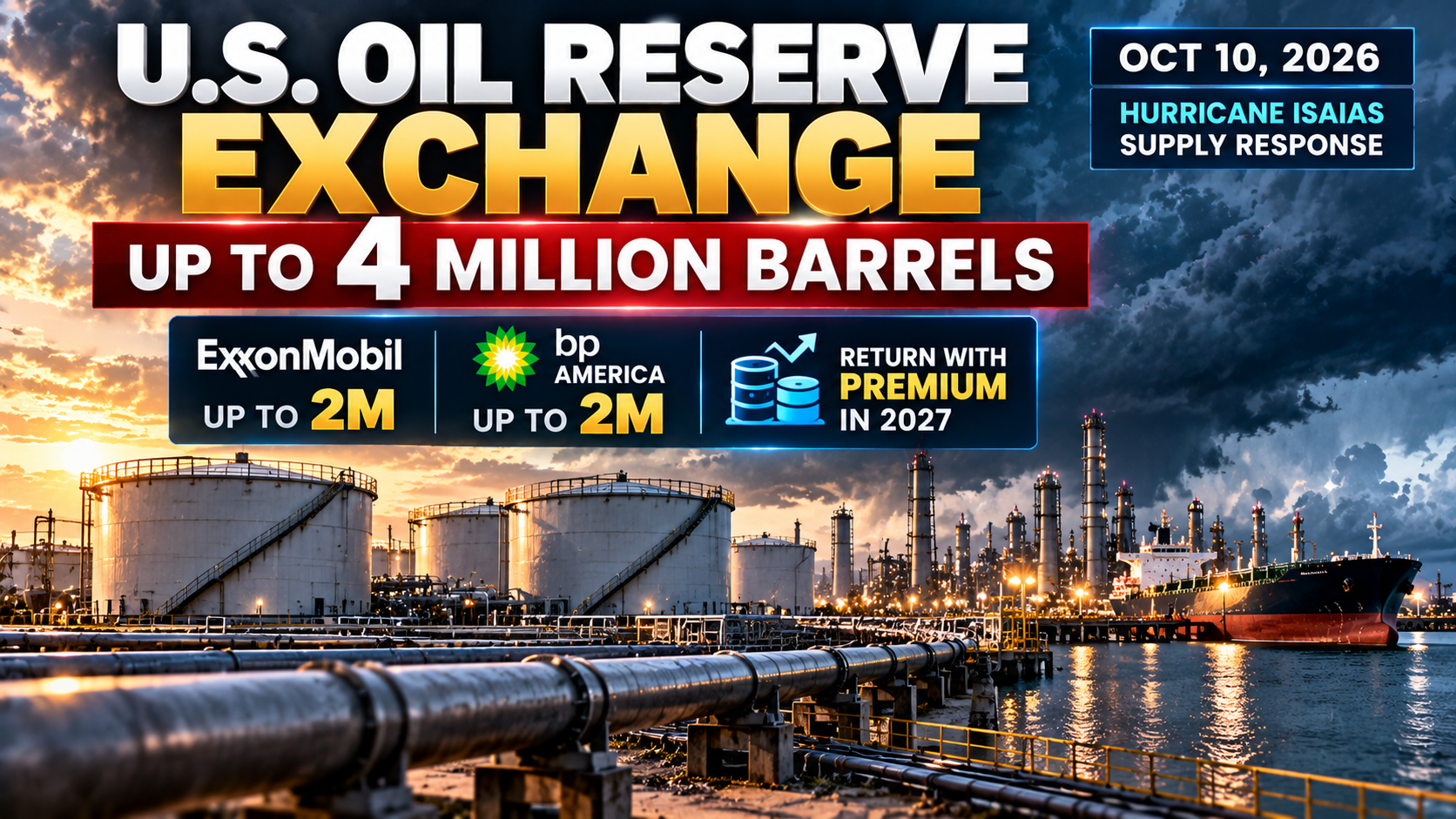
U.S. oil reserve exchange 2026: The U.S. Department of Energy authorized an emergency exchange of up to 4 million barrels of crude oil from the Strategic Petroleum Reserve on October 10, 2026. The action responds to fuel-supply disruptions associated with Hurricane Isaias in the Gulf Coast region. It is intended to help keep refineries operating and reduce interruptions in the energy supply chain.
Under the U.S. oil reserve exchange 2026 plan, participating companies borrow crude oil from the reserve and return barrels later, with additional premium barrels due in 2027. This is an exchange, not a permanent sale of all the authorized oil. The announcement does not guarantee that pump prices will fall immediately.
U.S. oil reserve exchange 2026: the 4 million-barrel allocation
The Department of Energy said it authorized exchanges of up to 2 million barrels each for ExxonMobil and BP America. The ExxonMobil portion includes accelerated delivery of crude previously awarded under the reserve program. The agency said the exchange structure is designed to support immediate supply needs while rebuilding the reserve later.
For the U.S. oil reserve exchange 2026, the phrase ‘up to’ matters. It describes the maximum authorized volume, not proof that all 4 million barrels had already moved when the announcement was issued. Actual deliveries, timing and refinery use depend on the companies and the operational terms of the exchanges.
The reserve is a federal emergency crude-oil stockpile. Its purpose includes responding to serious supply disruptions. Crude from the reserve is not the same thing as finished gasoline or diesel at a retail station; refineries must process crude into fuels before consumers can use them.
Why a hurricane can disrupt fuel supplies
Major storms can interrupt oil production, port operations, pipeline movement, storage terminals and refinery activity. Even a refinery that avoids direct structural damage may face shortages of feedstock, shipping delays or temporary power interruptions.
Gulf Coast energy infrastructure is especially important because it connects crude supplies, refineries and distribution networks serving many U.S. markets. A disruption at one point can affect scheduling and inventories farther away.
Hurricane Isaias made landfall near Destin, Florida, on October 9 and weakened after moving inland. The Energy Department’s October 10 announcement describes supply disruption caused by the weather, but does not publish a complete, verified count of affected refineries or a final national economic loss estimate.
U.S. oil reserve exchange 2026: how borrowing crude works
In the U.S. oil reserve exchange 2026, a company receives crude oil now and agrees to return oil later under specified conditions. That differs from a straightforward sale, where the government disposes of oil in return for payment. The exchange can help address short-term physical supply problems without permanently reducing the stockpile by the same amount.
The Energy Department says the companies will return borrowed crude plus additional premium barrels in 2027. It presents that structure as a way to replenish the reserve at no additional cost to taxpayers. The final fiscal and inventory impact should be evaluated against the actual deliveries and completed returns, not just the initial announcement.
For consumers, the U.S. oil reserve exchange 2026 mechanism is less important than its purpose: providing refineries access to crude when normal supply channels are disrupted. It can reduce pressure on a supply chain, but it cannot instantly repair storm damage, reopen roads or restore all refinery capacity.
Will gas and diesel prices fall?
Not necessarily, and not on a predictable timetable. Retail fuel prices reflect crude costs, refining margins, transport, inventories, taxes and local market conditions. A reserve exchange may help prevent some supply shortages, but it is only one input into a much larger market.
Consumers should be cautious about claims that a 4 million-barrel authorization translates directly into a fixed number of cents off every gallon. The Energy Department has not announced a guaranteed retail price reduction or a universal savings figure.
Regional effects may differ. Areas with damaged transport infrastructure or limited alternative fuel routes can face temporary shortages even if the national market has adequate supply. Conversely, other regions may see little immediate impact.
What it means for businesses and shipping
Fuel is an operating cost for trucking, delivery services, airlines, construction companies and many small businesses. If a storm causes local supply interruptions, firms may have to reroute vehicles, adjust schedules or absorb higher logistics costs.
An emergency crude exchange can help keep fuel production moving, which matters to businesses beyond the energy sector. E-commerce deliveries, food distribution and regional manufacturers all depend on predictable transport networks. Still, any specific claim about shipping costs or consumer prices requires current data from the relevant market.
Businesses with operations in affected areas should focus first on supplier communication, route safety and confirmed service availability. A national policy announcement does not replace local utility, port or road status information.
How this compares with other emergency energy responses
The Strategic Petroleum Reserve has been used in different ways over time, including emergency sales and exchanges. The choice depends on the type of disruption and the government’s policy objectives. In a hurricane response, the issue may be physical access to the right crude at the right refinery rather than a long-term shortage of oil worldwide.
That distinction explains why a targeted exchange can be appropriate even when officials are not announcing a broader national energy crisis. The objective is to bridge a temporary supply gap while commercial operations recover.
Longer-term energy resilience also depends on infrastructure hardening, backup power, transport redundancy and emergency planning. A reserve is useful, but it cannot substitute for those investments.
What to watch next
Three developments will determine the practical outcome: how quickly crude reaches the intended facilities, whether disrupted refineries and logistics networks return to normal, and how regional wholesale and retail fuel markets respond.
The Department of Energy said it would continue working with industry partners on fuel reliability. Updates on the U.S. oil reserve exchange 2026 may clarify delivered volumes or operational changes. Those updates should be checked before describing the full authorization as completed.
For household budgets, track local prices over several days rather than reacting to a single headline. For businesses, the key measures are supply availability and the cost of actually moving goods, not only the price of benchmark crude oil.
Frequently asked questions
How much oil did the U.S. authorize?
Up to 4 million barrels from the Strategic Petroleum Reserve.
Which companies are involved?
The authorization includes up to 2 million barrels each for ExxonMobil and BP America.
When is the oil due back?
The Energy Department says borrowed crude, plus premium barrels, is to be returned in 2027.
Does this guarantee cheaper gas?
No. It is designed to ease supply disruptions, but retail prices depend on several factors.
Bottom line and primary source
The U.S. oil reserve exchange 2026 announced October 10 is a targeted emergency response to hurricane-related supply problems. Its design allows companies to access crude now and replenish the federal reserve later. It may help maintain refinery operations, but consumers should not confuse an authorization with immediate nationwide fuel-price relief.
For the related weather and recovery situation, read our Hurricane Isaias flood risk and recovery update. The emergency oil exchange and local storm warnings are different developments.
Primary source: U.S. Department of Energy announcement, October 10, 2026.