


Reflection Beam AI is a 501-billion-parameter model announced by Reflection AI for coding, reasoning and agentic workloads. The company plans to release its weights later in October 2026. The model uses a sparse Mixture-of-Experts architecture with 23 billion active parameters and is expected to have its weights, technical report, model card and developer artifacts released later in October 2026.
The announcement matters because competition in advanced AI is no longer only about which lab can build the largest model. It is increasingly about who can deliver strong capability with efficient inference, practical agent performance and an ecosystem developers can actually use.
What is Reflection Beam AI?
Reflection Beam AI is the company’s first open-weight model. According to the company, it is a sparse Mixture-of-Experts, or MoE, model with 501 billion total parameters and 23 billion active parameters during inference.
That design is important because an MoE model does not need to activate every parameter for every token. In practical terms, it can combine a very large total capacity with lower active compute than a dense model of similar total size.
Reflection says Reflection Beam AI was built with a particular focus on coding, agentic tasks, reasoning and STEM workloads. The company is positioning the model as an open-weight alternative that can compete with larger open systems while using inference compute more efficiently.
Reflection Beam AI: Why do 501 billion parameters matter?
Parameter count alone does not tell users which model is better. Architecture, training data, reinforcement learning, inference setup and evaluation quality all matter. Still, Beam’s scale shows that the open-weight ecosystem is moving deeper into territory once associated mainly with closed frontier labs.
The more important number for everyday deployment may be the 23 billion active parameters. If Beam can deliver competitive results while activating only a fraction of its total parameters, it could make high-end inference more practical for organizations with serious infrastructure but without unlimited compute budgets.
That does not mean the model will be inexpensive to run in every environment. A 501B MoE model still requires substantial memory, networking and systems engineering. The efficiency claim is relative to capability and architecture, not a promise that Beam will run comfortably on ordinary consumer hardware.
Why Beam focuses on coding and AI agents
Business context: Model capability is only one layer of deployment. Our explanation of the AI agent economy looks at workflow costs, software integration and the permissions needed to turn an agent into a useful business tool.
Coding and agentic workloads have become some of the clearest tests of whether a model can do more than answer isolated prompts. An agent may need to plan a task, use tools, work inside a terminal, inspect files, recover from errors and continue across a long sequence of actions.
Reflection reports that Reflection Beam AI performs competitively across coding and agent benchmarks, including strong results on difficult software-engineering evaluations. The company also emphasizes inference efficiency rather than claiming Beam leads every benchmark.
That distinction matters. Developers should evaluate whether a model is reliable on their own workflows rather than choosing based only on a leaderboard. A model that is slightly weaker on a benchmark but cheaper, faster or easier to deploy can still be the better production choice.
How was Beam trained?
Reflection says Reflection Beam AI was pretrained on 23.8 trillion tokens drawn from curated web data and licensed datasets. The company also says its reinforcement-learning phase generated more than 100 million rollouts using a large NVIDIA GB300 GPU fleet.
The training effort also placed heavy emphasis on infrastructure. Reflection describes systems for rapidly distributing updated model weights, recovering from inference failures, running large numbers of concurrent sandboxes and checking reward integrity during reinforcement learning.
Those details point to a broader shift in AI development: building a frontier-level model increasingly requires not only model research, but also distributed systems, data pipelines, evaluation infrastructure and large-scale agent environments.
What Beam changes in the open-weight AI race
Reflection Beam AI enters a crowded field that already includes powerful open and open-weight models from multiple labs. Reflection specifically compares its model with systems such as GLM, Qwen, Kimi and DeepSeek in its launch materials.
The important development is not that one new model instantly replaces the others. It is that open-weight competition is becoming more specialized. Labs are competing on coding, reasoning, long-horizon agents, inference cost, licensing, deployment flexibility and ecosystem support at the same time.
Reflection says Beam’s weights will be released under the Apache 2.0 license. If the final release follows through with usable documentation, model cards, deployment support and evaluation artifacts, that could matter as much as the headline parameter count.
What could Beam mean for developers and businesses?
Infrastructure context: Open weights still require a deployment plan. Our guide to cloud computing explains the infrastructure choices behind hosting, scaling and managing software services.
For developers, a strong open-weight model can provide more control over deployment, fine-tuning, privacy and infrastructure choices. Organizations may be able to run models in environments where they control data handling rather than sending every workload to a hosted third-party service.
For businesses, the decision will still depend on total cost and reliability. Self-hosting a very large model can require expensive hardware and specialist operations teams. Open weights reduce one form of dependency, but they do not eliminate infrastructure costs.
Reflection Beam AI may be most attractive initially to AI companies, research teams, large enterprises and infrastructure providers that already have access to high-end GPU systems. Smaller teams may encounter it first through hosting partners and inference platforms.
How should developers compare Beam with other models?
Compare Reflection Beam AI on your own coding tasks, deployment costs and failure rates, then check independent evaluations. Reflection is presenting Beam as a major step for the open-weight frontier, with particular strength in coding and agents. The company itself acknowledges that some frontier open models remain ahead on raw capability in certain evaluations.
The more useful question is whether Beam can offer a combination of capability, efficiency, openness and deployability that is attractive enough for developers to adopt. That answer will become clearer once the weights and full technical materials are publicly available and independent evaluations begin.
What happens next?
Reflection says Beam is undergoing final red-teaming and evaluations. The company plans to release the model weights, technical report, model card and developer artifacts later this month, alongside integrations with open-source libraries and distribution partners.
Independent testing will be the next major milestone. Once researchers and developers can run the model themselves, it will become easier to judge real-world coding quality, agent reliability, latency, hardware requirements and fine-tuning behavior.
Reflection Beam AI: What self-hosting would require
Technical analysis: Open weights describe access to model artifacts. They do not describe the size of the server bill. Before adopting Reflection Beam AI, developers should separate three costs: holding the model weights, running each request and supporting the tools used by an agent. A gain in one area does not automatically lower the other two.
A sparse mixture-of-experts model activates only part of its capacity for a token. That is why total parameters and active parameters are different numbers. However, a serving system still needs a plan for the model’s full weight set. Active parameters should not be treated as a complete memory estimate. The practical requirement depends on the release format, precision and serving design.

Ask for a deployment specification, not a hardware guess
When the Reflection Beam AI artifacts arrive, look for supported serving software, weight formats and configuration examples. Check which features the examples actually demonstrate. A command that loads a model successfully is not evidence that it can sustain your intended request volume, context length or tool workload. Teams should record those requirements before renting infrastructure.
Request latency has several parts. A long prompt must be processed, tokens must be generated, and tools may take time outside the model. In a coding agent, test execution can dominate a run. Compare the complete elapsed time for the task rather than only the speed of the language-model response.
How to test Reflection Beam AI fairly
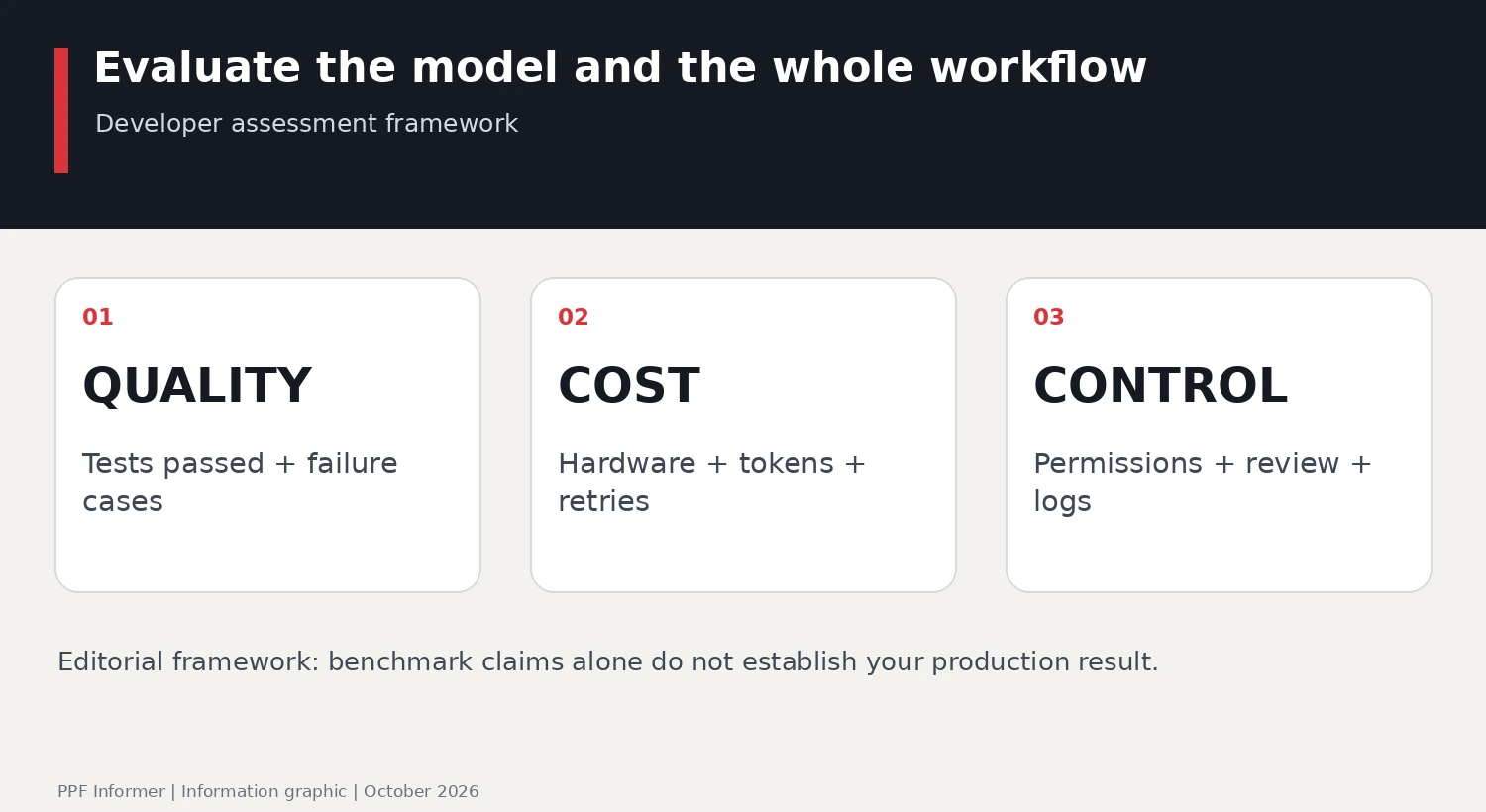
Use a fixed set of tasks that reflects real work: a bug fix, a small feature, a failed test and a request with incomplete instructions. Keep the repository version, tools and acceptance criteria stable. A comparison becomes hard to interpret if one model receives a cleaner environment or an extra hint that the other does not receive.
For Reflection Beam AI, useful measurements would include tests passed, changes accepted after review and failures that require human repair. Record unsupported claims and unnecessary edits as well as successful runs. A coding model can produce a plausible explanation while leaving a broken implementation, so the final artifact should be the unit of evaluation.
Also test tasks where the right action is to ask for clarification or stop. A model that continues confidently with insufficient information may look productive in a demonstration but create expensive rework. Reliability includes recognizing a boundary, preserving existing work and reporting an unresolved issue clearly.
Keep company results and independent findings separate
The launch benchmarks for Reflection Beam AI come from Reflection’s own announcement. They are useful information about the company’s evaluation, but they are not a substitute for independent replication. The next step is to inspect the released methods and compare results under similar conditions. Different tool harnesses and task settings can make apparently similar scores measure different things.
Reflection also describes its compute comparisons as estimates that exclude some serving overhead. That is another reason to distinguish a research efficiency claim from the cost of completing work in your own environment. Do not present a parameter ratio or an estimated compute advantage as a guaranteed reduction in a customer’s infrastructure bill.
Reflection Beam AI release checklist for developers
- Weights: Confirm that the downloadable files are available and complete.
- License: Read the license attached to the actual release.
- Model card: Check stated limits, intended uses and safety information.
- Serving: Verify the supported runtime and hardware configuration.
- Tools: Check structured outputs and the tool interface you plan to use.
- Reproducibility: Keep the model version and evaluation setup in your records.
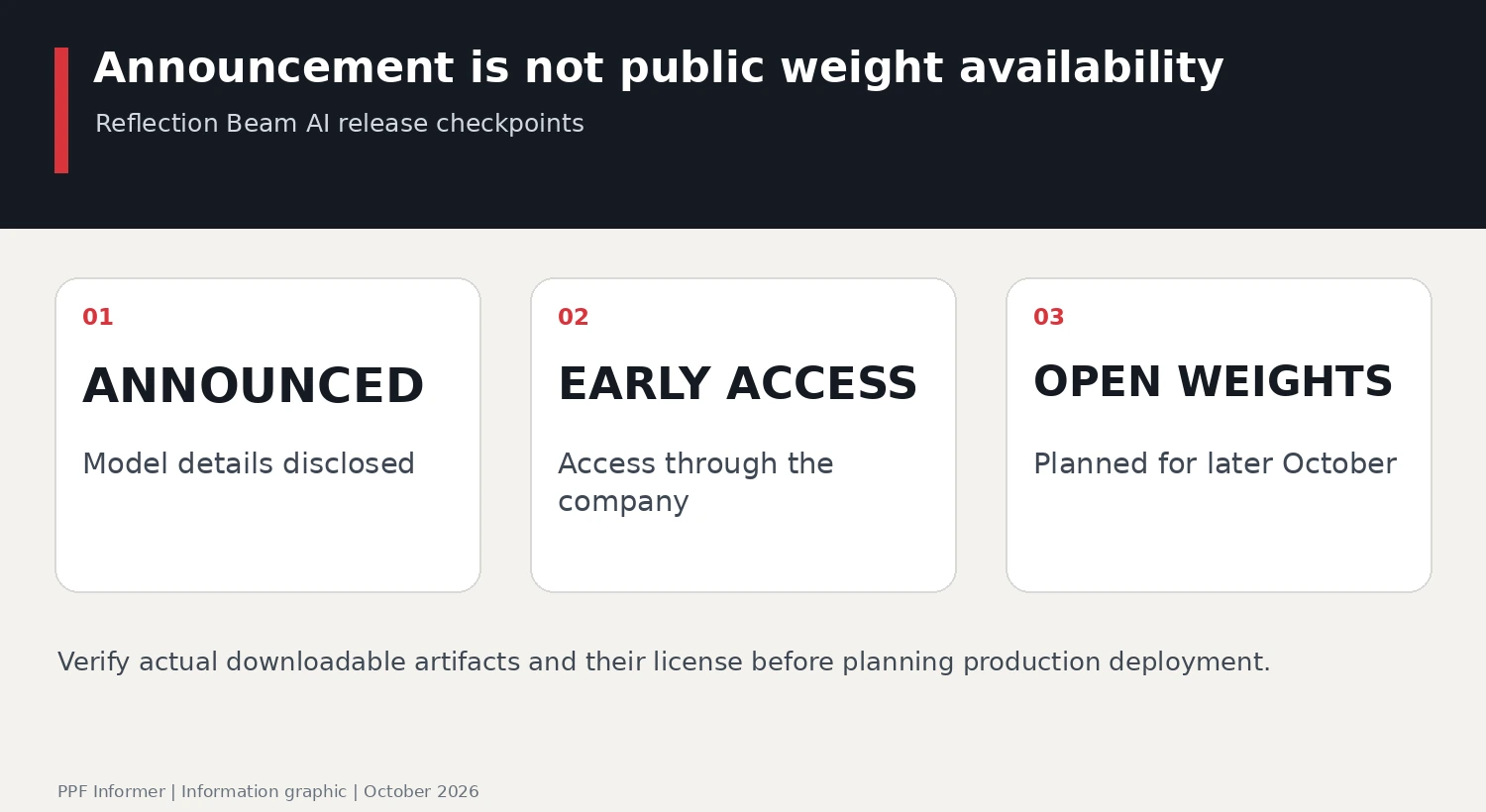
This checklist is an editorial assessment framework, not a list of artifacts we claim are already public. Reflection Beam AI is still between announcement and the planned open-weight release. Readers should check each item’s availability at the time they begin an evaluation.
Can small teams use it without running their own cluster?
Potentially, if a hosting provider offers suitable access. That would be a different purchase from self-hosting Reflection Beam AI. Compare provider data handling, rate limits, model versions and tool support. Avoid assuming that an API labeled with the model’s name exposes every feature of the final open release.
Will open weights make an agent safe to run?
They provide another deployment option, not an automatic permission system. A team evaluating Reflection Beam AI should define what files and tools the agent can access, which changes need review and how to recover from a failed run. The model, the agent harness and the business approval process have separate responsibilities.
The practical question is therefore broader than whether Reflection Beam AI can produce strong answers. It is whether a specific deployment can complete useful tasks at an acceptable cost, with errors that the team can detect and manage.
What will determine Beam’s practical value?
Reflection Beam AI is significant because it combines very large total model capacity with a sparse architecture and a clear focus on coding and autonomous agent workloads. Its 501 billion total parameters make the launch eye-catching, but its practical impact will depend on the 23 billion active-parameter design, release quality, independent evaluations and the cost of running it in production.
Source: Technical and launch details are based on Reflection AI’s official Beam announcement.