

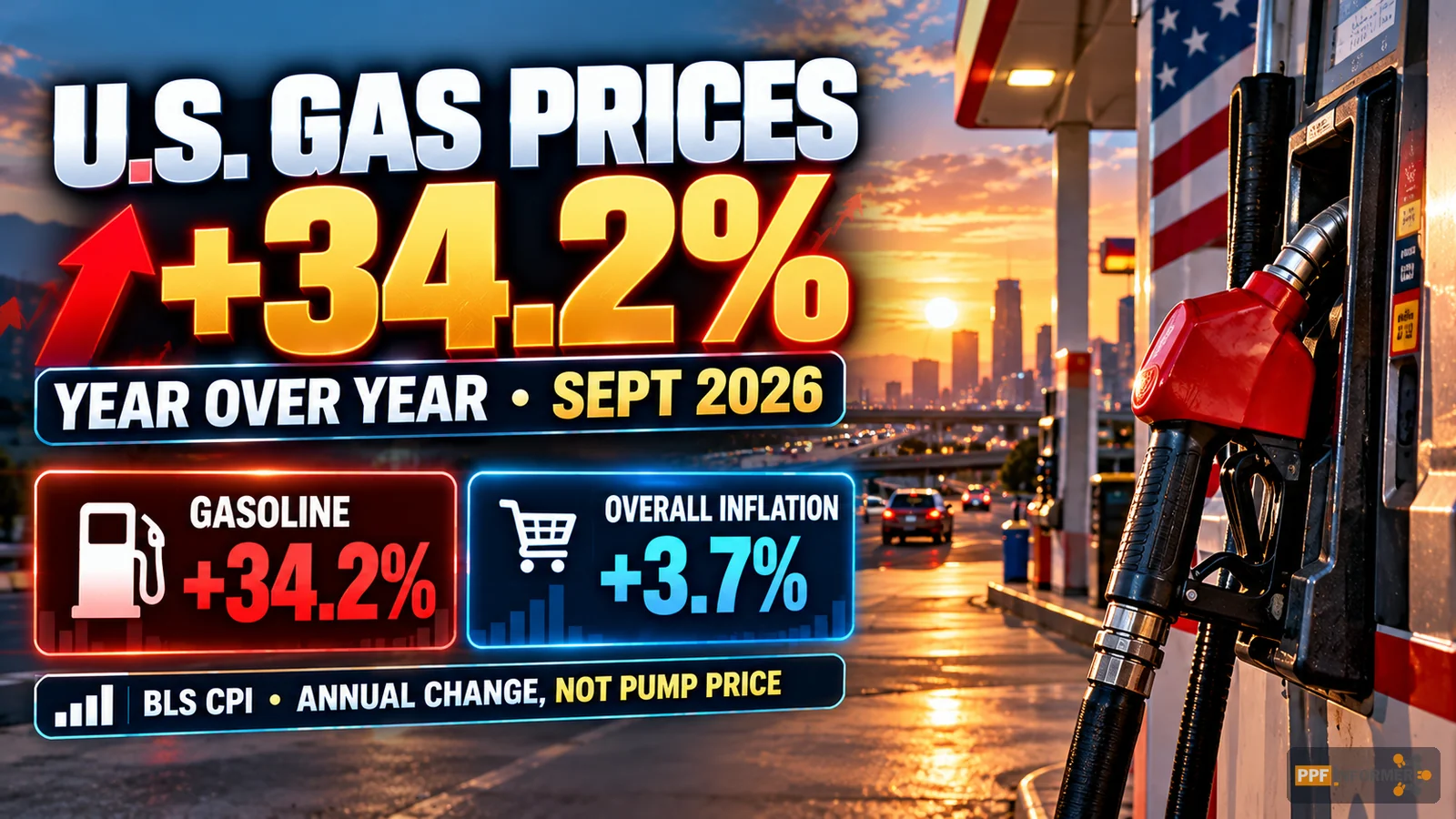
U.S. gasoline prices September 2026 — October 17: Gasoline prices were 34.2% higher in September 2026 than in September 2025, according to a new Bureau of Labor Statistics analysis released October 16. The same report puts overall consumer-price inflation at 3.7% over the year. That gap helps explain why many drivers may feel more pressure at the pump than the broad inflation number suggests.
The U.S. gasoline prices September 2026 figures are year-over-year changes in the Consumer Price Index, not today’s nationwide price per gallon. They do not mean every gas station raised prices by 34.2%, and they cannot tell a driver exactly what fuel costs in a particular city this morning.
the annual figures: What did BLS report?
The Bureau of Labor Statistics reported the following changes between September 2025 and September 2026: gasoline, all types, increased 34.2%; fuel oil rose 74.2%; airline fares increased 22.4%; piped natural gas climbed 5.0%; electricity rose 4.4%; and the all-items CPI increased 3.7%.
For U.S. gasoline prices September 2026, the agency says these selected 12-month figures are not seasonally adjusted. They measure price changes across categories in its consumer-price survey. A year-over-year comparison should not be confused with a one-month jump or a forecast of what happens next.
Why does gasoline stand out from overall inflation?
The contrast with the year-over-year report matters because overall inflation combines many categories, including housing, food, transportation, clothing and medical care. Some categories rose far less than gasoline, while a few fell. For example, the same BLS table shows food at home up 1.8%, shelter up 3.2%, used cars and trucks down 1.5%, and motor vehicle insurance down 5.0% from a year earlier.
A household does not experience an average price index directly. Its costs depend on where it lives, how far it drives and which bills dominate its budget. Someone commuting long distances may notice fuel prices more than someone who rarely uses a car. The national CPI cannot capture every family’s spending mix.
How much more could a household spend on gas?
To understand U.S. gasoline prices September 2026, consider a simple illustration, not an estimate of the average American household. If a driver spent $150 a month on gasoline at an earlier price level and bought the same amount of fuel after a 34.2% increase, the comparable cost would be about $201.30—roughly $51.30 more per month. Actual bills depend on the quantity purchased, local prices and driving habits.
The calculation assumes the same volume of gasoline and a price change equal to the national index. Real drivers may change routes, vehicle use or fuel consumption. Some areas may see very different price movements.
What about heating and electricity bills?
Alongside the gasoline data, the BLS table also shows a 74.2% year-over-year increase for fuel oil, a category important to households that heat with oil. Piped natural gas increased 5.0% and electricity 4.4%. These figures describe national consumer-price changes for those categories, not a utility company’s approved rate increase in every state.
Households facing energy-bill pressure should review their actual usage and tariff details before drawing conclusions. Weather, equipment efficiency, service fees and regional fuel markets can all affect the amount due. The index alone does not identify the cause of each bill.
Does the report explain why gas prices rose?
The U.S. gasoline prices September 2026 data do not establish a single causal explanation. Oil markets, refinery operations, distribution costs, seasonal fuel requirements, taxes and local competition can all influence retail prices. Determining the contribution of any one factor would require additional market evidence. For a separate example of how emergency oil supply policy operates, see our coverage of a U.S. oil-reserve exchange; that event does not establish the cause of this CPI increase. It would be speculative to attribute the entire 34.2% rise to one policy, storm or company based only on the CPI report.
The number also does not prove that prices will keep rising. A large annual change can be followed by a smaller change or a decline. Readers should check newer price data rather than extrapolate one observation into a forecast.
What can U.S. drivers do now?
In response to U.S. gasoline prices September 2026, drivers can compare posted prices along routes they already travel, combine errands when practical, keep tires at manufacturer-recommended pressure and avoid unnecessary idling. Those steps may reduce fuel use, but no fixed dollar savings can be promised for every vehicle or commute.
People budgeting for work or family trips should use actual local pump prices rather than multiply last year’s personal spending by a national CPI figure. For broader context, compare the latest BLS Consumer Price Index releases with current regional price information from trusted public sources.
Frequently asked questions
Did gas prices rise 34.2% overnight?
No. BLS measured the change from September 2025 to September 2026, not a single day or week.
Is the 34.2% figure the national average price per gallon?
No. It is a percentage change in a consumer-price index, not a dollar price.
Was overall U.S. inflation also 34.2%?
No. The all-items CPI increased 3.7% over the same 12 months.
Will gasoline prices rise again next month?
The report does not predict that. Future prices depend on conditions not established by this one release.
What to watch next
After the U.S. gasoline prices September 2026 report, new monthly CPI figures, regional gasoline prices and household energy bills will show whether this gap persists. For now, the confirmed story is that gasoline and fuel oil increased much faster than the overall consumer-price index during the year ended September 2026.