

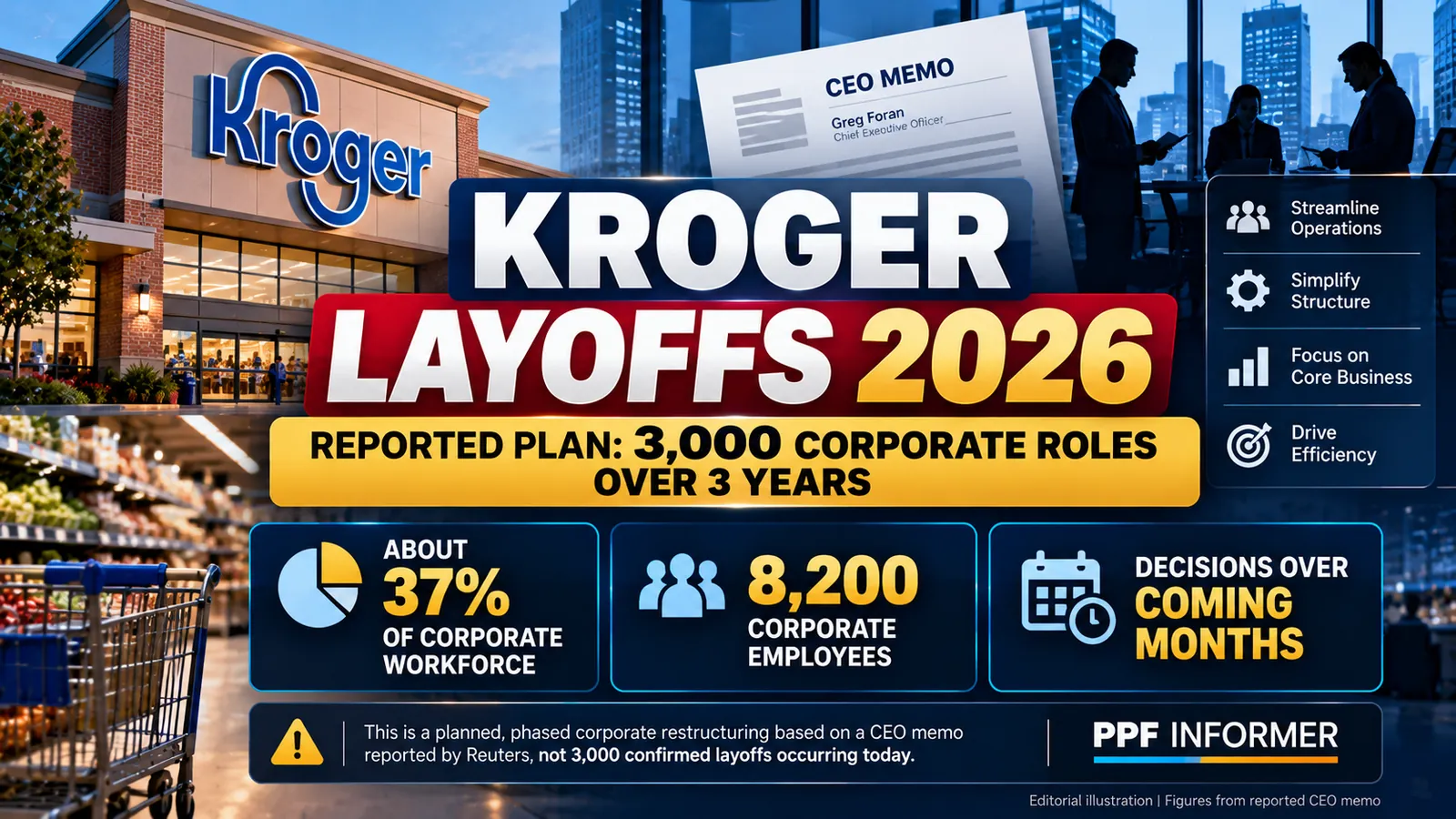
Kroger layoffs 2026: 3,000 corporate roles are at risk under a reported three-year reduction plan. Kroger layoffs 2026 are drawing attention after an October 12 report said the grocery chain plans to eliminate about 3,000 corporate jobs over three years. Reuters attributed the plan to an internal memo from CEO Greg Foran. The company has publicly described an expanded AI strategy, but the specific job reductions and individual impacts should not be treated as fully detailed official notices.
Kroger layoffs 2026: 3,000 corporate roles
Reporting on Kroger layoffs 2026 says Kroger plans to eliminate roughly 3,000 corporate positions over the next three years. The report cited a memo from CEO Greg Foran that Reuters said it had reviewed. The number is a reported plan, not a list of employees already terminated on October 12.
The Kroger layoffs 2026 plan would affect about 37 percent of Kroger’s approximately 8,200 corporate employees. That percentage describes the corporate workforce cited in the report, not all workers in Kroger’s stores and distribution operations.
Details about which departments, offices and positions will be affected are expected later, according to the reported memo. Employees should not assume that a role or location is included merely because it belongs to Kroger’s corporate organization.
Kroger layoffs 2026: what the CEO memo confirms
The public evidence available for the specific headcount comes from reporting about an internal memo. Kroger has separately published its AI strategy, but that strategy announcement should not be treated as a public confirmation of every layoff detail. The distinction matters for employees who need reliable information about their own positions.
Affected workers should prioritize direct written communication from the employer, formal notices, their human-resources team and state labor agencies. News reports can identify a developing plan, but individual separation dates and benefits usually require employee-specific documents.
If Kroger publishes a detailed company statement or regulatory filing, this article should be updated to reflect the new primary evidence. Until then, precise department-level claims would be speculation.
Why is Kroger reorganizing corporate work?
The reported memo connects the planned changes to reducing overlapping tasks, adopting technology and directing resources toward lower prices and store-level operations. Kroger’s September 22 corporate announcement describes a broader AI strategy using customer information, operational data and proprietary models to support shoppers and employees.
That does not prove that an AI tool is replacing each eliminated position. Restructuring decisions can combine cost pressure, workflow redesign, business priorities and automation. Without a role-by-role breakdown, attributing every cut to a specific technology would overstate the evidence.
Kroger’s official AI strategy includes shopping assistance and operational improvements. Workers considering future roles should focus on transferable skills rather than assuming all corporate functions will disappear.
When will the cuts happen?
Kroger layoffs 2026 are planned over roughly three years. It should not be read as an announcement that all 3,000 positions end immediately. A phased reduction can involve multiple departments and different dates, but the precise schedule has not been publicly detailed in the sources reviewed.
An employee who has not received an individual notice should avoid relying on rumors about exact dates. Managers and human-resources representatives may provide role-specific information when the company finalizes decisions.
Employees should save official communications about their status and review any deadlines for benefits, internal applications or separation agreements. They should avoid forwarding confidential company documents to personal accounts if doing so would violate policy.
Kroger layoffs 2026: worker next steps
For workers following Kroger layoffs 2026, start with a personal inventory of responsibilities, accomplishments and measurable outcomes. Update a resume and professional profile using nonconfidential examples of work. Make a list of contacts who can provide references and identify roles that use similar skills outside grocery retail.
Review the company’s benefits materials so you understand health coverage, retirement accounts, paid leave and any potential severance rules. Do not assume every worker will receive the same package; eligibility depends on the actual terms and applicable law.
Build a practical financial buffer where possible. Estimate essential monthly expenses and check the requirements for unemployment benefits in your state. Rules and waiting periods vary, so use your state workforce agency rather than generic social-media advice.
Workers who receive an agreement should read it carefully and consider professional legal or financial advice when the terms are unclear, particularly around releases, noncompete language or benefit deadlines.
Does the WARN Act apply to Kroger’s reported cuts?
For Kroger layoffs 2026, the federal Worker Adjustment and Retraining Notification Act can require qualifying employers to give advance written notice of certain plant closings and mass layoffs. The U.S. Department of Labor explains that the law generally involves employers with at least 100 employees and specific thresholds tied to a single site of employment.
A nationwide total of 3,000 planned reductions does not by itself establish that WARN is triggered at every location. Whether notice is required depends on factors such as where the layoffs occur, how many employees are affected at each site and the timing. State laws may impose additional requirements.
Employees can check state WARN notices and consult the Department of Labor’s guidance. They should not assume that a lack of a notice in one state means no layoffs will occur, or that every corporate reduction automatically qualifies for 60 days of federal notice.
Where can workers find free career help?
The U.S. Department of Labor sponsors CareerOneStop, which provides information on recovering from a layoff, searching for jobs, training and unemployment resources. American Job Centers can also connect people with local employment services.
Workers can use these resources to identify in-demand occupations, compare skills and explore short training programs. Training should be selected based on realistic job requirements and cost, not simply because a course markets itself as ‘AI-proof.’
People with experience in merchandising, analytics, finance, logistics, human resources or customer operations may have transferable skills across industries. A useful job search translates previous responsibilities into outcomes employers can recognize, such as reducing delays, improving inventory accuracy or managing complex teams.
What does this mean for the wider U.S. job market?
The Kroger layoffs 2026 plan adds to attention on how large employers are changing corporate operations. But one company’s restructuring is not enough to calculate national layoffs or prove that AI has caused a specific number of job losses across the economy.
To assess broader trends, compare official Bureau of Labor Statistics employment data, job openings, layoffs and unemployment claims. Each measure captures a different aspect of labor demand and none should be used alone.
For jobseekers, the immediate lesson is to diversify applications, maintain an up-to-date record of achievements and check actual hiring requirements. A large employer’s reorganization can be unsettling, but the national picture requires more evidence than a single headline.
Frequently asked questions
How many jobs is Kroger reportedly planning to cut? Roughly 3,000 corporate roles over three years, according to an October 12 report citing a CEO memo.
Are all store employees affected? The reported figure concerns corporate roles; it is not a claim that 3,000 store positions are being eliminated.
Which offices will be hit? The public reporting reviewed does not establish a complete location-by-location list.
Can employees get unemployment benefits? Eligibility depends on state rules and the individual’s circumstances. Check the relevant state workforce agency.
For the wider U.S. job-market picture, see our October U.S. jobless claims coverage. The figures reflect different sources and measures.
Bottom line
Kroger is reportedly planning to reduce about 3,000 corporate roles over three years as it changes how work is organized. Specific locations, dates and employee-level details remain uncertain. Workers should seek official written notices and use trusted employment resources while preparing for possible changes.
Primary contextual sources: Kroger’s official AI strategy; U.S. Department of Labor WARN guidance; CareerOneStop. The 3,000-role figure is attributed to Reuters’ October 12 report on an internal memo; no competitor news link is included.