

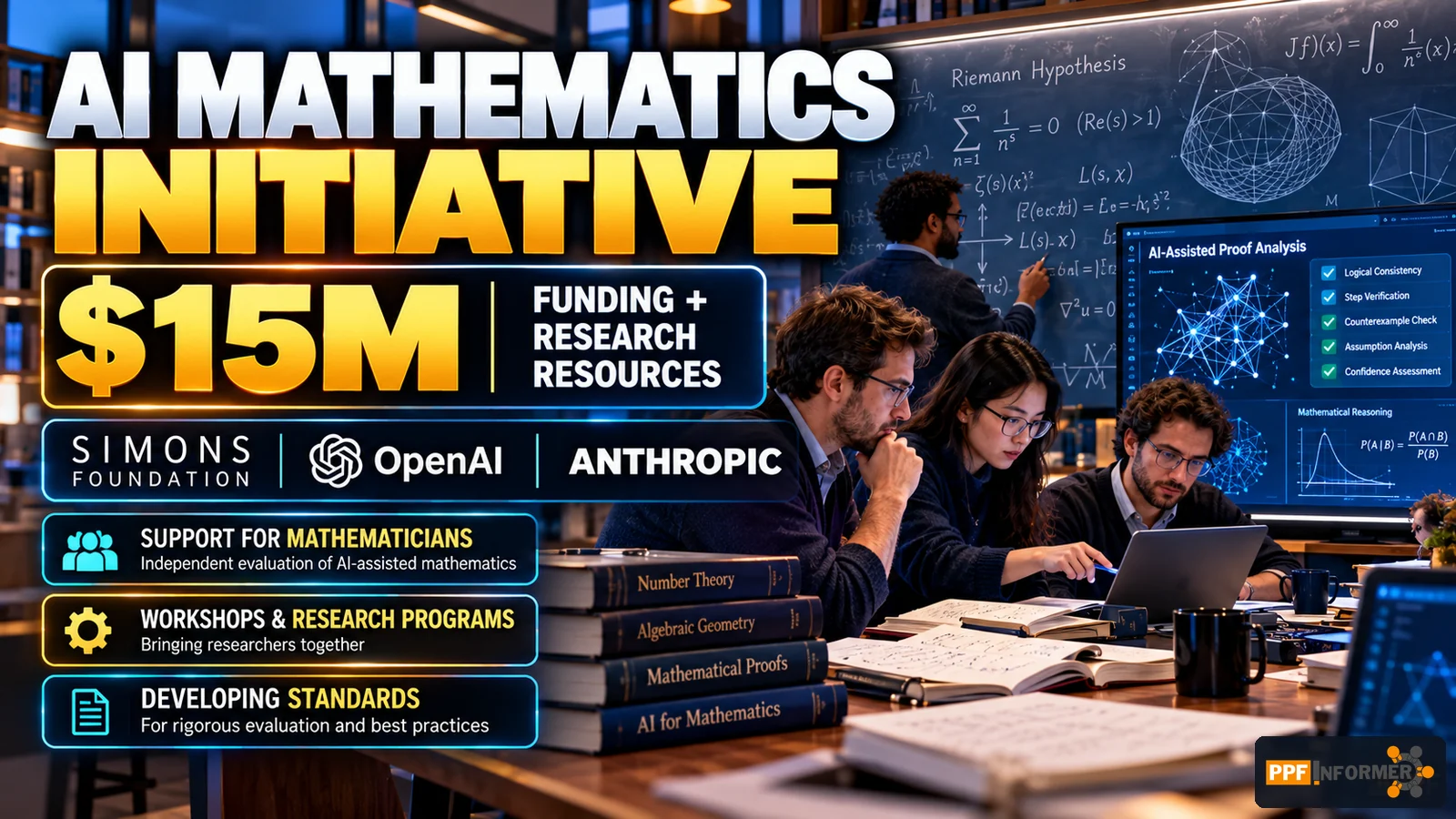
AI mathematics initiative — October 17, 2026: The Simons Foundation, OpenAI and Anthropic have announced a combined $15 million commitment in funding and resources to help mathematicians evaluate AI-assisted research. The October 15 initiative will be managed by the Simons Foundation, with planned workshops, an open call for proposals and computing support for selected researchers.
The AI mathematics initiative has an important distinction: the announcement is about helping mathematicians check and understand AI-generated work. It does not say that AI has solved mathematics or that every researcher can immediately apply for a cash grant.
the research program: What’s included in the $15M?
The Simons Foundation’s official statement describes combined funding and resources from the foundation and two AI developers. Simons will manage awards and organize activities intended to help researchers test recent AI-assisted results, share tools and shape standards for the field.
OpenAI’s October 15 update identifies its own $5 million contribution and says supported researchers can receive model and computing access. Anthropic also plans to provide tools and compute. The main announcement does not itemize the full total into cash grants and in-kind resources. Headlines calling it $15 million in cash scholarships would be misleading.
Why does AI mathematics need independent verification?
The AI mathematics initiative addresses a field where AI systems can suggest useful conjectures, proof strategies and examples. But they can also omit an assumption, invent a reference or make a logically invalid leap. A fluent explanation is not proof. Mathematicians must still establish that a result follows from precise definitions and valid reasoning.
Independent checking may involve reproducing calculations, testing special cases, reviewing the argument line by line or using formal proof software. Documentation matters too. A research group that records model versions, prompts and human corrections makes it easier for other scientists to investigate what actually happened.
Formal verification is not a universal shortcut. A checker can confirm that a formal argument follows certain rules, but researchers still need to ensure the formal statement captures the original mathematical question. A verified answer to the wrong question remains unhelpful.
What kinds of activities are planned?
Workshops and research discussions
The the funding effort plans activities that bring mathematicians together to examine AI-assisted results and share approaches to evaluation. Those meetings could help clarify disclosure, attribution and reproducibility practices. The foundation has not announced a mandatory industry-wide standard or a guaranteed number of workshops.
Access to models and compute
Researchers supported by the AI mathematics initiative may gain access to tools from OpenAI and Anthropic. That could make experimentation more practical for groups without large computing budgets. However, no universal free-access promise, fixed usage allowance or complete eligibility list has been published.
Community leadership
The foundation emphasizes that mathematicians should drive decisions about how AI tools are evaluated and adopted. That is especially important when a company both develops a model and promotes results generated by it. Independent specialists can inspect claims without assuming that a benchmark or demonstration proves research reliability.
What does this mean for U.S. universities?
For American mathematics departments, the this initiative creates a possible new route for collaboration and research support. Faculty can begin preparing reproducible experiments, reviewing disclosure practices and teaching students to distinguish AI suggestions from validated results. These steps are useful whether or not a department eventually receives funding.
The AI mathematics initiative does not guarantee grants to any named U.S. campus, immediate fellowships or a fixed number of jobs. Applicants should wait for the official call before relying on third-party application links.
PPF Informer previously covered GPT-Rosalind academic access, which concerns eligibility for a specific AI offering. This new initiative has a different focus: the mathematical community’s ability to evaluate and use AI-assisted work responsibly.
What is confirmed and what remains unknown?
Confirmed: The partners announced a $15 million combined commitment on October 15. Simons will administer support, an open call is planned, and model and computing resources are part of the package. OpenAI separately identified a $5 million contribution.
Unconfirmed: Individual award sizes, a complete application schedule, detailed eligibility rules and the cash-versus-compute breakdown have not been established in the main statement. No particular mathematical theorem or future breakthrough is guaranteed.
Analysis: Independent evaluation could improve trust in AI-assisted research, but the impact will depend on the quality and transparency of work the initiative supports. That outcome must be measured later.
Frequently asked questions
Is all $15 million available as cash?
No. The total includes funding and other resources. The full cash-only amount is not stated in the announcement.
Can students apply now?
An open call is planned, but the October 15 announcement does not provide complete student eligibility or a confirmed deadline.
Does this prove AI can replace mathematicians?
No. The initiative supports mathematicians in assessing AI tools. It makes no such prediction.
What happens next?
For the AI mathematics initiative, useful milestones will be the official application call, terms for compute access and independently evaluated examples of AI-assisted mathematical work. Until then, the confirmed news is a new investment in human-led research scrutiny, not a guarantee of machine-made discoveries.