

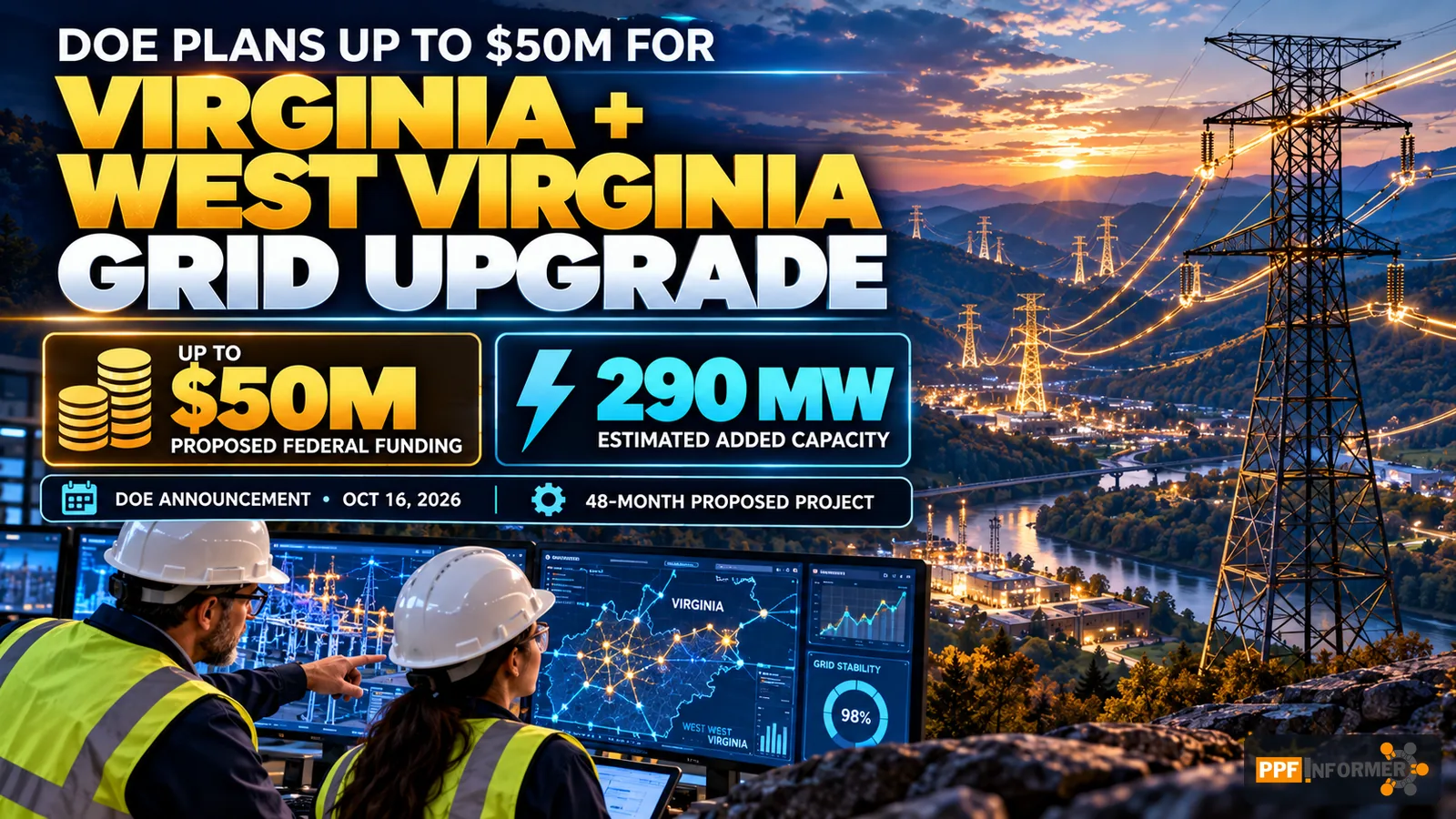
Virginia West Virginia grid upgrade — October 17, 2026: The U.S. Department of Energy announced on October 16 that it intends to provide up to $50 million in Defense Production Act funding for an electricity-transmission project in Virginia and West Virginia. The proposed upgrade would use advanced conductors and real-time monitoring to increase the amount of power existing lines can carry.
For the Virginia West Virginia grid upgrade, DOE estimates the project could add approximately 290 megawatts of transmission capacity across Appalachian Power’s Virginia system. That is an estimate for a proposed infrastructure project, not a claim that 290 megawatts of new generating capacity are already online. The distinction matters for customers, businesses and investors following regional electricity demand.
the transmission project: What did DOE announce?
DOE’s October 16 announcement describes its intent to use up to $50 million in federal funding for Virginia Energy’s Grid Enhancing Technologies for Virginia & West Virginia Large Load Growth project. Virginia Energy would work with Appalachian Power, Potomac Edison and regional partners.
The planned Virginia West Virginia grid upgrade is designed to increase electricity delivery capacity along existing corridors rather than depend entirely on new rights-of-way. DOE describes a proposed 48-month effort and says advanced upgrades could deliver additional capacity one to four years sooner than conventional transmission improvements. Those timelines are projections, not completed milestones.
How can existing power lines carry more electricity?
Advanced reconductoring
Reconductoring replaces or upgrades the wires that carry electricity. Modern conductors can sometimes transport more power within an existing transmission corridor. This can reduce the need for entirely new routes, although construction, engineering and approvals may still be necessary.
Dynamic Line Rating
Traditional line ratings often use conservative assumptions about weather and heat. Dynamic Line Rating systems use monitoring and environmental conditions to estimate how much electricity a line can safely carry at a given time. For example, cooler or windier conditions may permit more transfer than a fixed conservative rating, subject to equipment limits and operating rules.
In the the proposed upgrade, neither technology creates electricity. Both aim to improve how effectively existing infrastructure moves it. That is why the DOE’s 290-megawatt figure refers to transmission capacity, not a new power plant.
Why does the Virginia region need grid upgrades?
DOE says the Virginia West Virginia grid upgrade is intended to address growing electricity demand, congestion and reliability concerns affecting homes, businesses, government operations and defense-related facilities. More transmission headroom can help utilities deliver power when demand increases or when certain paths are constrained.
The department frames the project as part of a broader national-security infrastructure strategy. That is the government’s stated rationale; it does not establish that every ratepayer will see a specific bill reduction. Local rates depend on utility regulation, fuel costs, capital spending and other factors beyond this single announcement.
What does the $50 million mean for business?
The the initiative funding ceiling could support equipment purchases, engineering work and construction activity if the project advances as proposed. Suppliers of conductors, sensors, grid software and installation services may be interested in procurement opportunities. However, the announcement does not identify confirmed contract winners or publish a detailed jobs forecast for this specific project.
For companies considering expansion in the region, more reliable transmission could eventually reduce one infrastructure constraint. But firms should not assume the project is complete or that additional capacity is available at their particular site. Utility interconnection studies and local service conditions remain essential.
Is the funding guaranteed?
No. The agency uses the language of an intent to deploy funding and says the project will receive up to $50 million. That is different from a completed payment or a final construction certificate. The announcement also identifies a broader $1 billion federal appropriation for energy projects considered important to national security, but the entire appropriation is not allocated to this one project.
The proposed Virginia West Virginia grid upgrade 48-month schedule should not be treated as a guaranteed commissioning date. Engineering, equipment availability, permissions and coordination among utilities can affect implementation.
How does this affect electricity prices?
DOE says the the grid project is expected to reduce congestion and support lower electricity costs. That is an intended benefit, not a quantified promise of a certain monthly saving. The eventual effect depends on how the transmission system is operated, project costs and how regulators allocate those costs to customers.
Consumers should look for filings and updates from their own utility or state regulators rather than rely on a nationwide price estimate. Businesses with high electricity demand should request site-specific service information.
Frequently asked questions
Is DOE building a new 290-megawatt power plant?
No. The 290-megawatt estimate concerns additional transmission capacity on existing infrastructure, not new electricity generation.
How much federal funding is proposed?
Up to $50 million under the Defense Production Act funding approach described by DOE.
When will the upgrade be finished?
DOE describes a proposed 48-month project, but the announcement does not establish a guaranteed completion date.
Will every household’s bill go down?
No specific customer saving is confirmed. Any eventual rate impact depends on local utility and regulatory decisions.
What to watch next
For the Virginia West Virginia grid upgrade, key milestones include final funding documentation, project engineering, procurement and verified installation progress. Those will show whether the proposed capacity gain and accelerated timeline are achieved. Until then, this is a substantial federal infrastructure intention, not a completed grid expansion. For a separate look at federal energy investment, read our DOE energy workforce training report; it concerns a different program.