

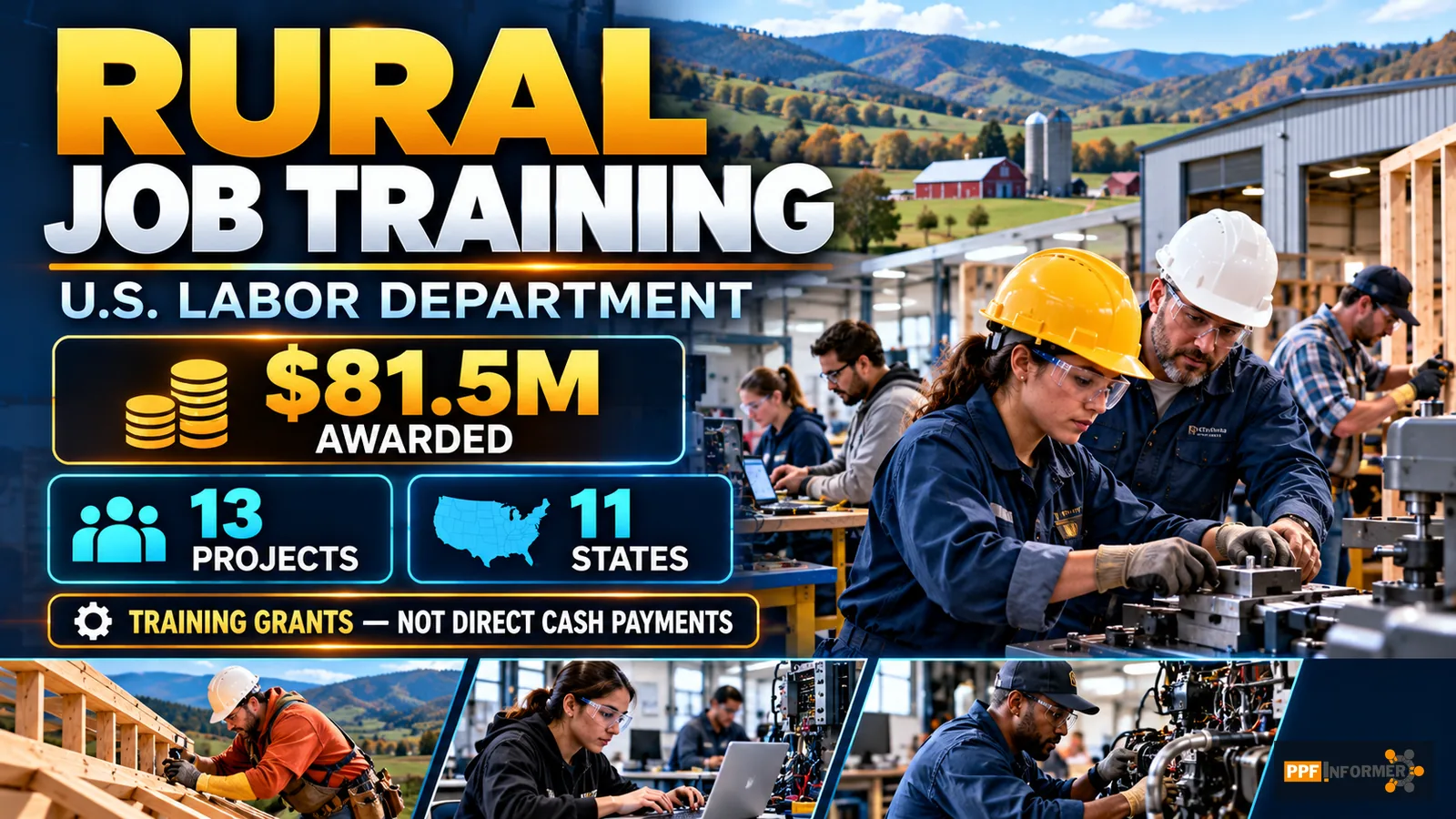
Rural job training grants — October 17, 2026: The U.S. Department of Labor announced $81.5 million in rural workforce-training grants on October 16. The seventh round of the Workforce Opportunity for Rural Communities initiative supports 13 projects across 11 states in the Appalachian, Delta and Northern Border regions.
These this funding are intended to help regional employers develop workers’ skills and help residents qualify for better employment. It is not an automatic $81.5 million payment to individual job seekers, and the announcement does not guarantee that every resident of the eligible regions can immediately enroll.
Rural job training grants: What is the $81.5M program?
According to the Labor Department’s October 16 announcement, the grants are administered by the Employment and Training Administration under the Workforce Opportunity for Rural Communities, or WORC, program. The funding supports 13 projects across 11 states, focusing on the needs of employers in high-growth and emerging industries.
The the program program works with regional development partners in Appalachia, the lower Mississippi Delta and the Northern Border. Its stated goals include improved employment opportunities, higher wages, economic mobility and greater labor-force participation in predominantly rural communities.
Which regions and organizations are involved?
The rural job training grants initiative spans multiple regions. One primary regional partner, the Delta Regional Authority, said on October 16 that approximately $33.6 million of the broader round will support six organizations across five states in its service area.
Its announcement names Tuskegee University in Alabama, Arkansas Rural Health Partnership, Delta Health Alliance and Part of the Solution Foundation in Mississippi, Community Partnership of Southeast Missouri, and CodeCrew in Tennessee. These are examples of organizational awardees, not a list of guaranteed individual training places.
The Delta Regional Authority identifies awards including $7.5 million for Tuskegee University and $4 million for CodeCrew. Applicants should check the relevant organization’s own program details rather than assume the amount awarded is divided equally among participants.
What kinds of careers could benefit?
The the awards under WORC are designed around regional employer needs, so training priorities vary by project. Depending on the local grantee, programs may address health care, technical skills, manufacturing, construction or other industries important to the region. The federal announcement does not mean every named occupation will be offered at every location.
For job seekers, the practical question is which specific courses, apprenticeships or work-based learning opportunities a funded organization will offer. A grant to a regional partnership may first support curriculum, employer coordination, equipment or training capacity before new enrollment begins.
How can rural job seekers find training?
For rural job training grants, start with the official Department of Labor release and identify a project serving your state or community. Then visit the selected organization or its workforce partner to check the program’s actual application page. Ask whether enrollment is open, who is eligible, what credentials are offered and whether participants face any fees.
Local American Job Centers may also help residents understand available training and employment services. Use the official CareerOneStop American Job Center locator rather than paying an unfamiliar website to reveal supposed federal grants.
Before enrolling, confirm whether the training leads to an industry-recognized credential, whether an employer partner offers interviews or placements, and whether the program provides transportation or childcare support. Those benefits cannot be assumed from the federal funding total.
What should employers do?
Rural employers facing hard-to-fill roles can review whether a local grantee is seeking industry partners. Employers may be able to help identify skills gaps, advise on curriculum or offer work-based learning opportunities. The exact partnership process depends on the funded organization.
Businesses should not treat a grant announcement as a promise of free hiring services. They should request the grantee’s program terms and verify any commitments before planning recruitment around a future training cohort.
Does this mean 13 new training centers will open?
No. The the initiative announcement identifies 13 funded projects, which may be administered by existing organizations or partnerships. A project is not necessarily a new physical campus, and the federal release does not establish a national count of new training buildings.
Likewise, $81.5 million in awards is not the same as a measured increase in employment. Job placements, wages and retention rates will need to be assessed after programs operate.
How is this different from other workforce announcements?
The rural job training grants focus on employer-driven training across several regions. PPF Informer recently covered a separate Department of Energy workforce-training initiative. These are distinct programs with different funding authorities and target participants. Applicants should not confuse their eligibility or deadlines.
Frequently asked questions
Can I claim part of the $81.5 million personally?
No automatic individual payment is announced. Funds go to selected projects, which may offer eligible residents training services.
How many projects and states are involved?
The Labor Department says 13 projects across 11 states.
Are applications open everywhere?
Not necessarily. Enrollment dates and requirements depend on each grantee. Check the official local provider.
Are jobs guaranteed after training?
No universal job guarantee is established by the grant announcement. Ask providers for verified placement information when available.
What happens next?
As rural job training grants move into implementation, watch for local program launches, enrollment rules, course lists and employer partnerships. The grant awards are a significant investment in rural workforce capacity, but their real value to workers will depend on access, training quality and actual employment outcomes.